Chinese Defense Ministry highlights Liaoning carrier group’s training expansion toward far-seas combat application
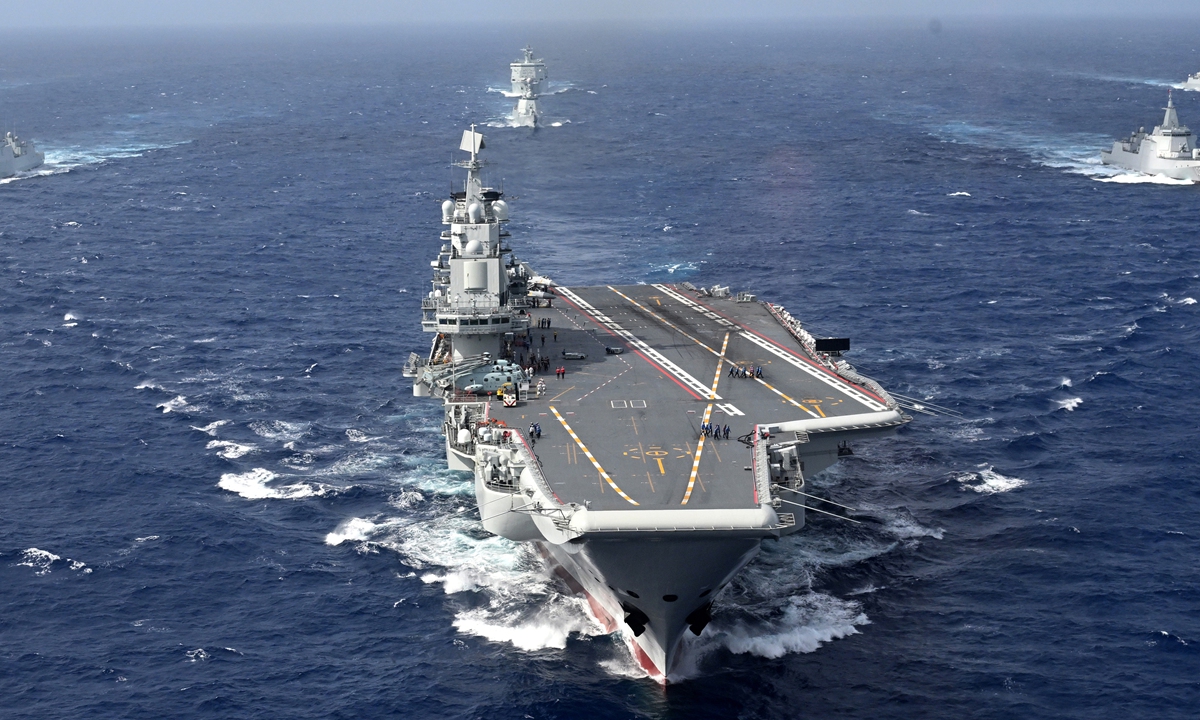
The Liaoning aircraft carrier participates in a dual-aircraft-carrier formation drill on October 21, 2024. Photo: VCG
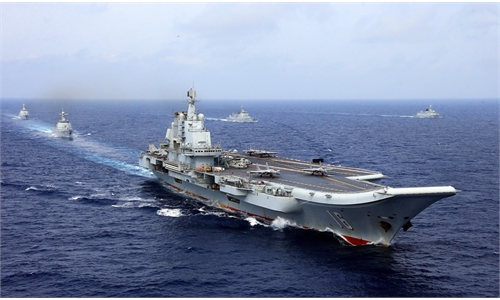
The ongoing training operations of the Chinese People's Liberation Army (PLA) Navy's Liaoning aircraft carrier task force in the Western Pacific are routine training conducted in accordance with the annual plan, Senior Colonel Jiang Bin, spokesperson for China's Ministry of National Defense, said at a regular press conference on Thursday, elaborating on the PLA Navy's announcement about the training on May 19.
The spokesperson highlighted that since its commissioning, the Liaoning has organized a series of comprehensive exercises as planned, with carrier group training expanding toward far-sea combat application, forming system-of-systems combat capabilities.
On May 19, the PLA Navy sent a carrier task group led by PLANS Liaoning to relevant waters of the Western Pacific to conduct training on such subjects as far-seas tactical flight, live firing, support and cover, and integrated search and rescue, so as to test and enhance the realistic combat training capabilities of the forces, said the PLA Navy.
Jiang said on Thursday that as a pathfinder for China's aircraft carrier construction and an incubator for carrier talent, the Liaoning has played an irreplaceable role in enhancing the combat capability of the PLA Navy, and will continue to make greater contributions as the PLA Navy sails toward blue waters, safeguarding national sovereignty, security and development interests as well as world peace and stability.
Japanese Defense Ministry Joint Staff hyped that it spotted takeoffs and landings of carrier-borne fighter jets and helicopters on the Liaoning on Tuesday.
The Japanese side also claimed the composition of the Liaoning carrier group, among which the Type 054B frigate Luohe has drawn particular attention from external parties. This marks the first time that the Type 054B guided-missile frigate, one year after entering service, has joined an aircraft carrier group for training, and also represents the first time this ship type has entered the Western Pacific to conduct far-sea missions.
"As a new frigate improved from the Type 054A, the Type 054B features enhanced radar performance with greater air detection range. Meanwhile, its strike capabilities have been comprehensively upgraded, with missile range, accuracy and lethality all superior to its predecessor, significantly enhancing offense and defense capabilities in far-sea waters," Zhang Junshe, a Chinese military affairs expert, told the Global Times on Thursday. Zhang noted that the Type 054B frigate's deployment with the Liaoning group to the Western Pacific for training marks the ship's maturity in far-sea combat capability.
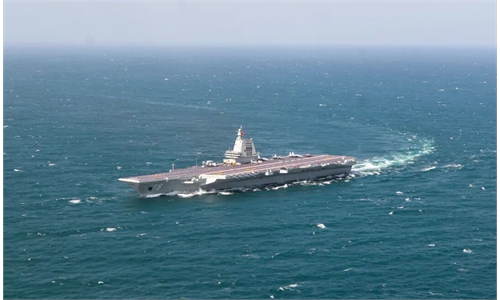
A CCTV News report on May 23 about the Liaoning's ongoing training mentioned that whether the new-generation stealth carrier-based fighter, the J-35, can adapt to ski-jump takeoff from the Liaoning has drawn significant attention. The report also noted that this exercise could send a key strategic signal: the new-generation stealth fighter J-35 and the catapult-capable J-15T can perfectly adapt to the ski-jump takeoff mode of the carrier.
For this, Zhang said that the J-35 fighter is fully capable of conducting ski-jump takeoffs from the Liaoning. As a domestically developed fifth-generation stealth fighter, the J-35 features long radar detection range, large combat radius, long range, and can carry air-to-air and air-to-ship missiles with extended range. It also has supersonic cruise capability and exceptional stealth performance. In combat, the J-35 can act as a "door-kicker," being the first to penetrate enemy air defense systems and strike enemy fighters and radar installations from long range, while the J-15 heavy fighter, with its advantage in large payload capacity, can conduct saturation strikes.
The high-low combination of J-35 and J-15 can significantly enhance the carrier group's air penetration, air-to-air and air-to-ground strike capabilities, expand maritime defense depth, and ensure the carrier can effectively fulfill its offensive and defensive mission in far-sea waters, said the expert.
Previously, Japanese vessels and aircraft have a record of repeatedly conducting close-in reconnaissance during PLA carrier group training in the Western Pacific, seriously threatening the safety of the strike group and easily causing maritime and air incidents. Zhang emphasized that relevant countries' vessels and aircraft should avoid intruding into the training zones of PLA Navy carrier groups to conduct close-in harassment, or else they will bear the consequences.
"Naval vessels of all countries enjoy the freedom of navigation, overflight and training at high seas. Japan should not apply double standards and should respect the legitimate rights of the PLA Navy. Japan should not conduct such dangerous acts and should view the PLA Navy's normal far-sea training with a normal mindset," Zhang said.
RELATED ARTICLES