Young Chinese volunteer at nursing residences for affordable living, bringing vitality to seniors
Bridging age gaps
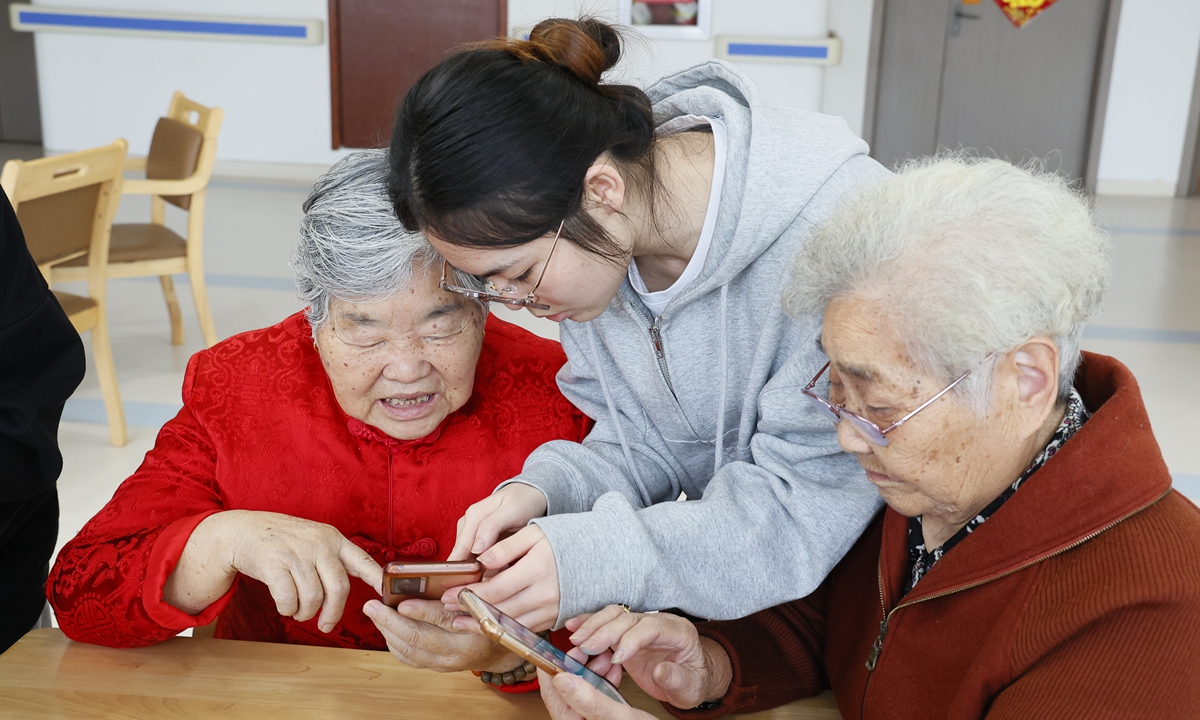
A young person who resides with the elderly at Jinhua social welfare center, East China's Zhejiang Province, teaches senior residents how to use a smartphone on October 23, 2025. Photo: VCG
On an ordinary afternoon, 26-year-old robotics professional Lin Xiaoyu finished her morning remote meetings and stepped out of her room in a nursing home in Foshan, South China's Guangdong Province. She headed straight to the third-floor communal activity room.Lin is not there as a visitor, but a full-time resident. In exchange for 30 hours of volunteer service each month, she enjoys accommodation at just 1,000 yuan ($147) per month for one bedroom with bathroom, far below market rates.
Her experience is not unique. On Chinese social platforms such as Xiaohongshu and Douban, "moving into a nursing home" has become a popular lifestyle topic among young people. In late 2025, an East China's Zhejiang Province netizen, 27, posted about moving into a nursing home with her grandmother, garnering over 100,000 likes and sparking widespread attention. She revealed her monthly accommodation cost was only 1,500 yuan.
Recognizing the complementary needs of seniors and youth, nursing institutions in multiple Chinese cities have begun piloting programs open to young people. Through volunteering-for-housing or discounted rent models, they are exploring a new community form known as "youth-elder co-living."
Xinhua Daily reported on May 23 that several cities in East China's Jiangsu Province have launched such programs, allowing young people to live at low or no cost in nursing homes by providing at least 20 hours of volunteer service per month.
A member of the Standing Committee of CPPCC Shanghai Committee proposed earlier in 2026 to pilot an "intergenerational co-living" model in Shanghai's nursing institutions, according to the Shanghai Observer.
Yang Tuan, a researcher at the Chinese Academy of Social Sciences' Social Policy Research Center, described "youth-elder co-living" as both an exploratory attempt by the elderly care industry to optimize resource allocation and upgrade its operations, and a grassroots innovation addressing deeper social issues such as population aging, urban youth loneliness and emotional well-being.
It seeks to reconstruct a micro-social ecosystem of neighborhood mutual assistance and intergenerational integration non-affiliated with blood relations. Its success hinges on a balance between policy guidance, the emotional needs of generations, and market logic, Yang told the Global Times.
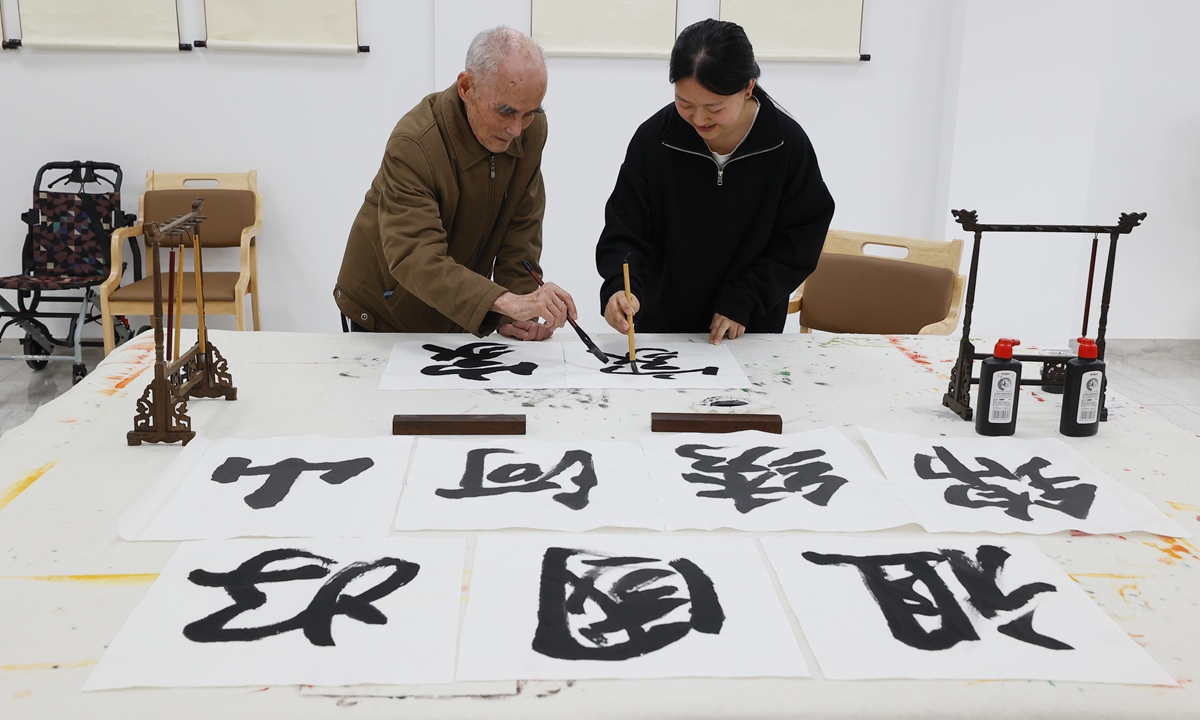
A young person born in the 2000s practices calligraphy with one of her elderly co-residents in the center on October 23, 2025. Photo: VCG
New models for nursing homesIn parts of Lishui, Zhejiang, nursing homes are no longer seen solely as places for seniors to spend their later years.
Since February 2024, the Jinyun County Civil Affairs Bureau, in collaboration with local nursing homes, has launched a companionship-based elderly care service. Several designated homes now offer housing to young and middle-aged people aged 18 to 45 at a monthly rent of 1,000 yuan, reported CCTV News.
Li Min (pseudonym), head of a Jinyun county nursing home, told reporters that since the project launched, the facility has become a shared home for dozens of young people and dozens of elderly residents.
From morning till evening, she sees young residents accompanying seniors for walks in the courtyard, teaching them how to make video calls on smartphones, sharing workplace stories or simply chatting. The cafeteria is filled with the aroma of food and the sound of laughter.
"Young people need stable, affordable housing, while they bring fresh knowledge, information, sharp minds and youthful energy - exactly what most seniors who crave social participation and fear loneliness need," Li told the Global Times.
Yang noted that this innovative approach helps alleviate the operational pressure caused by underutilized resources in nursing institutions.
Data from China's Ministry of Civil Affairs shows that in 2024, the average occupancy rate of nursing homes nationwide was below 50 percent, with some regions seeing vacancy rates exceeding 60 percent, as per the China City News in October 2025.
At the same time, demand for elderly care services has grown rapidly. By the end of 2025, China's population aged 60 and above had exceeded 320 million, an increase of 16.49 million from the previous year. It is projected to surpass 400 million by around 2035, reported the Minsheng Weekly on March 30.
Young residents directly improve resource utilization and supplement operating funds, Yang explained. "They also reduce the need to hire additional caregivers, adding fresh caregiving capacity. This gives nursing homes a valuable buffer period to develop service models that better match the real needs and payment ability of the elderly, ultimately attracting more seniors through upgraded offerings."
Intergenerational win-win
Beyond the economic motivations of nursing institutions, the pilot programs for intergenerational integration reflect a mutual pursuit between the younger and older generations.
Lin told the Global Times that her decision to live in a nursing home was driven by both practical and emotional needs.
"Living with the elderly has eased my sense of loneliness from leaving home," she said. "The seniors here are like my own grandparents. They gave me homemade snacks and tell stories from their youth, a warmth you can't get in an ordinary rental apartment."
Among young people who have participated in intergenerational co-living projects, 86 percent reported "enhanced sense of social responsibility," and 72 percent said it "improved their interpersonal skills," reported pension service portal linkolder.com in 2025.
In a Foshan nursing apartment, 68-year-old retired teacher Zhang Weiguo, who lives alone, has felt the warmth of intergenerational companionship since young tenants moved in.
"When I first moved in, I mostly sat alone by the window. My children work in other cities and rarely come back to Foshan," Zhang told the Global Times. "Now, young people teach me how to video call my grandchildren on WeChat, help me book medical check-ups online and pull me into handicraft activities."
While cities across China are actively exploring youth-elder co-living, turning these projects into genuine intergenerational mutual assistance communities is no easy task.
Li said the biggest challenge is balancing supply-demand matching with service standards.
"We invest considerable effort in interviewing and screening young people who are caring, patient and capable of providing companionship," she explained. "We assess whether they have relevant skills, such as digital literacy, musical or dance talent, or gardening knowledge. Many young people are kind and have potential, but lack direct skills, so we can't accept them."
Li hopes for more policy support and societal backing, such as professional intergenerational communication training or partnerships with universities and companies for volunteer programs, to make the model more sustainable.
Yang emphasized that for the model to develop sustainably rather than becoming cheap rental housing or inexpensive caregiving, it is crucial to deeply understand both sides' needs and achieve genuine value matching. This requires more refined project design and management, clear boundaries between "service" and "companionship," and incentive mechanisms that turn volunteers' time and skills into the emotional comfort and social connection seniors truly need, without replacing professional care.
"Intergenerational mutual assistance builds a true sense of community, helping young people rediscover self-worth and belonging beyond their jobs, while bringing seniors respect and joy through companionship," Yang said. "This exploration is just the beginning. We are just starting to see the prototype of a more diverse, integrated, warm and resilient future community."
RELATED ARTICLES