State Council investigation team opens public reporting channels for Shanxi coal mine explosion inquiry
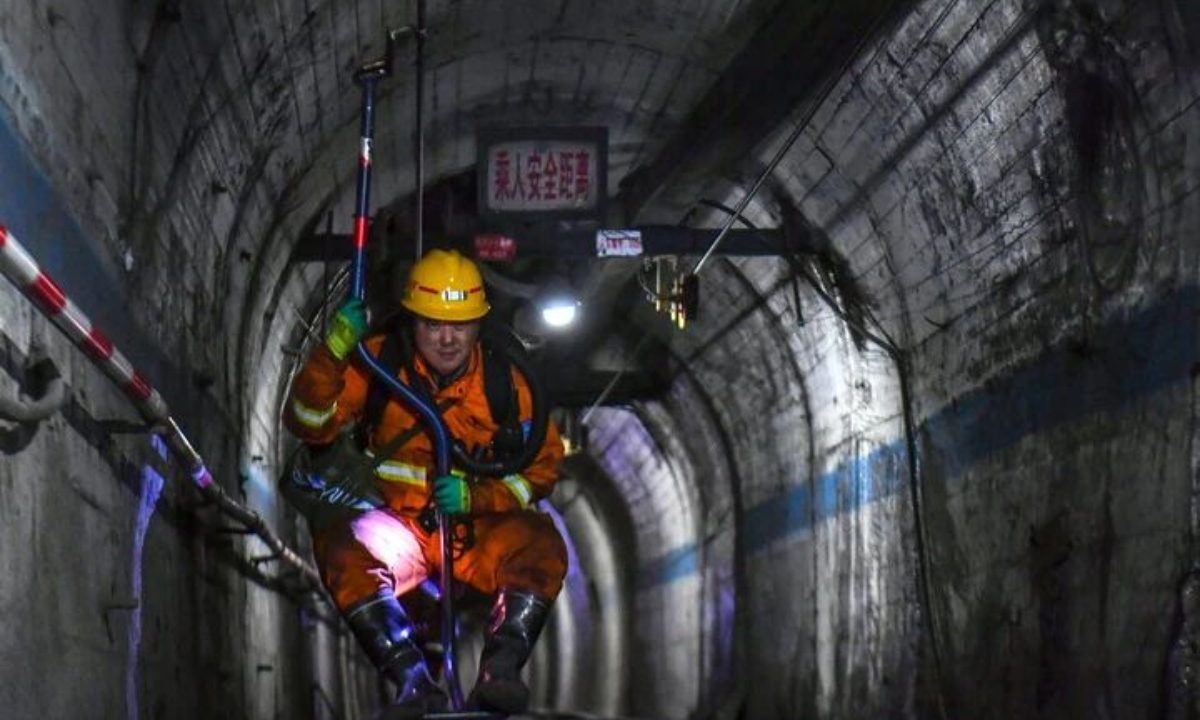
Rescuers emerge from the mine after more than 10 hours of underground search operations at the Liushenyu coal mine in Changzhi, North China's Shanxi Province on May 23, 2026. Photo: Xinhua
The investigation team dispatched by China's State Council into the deadly gas explosion at the Liushenyu coal mine in Changzhi, North China's Shanxi Province announced on Sunday that it will accept public reports related to the accident from May 31 to June 20, according to China Central Television (CCTV).
The announcement specified a reporting hotline and postal address, providing channels for the public to submit information relevant to the accident.
The move came as Shanxi launched a province-wide campaign on Saturday to identify and rectify safety risks and hidden hazards in coal mines, per Shanxi Daily.
Lu Dongliang, governor of Shanxi Province, announced at a meeting that Shanxi would carry out a rigorous and hard-hitting province-wide campaign to identify and eliminate safety risks and hidden hazards in coal mines, closely targeting key individuals responsible for illegal production activities. Authorities will severely punish those involved in illegal and criminal activities as well as those guilty of dereliction of duty and misconduct in accordance with laws and regulations.
Lu called for focusing on mines with the most prominent problems and highest safety risks, adopting a "zero-tolerance" approach toward illegal activities, including concealed mining operations, falsification of safety monitoring data, unauthorized mining beyond approved boundaries, illegal subcontracting and transfer of operations, and failures to implement measures for preventing and controlling major disasters, per the report.
The meeting called for rectifying problems identified through central government safety inspections, strengthening supervision in key sectors such as non-coal mines, hazardous chemicals, fireworks, and construction, and advancing the three-year campaign for addressing fundamental safety risks.
The explosion had claimed 82 lives, while two people remained missing as of May 26. Search and rescue operations are still underway, reported Xinhua News Agency on May 26.
A preliminary investigation found that the Shanxi Tongzhou Group, the company that runs the coal mine, had committed serious violations of laws and regulations. Investigators discovered discrepancies between the number of workers displayed on underground personnel information boards and the actual number of people underground. Mine maps provided by the company were also found to be inconsistent with actual conditions. Regulatory records show that the company had been penalized at least five times over the past five years, Xinhua reported.
The State Council investigation team said it would conduct a rigorous and uncompromising probe, identify the causes of the accident, clarify the responsibilities of local governments, regulators and the company, and impose severe penalties in accordance with the law. The mine's actual controller and responsible personnel have already been placed under legal control measures, according to Xinhua.
Separately, China's Ministry of Emergency Management on May 24 released a revised version of the criteria for identifying major hidden hazards in coal mines, which will take effect on July 1.
The revised standards specify circumstances constituting 17 categories of major hazards, including production exceeding approved capacity, intensity or workforce limits, operations conducted while gas concentrations exceed safety limits, mining beyond approved boundaries, and risks associated with rock bursts.
Two of the revised provisions are closely related to the Liushenyu mine explosion. One concerns operations carried out despite excessive gas levels, while another addresses the failure of coal and gas outburst-prone mines and high-gas mines to establish gas drainage systems as required, or the inability of such systems to function properly.
Global Times
RELATED ARTICLES