World intelligence expo shows smart manufacturing shifting from concept to reality
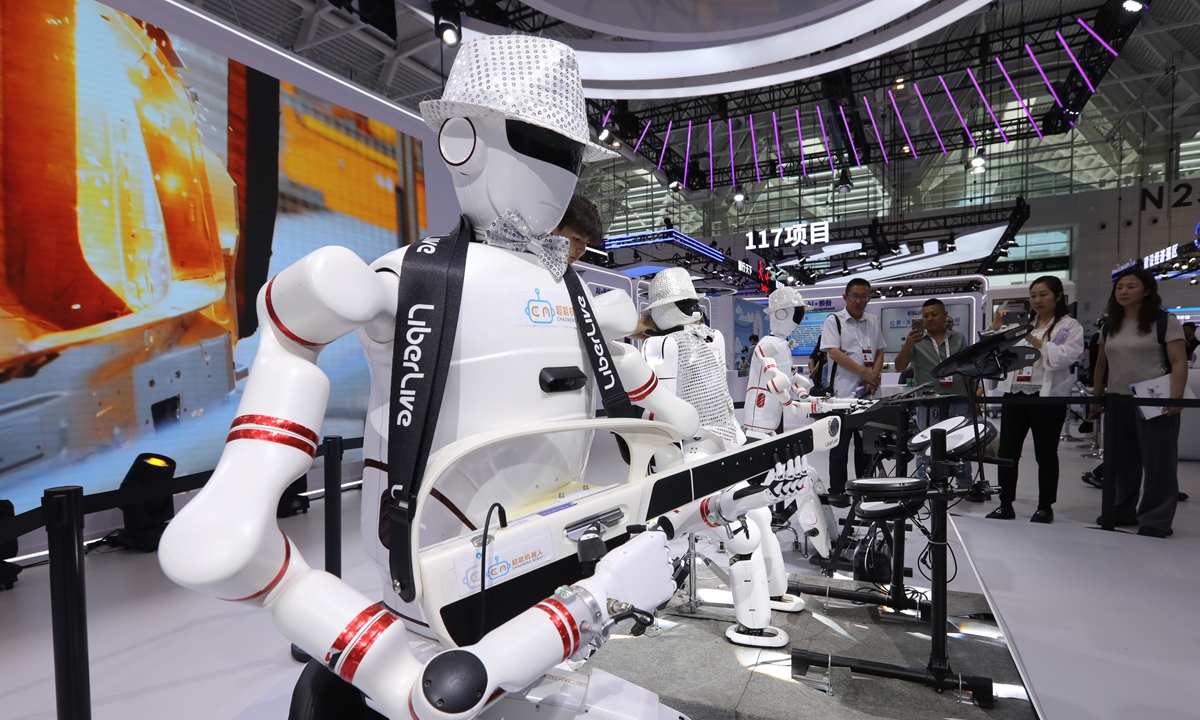
A robot band plays the electric guitar and other musical instruments at the 2026 World Intelligent Industry Expo, which opened in China's Tianjin Municipality on May 28, 2026. Photo: VCG
A robotic arm stretched out over a sizzling griddle, spreading batter in smooth circles before cracking an egg, scattering chopped scallions and folding the finished jianbing into place. In a few minutes after a visitor scanned a QR code to place an order at the World Intelligence Expo 2026 in Tianjin, a steaming Chinese savory crepe slid onto the pickup counter.
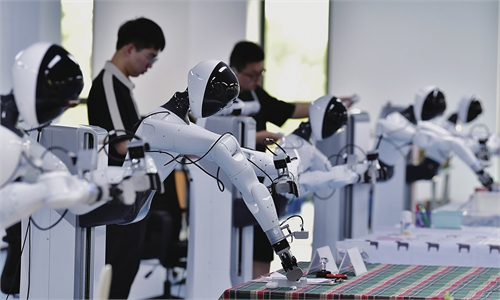
Spectators raised their phones to capture the moment, with some saying the robot was faster than them. At the expo, the robot band kept the rhythm while humanoid robot boxing matches drew crowds around the ring. Robot dogs moved through the exhibition hall, occasionally stopped by visitors who approach them and show an interest to interact with them. Scenes once confined to science fiction were now unfolding across a single exhibition venue.
Held in Tianjin from May 28 to 31 under the theme "Intelligence: Extensive Development Space, Sustainable Growth Driver," the World Intelligence Expo 2026 featured six major exhibition zones and brought together 741 companies. As of noon on Saturday, the main venue had recorded 182,000 visits, according to a Sunday report by China Media Group.
More than 200 innovations were unveiled during the expo, spanning sectors including intelligent manufacturing, the low-altitude economy and smart devices, the report said.
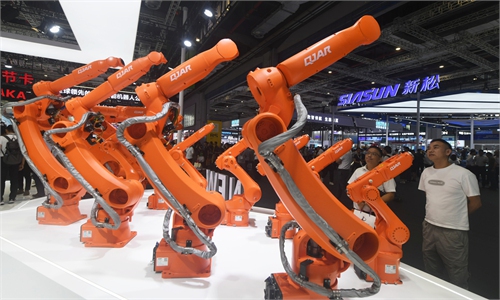
Walking through the exhibition halls, visitors are witnessing firsthand how China's fast-evolving intelligent manufacturing sector is moving beyond concepts and into everyday applications.
From showpieces to daily life
Compared with a few years ago when the focus was on whether robots could move or run, this time the robots are beginning to take on practical tasks and move closer to daily life.
At the exhibition, a robot band demonstrated its precise synchronization and agility through a live performance for visitors.
The band, made up of robot guitarists, drummers, and keyboard players, performed in sync on stage. Exhibition staff told the Global Times that the robots must closely follow the conductor's beat and maintain millisecond-level synchronization with one another to achieve precise coordination during ensemble and alternating performances. The demonstration was intended to show that humanoid robots are capable not only of handling repetitive tasks efficiently, but also of carrying out complex, rhythm-based collaboration.
Notably, many of the robots on display highlighted their close integration with everyday life, with some already being deployed across various industries.
A domestic intelligent security robotics company, Galileo (Tianjin) Technology Co, showcased its emergency rescue robot. Leveraging the strong off-road mobility of quadruped robots, the system is tailored for complex terrain and hazardous environments, and can be equipped with a range of industry-specific devices, the exhibition's technical staff told the Global Times. It features all-weather operation, high payload capacity, strong adaptability to harsh environments, long endurance, autonomous charging, and high-precision sensing capabilities.
In the integrated air-ground inspection system showcased by State Grid Tianjin Electric Power, quadruped robot dogs patrol narrow underground cable tunnels around the clock. They can autonomously pass-through fire doors and use dual-spectrum infrared cameras mounted on gimbals to conduct precise temperature checks.
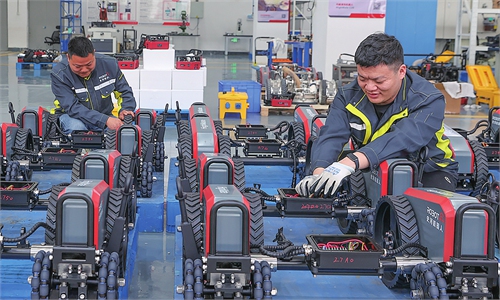
At Tianjin Port Group's booth, twistlock handling robots and autonomous forklifts demonstrated how automation can improve loading efficiency and operational accuracy, while underwater and firefighting robots took on dangerous tasks that would otherwise require human workers.
The brain-computer interface exhibition area also became one of the expo's most popular attractions this year.
According to on-site staff, unlike earlier mechanically assisted models, the new generation of smart exoskeletons is equipped with AI-powered adaptive gait algorithms that can detect users' movement intentions and provide real-time assistance. The devices can be used for activities such as hiking and trekking, while also supporting elderly mobility and rehabilitation training.
Notably, exoskeleton products have emerged as one of the most eye-catching examples of the country's digital and intelligent transformation.
Official data released on May 26 showed that digital and intelligent industries delivered solid progress in industrial upgrading in the first four months of the year, with online retail sales of smart mobility exoskeletons surging 785.5 percent.
China's intelligent manufacturing sector has already shifted from showcasing technological capabilities to delivering practical applications, reflecting a fundamental change in industrial logic, Chen Jing, a vice president of the Technology and Strategy Research Institute, told the Global Times on Sunday.
The industry's core competitive edge is also evolving from hardware specifications alone to integrated software-hardware capabilities, Chen added. "As hardware structures, computing power and sensor technologies become increasingly standardized, factors such as positioning accuracy, payload capacity and system integration capabilities are becoming more important differentiators."
An international technology and industry analysis outlet Global Newswire described the expo as showcasing a full-spectrum, scenario-driven roadmap for intelligent technologies, highlighting cutting-edge innovations, new products and practical applications while placing strong emphasis on commercialization, industrial cooperation and the translation of technological achievements into real-world use cases.
Future industries, policy priorities
What visitors experienced on the exhibition floor offered a direct glimpse into how intelligent manufacturing is increasingly moving from concepts into real-world deployment, while the industry's rapid evolution continues to be guided by targeted policy support and direction.
The 2026 Government Work Report proposed for the first time to "create new forms of smart economy," marking a shift in the country's approach to artificial intelligence - from viewing it primarily through the lens of technology and products to elevating it as a strategic priority shaping industrial chains, industrial ecosystems, and broader economic development, according to the Science and Technology Daily.
Meanwhile, the outline of China's 15th Five-Year Plan (2026-2030) for national economic and social development, released in March 2026, clearly emphasizes comprehensive implementation of the "AI Plus" initiative, according to Xinhua News Agency.
Industry observers said the shift has been driven by policy support, industrial collaboration, and abundant application scenarios, while companies are actively translating technological breakthroughs into scalable industrial capabilities and further integrating intelligent manufacturing into the broader economy.
Advanced intelligent robots are becoming a core engine driving the development of new quality productive forces, as production models shift from direct human-machine operations toward collaborative systems involving humans and intelligent agents, alongside a broader transition from centralized control to distributed intelligent coordination, according to Chen. He added that as intelligent agents gain stronger autonomous decision-making capabilities, mechanisms for value creation and distribution will need to evolve accordingly.
The coordinated development of computing infrastructure has become a key foundation underpinning the growth of artificial intelligence. By the end of March, China's intelligent computing capacity had reached 1,882 EFLOPS, Xinhua reported.
As technology enthusiast Zheng left the exhibition hall holding a jianbing made by a robot, he told the Global Times that while ordinary people may not fully understand the technologies behind such innovations, seeing imagined future scenarios unfold in front of their eyes still felt astonishing. To him, what stood before visitors was more than a robotic arm making snacks - it was a tangible glimpse of China's rapidly advancing intelligent manufacturing ecosystem.
RELATED ARTICLES