Illustration: Chen Xia/GT
Philippine President Ferdinand Marcos Jr's recent state visit to Japan, and the joint statement elevating bilateral ties to a "comprehensive strategic partnership," were officially framed around the 70th anniversary of Japan-Philippines diplomatic relations.The substance of the document, however, points to a broader and more deliberate alignment across security, defense, maritime affairs, economic security and supply chains. The timing warrants attention. At a moment when the region's major powers are seeking to establish mechanisms to manage competition and reduce the risk of miscalculations, the trajectory set out by Tokyo and Manila moves in the opposite direction, expanding security commitments and introducing new points of friction on maritime questions under the framing of a "rules-based order."
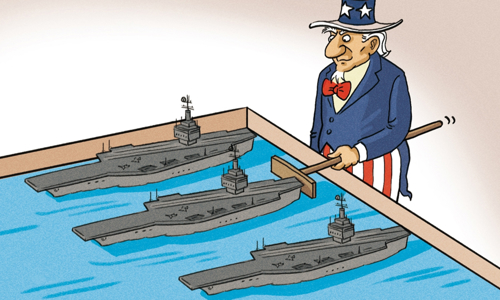
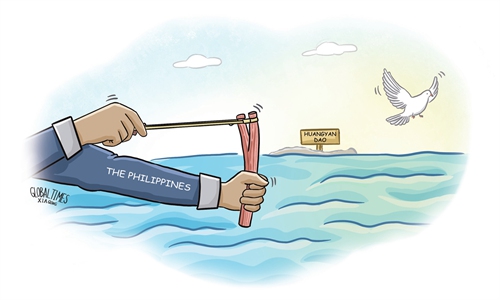
For the Philippines, the visit reflects an effort to internationalize the South China Sea issue and embed it within wider alliance and minilateral frameworks, rather than managing differences through bilateral channels and regional mechanisms. The joint statement extends this approach by linking the South China Sea, the Taiwan Straits, the East China Sea and the proposed maritime delimitation into a single agenda, positioning the Philippines as a forward element in the first-island-chain posture of the US and its allies.
The more deeply a country embeds itself in major-power competition, the more constrained its policy autonomy tends to become. External support in the form of equipment, assistance and diplomatic attention is typically short-term, whereas exposure to front-line friction is durable. A posture premised on balancing among larger powers may ultimately leave Manila with less room for maneuver, not more.
Japan, for its part, is not merely responding to requests from the Philippines, but advancing its own evolving security policy. The Reciprocal Access Agreement has entered into force and the Acquisition and Cross-Servicing Agreement has been signed; the joint statement said that negotiations will begin on an agreement to protect classified military information. Japan-Philippines cooperation will expand on defense equipment, including destroyers, aircraft and radar systems.
These steps indicate that the Philippines has become an important partner in Japan's efforts to expand its role in regional security, develop defense-equipment exports and deepen coordination within the US alliance network. Citing a more demanding security environment, Tokyo has progressively relaxed earlier constraints on its defense posture and arms transfers, and its cooperation with Manila fits within that wider shift.
Both governments present this alignment in the language of a "rules-based order," with repeated references to a "free and open Indo-Pacific," international law, the United Nations Convention on the Law of the Sea and the so-called 2016 South China Sea arbitral award. The substance of the maritime question, however, deserves closer scrutiny. Any arrangement between Tokyo and Manila would raise a substantive legal question if it purports to affect China's asserted maritime rights. Presenting such a process primarily as a contribution to "legal certainty" may, from Beijing's standpoint, have the opposite effect.
The decision to address the South China Sea, the East China Sea, the Taiwan Straits and trilateral Japan-Philippines-US cooperation within a single document suggests that the statement is best understood not as routine bilateral cooperation but as part of a broader strategic alignment. The associated risks are likely to be borne disproportionately by regional states. This consideration is especially relevant given the Philippines' current role as ASEAN's rotating chair, a position that carries responsibility for upholding ASEAN centrality and regional stability and that sits in some tension with deeper involvement in an externally driven security agenda.
The Asia-Pacific's longer-term interests are better served by measures that sustain cooperation and keep development at the center of the regional agenda. Positioning themselves at the forward edge of major-power competition may bring Tokyo and Manila short-term attention, assistance and capability, but it also risks increasing their own exposure, eroding regional trust and connecting complex maritime disputes in ways that are difficult to contain. A more durable approach would prioritize the integrity of international law, respect for the rights and interests of all parties concerned, and the management of differences through dialogue. This is a course more consistent with the commitment to regional peace and stability that all sides claim.
The author is an associate professor at the School of International Studies of Nanjing University. opinion@globaltimes.com.cn
RELATED ARTICLES