China’s voice echoes widely at SLD amid security discussions; Chinese delegates elaborate position, confront wrongdoings at events
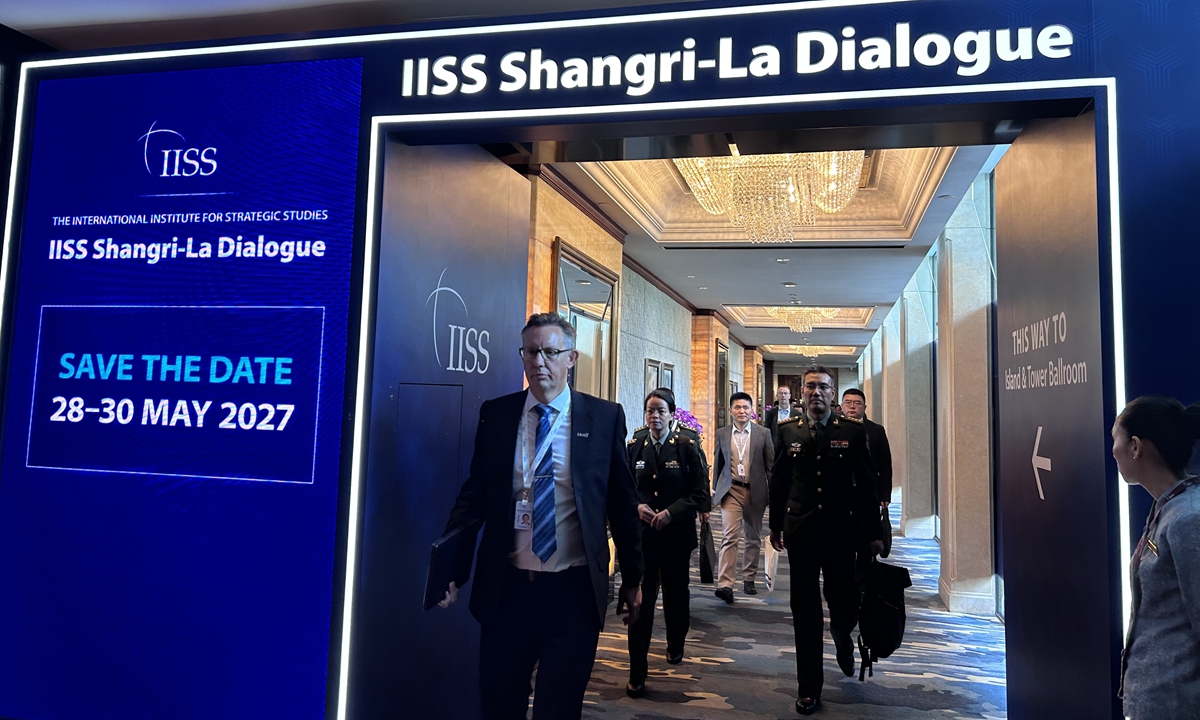
Members of the Chinese delegation and other delegations walk out of the conference venue of the 23rd Shangri-La Dialogue in Singapore on May 31, 2026. Photo: Guo Yuandan/GT
The 23rd Shangri-La Dialogue (SLD) concluded in Singapore on Sunday, where defense officials and scholars from around 40 countries and regions had gathered to discuss regional and global security issues. During the three-day event, "China" emerged as one of the most frequently mentioned keywords in international media coverage. At the special session where Chinese representatives spoke, they were also among the most frequently questioned participants.
Reuters reported on Saturday an interview with Vietnamese President To Lam under the headline: "Better China ties can help regional peace, security, Vietnam's top leader says." "If we can maintain good relations and dialogue, then all disagreements can be resolved," Lam said.
"China is not a remote power to be managed, where it is a civilizational neighbor and a strategic partner in shaping the regional," said Muhammad Abdurrohim, research coordinator at the ASEAN-China Research Center of Universitas Indonesia, in an interview with the Global Times. "In the security domain, I view that China's role through the prism of shared Asian interests," he added.
"The global landscape is becoming increasingly complex. In my opinion, China is fully capable of acting as a responsible power in promoting security and stability in the region," said Duong Van Huy, senior research fellow at the Institute of Asia-Pacific Studies, Vietnam Academy of Social Sciences.
China's position
At the venue, a Global Times reporter observed that although there was no keynote speech delivered by a Chinese representative this year, voices from the Chinese delegation were heard in almost every plenary session through questions.
"Is the Japanese government prepared to respond in an equally serious and unequivocal manner to the concerns of China, South Korea and victim nations of Southeast Asia regarding the history of the Second World War, thereby creating the conditions for mutual trust and regional security?" asked Shen Zhixiong, a senior colonel from the National Defense University and a member of China's delegation to the SLD to Shinjiro Koizumi. However, Koizumi did not answer the question head-on, instead reiterating Japan's willingness to maintain candid dialogue and communication.
A similar exchange occurred during the Q&A session with the Philippine defense secretary. A Chinese representative questioned how the Philippines could reconcile its stated respect for the rule of law and preference for peaceful dispute resolution with its actions of sending personnel to uninhabited reefs in the South China Sea, which violates the Declaration on the Conduct of Parties in the South China Sea. According to reports, Gilberto Teodoro did not directly address the alleged contradiction. Instead, he launched into an emotional discussion of the Code of Conduct in the South China Sea, at times appearing incoherent, before being interrupted by the moderator.
At a special session on "Managing Threats to Strategic stability" held on Saturday, the head of China's delegation to the 23rd Shangri-La Dialogue (SLD), professor Meng Xiangqing, questioned Japan in his speech: "Can a country that has never fully eradicated the remnants of militarism truly claim the moral authority to lecture others about defense cooperation on the international stage? Can it earn the trust of the international community, especially the Asian countries that once suffered under its aggression? I have serious doubts."
China's delegation also expressed its position on this session. Meng said that China's Global Security Initiative and Global Governance Initiative advocate a vision of common, comprehensive, cooperative and sustainable security, emphasizing multilateralism and the rule of law, and offering important ideas for addressing global challenges.
A Danish journalist, who requested anonymity, told the Global Times that foreign media outlets are keen to report China's stance and are eager to hear insights from Chinese experts.
According to the South China Morning Post, the Chinese delegation's remarks were among those closely watched.
As the special session was closed to the media, journalists gathered outside the venue both before and after it began. At this special session that was livestreamed to media, the only one featuring a formal speech by a Chinese delegate, Professor Meng was the most frequently questioned speaker.
China-US ties in focus
In a widely watched speech on Saturday, US Defense Secretary Pete Hegseth noted that US-China ties are "better than they've been in many years" and the US administration seeks a stable peace, fair trade, and respectful relations with China.
Noting the meeting between the two heads of state in Beijing "historic," Hegseth said the two sides agreed that the US and China should build a constructive relationship of strategic stability based on fairness and reciprocity, reaffirming that while our nations will vigorously protect our respective interests, we can secure practical, mutually beneficial agreements where our interests align. He also stressed military-to-military communication to coordinate, deconflict, and reduce the risk of miscalculation.
Yet Hegseth also raised "alarm" regarding so-called China's military buildup and the expansion of its military activities in the Pacific region and the US approach in the Pacific centers on deterrence by denial along the so-called "First Island Chain." But he added the US does not approach challenge with needless confrontation.
Multiple media noticed that the US defense secretary did not mention Taiwan in his speech, in contrast to mentioning the island five times the previous year. According to the Straits Times, some participants observed a "softer tone" in the US' approach toward China.
Meng, in response to Hegseth's remarks, noted that "Constructive strategic stability" in bilateral ties means positive stability with cooperation as the mainstay, healthy stability with competition within proper limits, constant stability with manageable differences, and lasting stability with expectable peace, which can provide strategic guidance for China-US relations over the next three years and beyond.
Meng expressed the hope that China and the US will meet each other halfway, deliver on the consensus reached between the two heads of state, and push the two militaries' relations forward in a sound, stable and sustainable manner.
RELATED ARTICLES