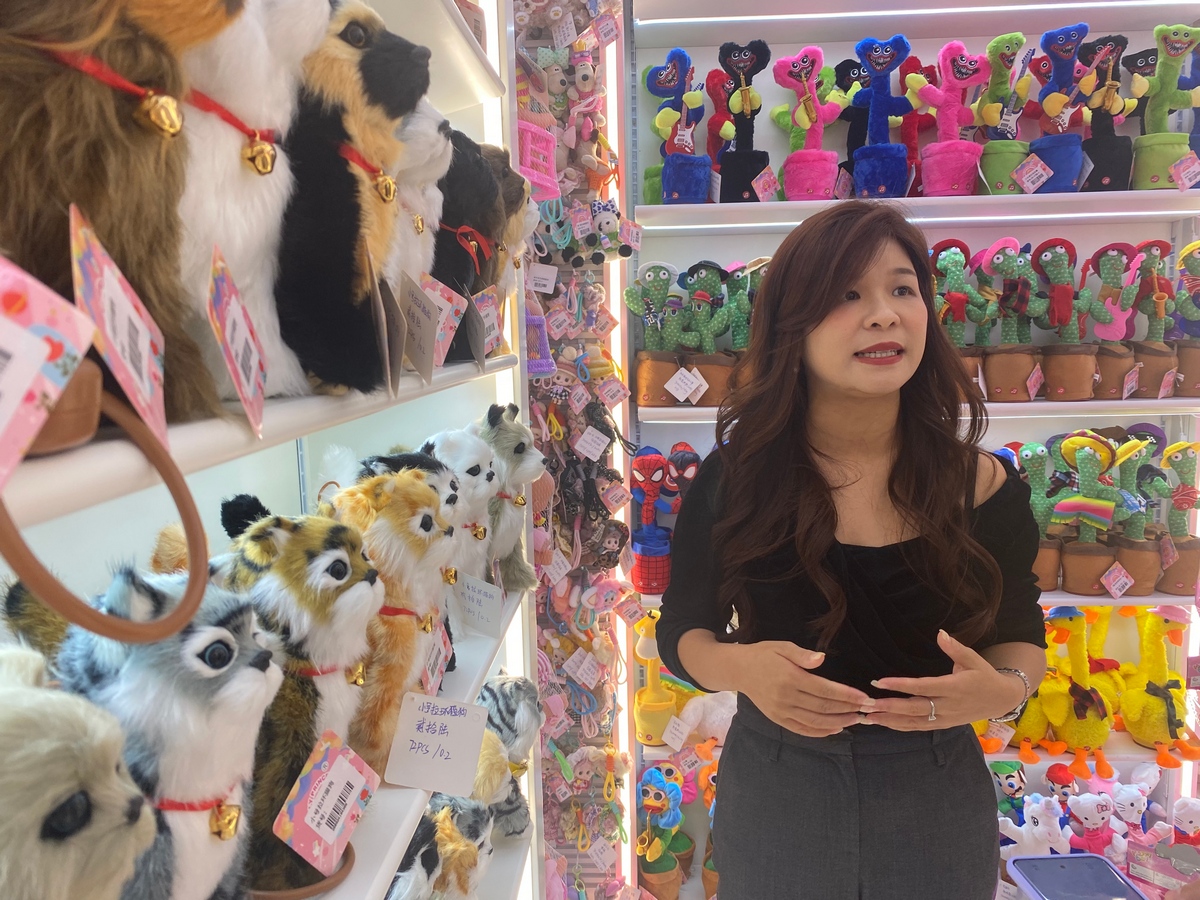
Sun Lijuan works inside her shop at the Yiwu International Trade City in Jinhua City, East China's Zhejiang Province on September 26, 2025. Photo: Zhang Weilan/GT
With June 1, which was Children's Day, stirring domestic enthusiasm for toys in China, a big market opportunity is also unfolding overseas. Smart artificial intelligence (AI) toys that chat, offer educational content and recognize children's moods have captured growing interest among foreign buyers. Numerous Chinese toymakers have registered a marked uptick in export orders for AI-integrated playthings, racing to capitalize on booming global appetite for this new product category.
Yiwu, a small commodity hub in East China's Zhejiang Province, hosts more than 3,000 toy vendors whose products are shipped to more than 200 countries and regions. According to China Media Group (CMG), Yiwu's toy exports surged 11.6 percent year-on-year in the first four months of this year. Local merchants have noted rising demand for AI toys from overseas buyers.
"In the first half of this year, our export orders for interactive talking dolls have risen slightly compared with last year," Sun Lijuan, owner of Yiwu based toy manufacturer Moly Princess, told the Global Times on Monday. "But what really stands out is the repurchase rate, which is about 70 to 80 percent. Most of our wholesale clients come back for more."
Her South American buyers are already placing orders for Christmas‑themed toys, with shipments scheduled from May through August.
Wang Junwen, another toy merchant based at Yiwu International Trade City, told the Global Times that his AI-enabled dolls have gained strong traction among buyers in the Middle East.
"Our smart dolls can link up with a dedicated mobile app. Kids can fire all kinds of casual questions at them, from inquiries about the day's weather to simple personal questions like 'how old are you?'" Wang told the Global Times on Monday.
The robust export performance of downstream toymakers has driven higher demand from overseas clients for upstream AI technical solution suppliers. Tuya Smart is one such technology provider, supporting toy firms to create AI-equipped playthings, streamline their research and development cycles, and facilitate mass manufacturing.
Inquiries from toy manufacturers have surged this year, while new brand partners have multiplied, and demand has remained strong, the Global Times learned from Tuya Smart on Monday.
Several AI toy models developed with technical support from Tuya Smart have secured solid overseas sales. The AOOMII AI Smart Robot Cat is one such case. Launched in 2026, the robot cat landed an order of 5,000 units from US retail giant Walmart within its first month on the market, and its monthly shipments now stand at roughly 10,000, the Global Times learned from the company.
"Domestic consumers already have a basic idea of what AI toys are - they've seen them, heard about them, even compared prices. But overseas, there's still a large knowledge gap. When overseas clients see these products for the first time, the initial impact often turns quickly into buying interest. The closing rate is much higher," Zhao Yifeng, director of AI Solutions for the Eurasian market of Tuya Smart, told the Global Times on Monday.
China's AI toy market reached 29 billion yuan ($4.28 billion) in 2025, and it's projected to surpass 100 billion yuan by 2030, CMG reported.
The surging popularity of AI toys is primarily driven by the rapid advancement of large-language model industries. Iterations in AI technology and finished products precisely match evolving consumer demand, making the rise of AI toys a classic industrial case where technological breakthroughs spawn new consumption trends, Liu Dingding, a veteran observer of the technology industry, told the Global Times on Monday.
RELATED ARTICLES