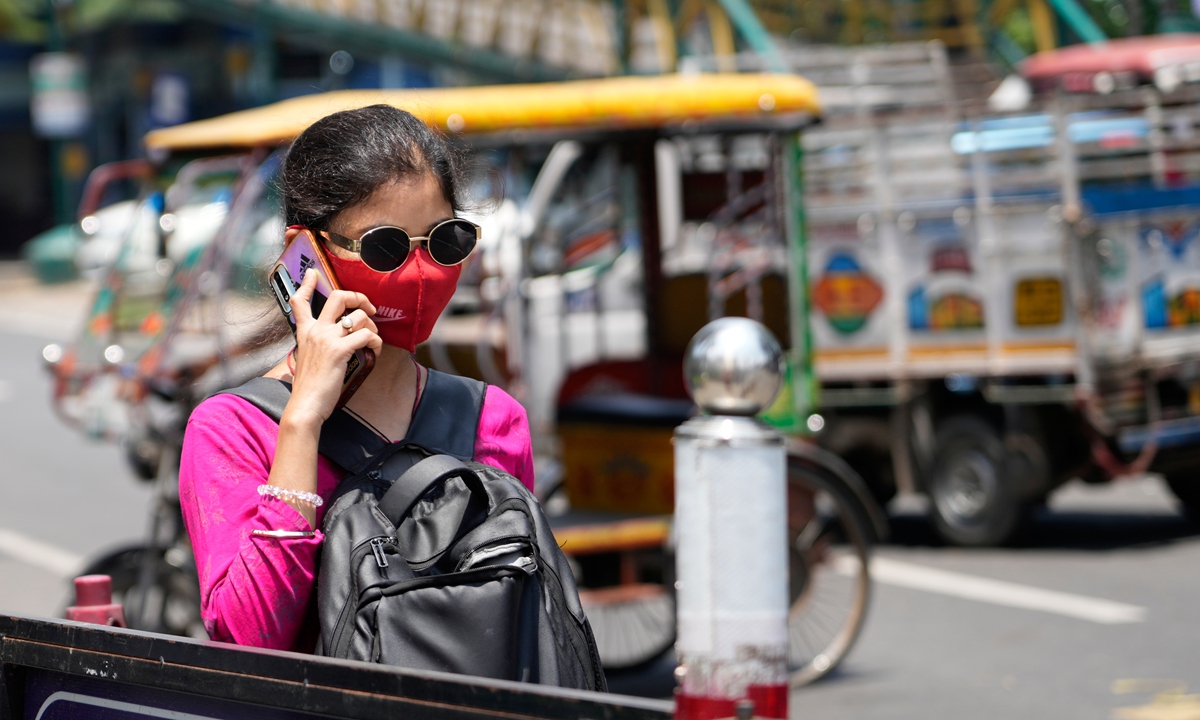
A woman covering her face walks in the sun on a hot summer day in Kolkata, India, Monday, June 1, 2026. Photo: VCG
"It felt like my organs were boiling," a Chinese student studying in India told the Global Times, as severe heatwave conditions prevailed across parts of India. A Chinese expert said on Monday that the scorching weather reflects global warming, abnormal atmospheric circulation and local geographic vulnerabilities.
The extreme weather has disrupted daily life across states including Uttar Pradesh, where some roads and markets closed during afternoon hours as temperatures became difficult to endure. In Banda, maximum temperatures reached 48.2 degrees C in May, prompting local authorities to suspend classes and announce early summer holidays in several districts. Farmers in some rural areas have shifted work to nighttime to avoid daytime exposure, EuroNews reported.
According to a BBC report on Friday, India's heat season typically lasts from April until early July, before the monsoon brings relief. But climate scientists say extreme heat is becoming longer, harsher and more unpredictable as heatwaves across South Asia intensify under global warming.
Mapping heat-induced mortality risk to individual districts revealed that the state of Uttar Pradesh alone accounts for about 8,100 excess deaths during a five-day heatwave, while excess deaths in districts, including Ahmedabad, Jaipur and Surat, each exceed 250 in a single event, per the report.
In a post on X on May 27, Indian Prime Minister Narendra Modi warned of the impact of soaring temperatures across the country, saying that "different parts of India are witnessing soaring temperatures and the challenges that come with it… This heat is harsh on all of us, and I urge you all to take as many precautions as possible," he wrote.
India's latest spell of extreme heat began in late April. Although temperatures during that period did not reach the 45 C highs recorded in mid-May, Lu Jiayi, a first-year Chinese graduate student at Jawaharlal Nehru University in New Delhi, told the Global Times that she experienced the hottest weather of her life.
Apart from taking frequent showers, Lu relied on large amounts of ice water to cope with the heat. An ice-water dispenser was available near the entrance of her dormitory building, where she would refill her one-liter bottle repeatedly. "I had to refill it four or five times every night," she recalled.
Originally from Northwest China's Shaanxi Province, Lu said she had experienced temperatures above 40 C in China before, but the heat in India was "on a completely different level."
The sweltering conditions lasted for nearly two weeks. "I simply couldn't take it anymore, so I returned to China on April 29, when daily highs had already reached 43 C or above," she said. The decision coincided with the start of her university's summer break. Although she had initially planned to remain in India to shoot video footage for her projects, the physical discomfort ultimately forced her to change her plans.
"All of the Chinese students had gone back home, and many local students had also left for cooler places to escape the heat," she said.
Lu told the Global Times that, to the best of her knowledge, some foreign students remain in India. She added that the Chinese student population in India is currently relatively small, with some opting for air-conditioned housing during periods of extreme heat.
"Such extreme heat is not new to India," Ma Jun, director of the Institute of Public and Environmental Affairs, told the Global Times on Monday, noting that the frequent heatwaves affecting the Indian subcontinent are driven by a combination of natural and human-induced factors.
"The Indian subcontinent's recurrent heatwaves stem from a combination of natural and human-induced factors. Delayed monsoon rains, heat-dome conditions caused by localized high-pressure systems, and hot, dry winds from western desert regions help sustain extreme temperatures, while expansive urbanization, shrinking vegetation cover and the urban heat-island effect further intensify the heat and keep nighttime temperatures unusually high," Ma said.
A report published in 2019 by the International Labour Organization estimates heat stress could reduce India's total working hours by 5.8% by 2030, with outdoor workers in agriculture and construction among the worst affected.
A Lancet Countdown report found India lost around 247 billion potential labour hours to heat in 2024, resulting in economic losses of $194 billion.
Ma also warned that the impacts of extreme heatwaves extend far beyond immediate discomfort, posing direct threats to public health, disrupting outdoor work and livelihoods, particularly for low-income groups, and undermining agricultural production.
He noted that India's capacity to cope with extreme heat remains limited, with surging electricity demand increasing the risk of power outages that can also affect water supplies. Prolonged heat and drought may further strain water resources and degrade water quality. Socially, vulnerable groups, especially low-income households and slum residents, face disproportionate risks due to limited access to cooling, unstable electricity supplies, reduced outdoor income and constrained healthcare resources, leading to higher mortality risks.
"India will need a long-term response that includes strengthening climate adaptation measures while also contributing to global efforts to reduce carbon emissions and mitigate climate change," the expert said.
RELATED ARTICLES