China unveils plan to accelerate agricultural, rural modernization
Nation’s policy support to secure targets in next five years: expert
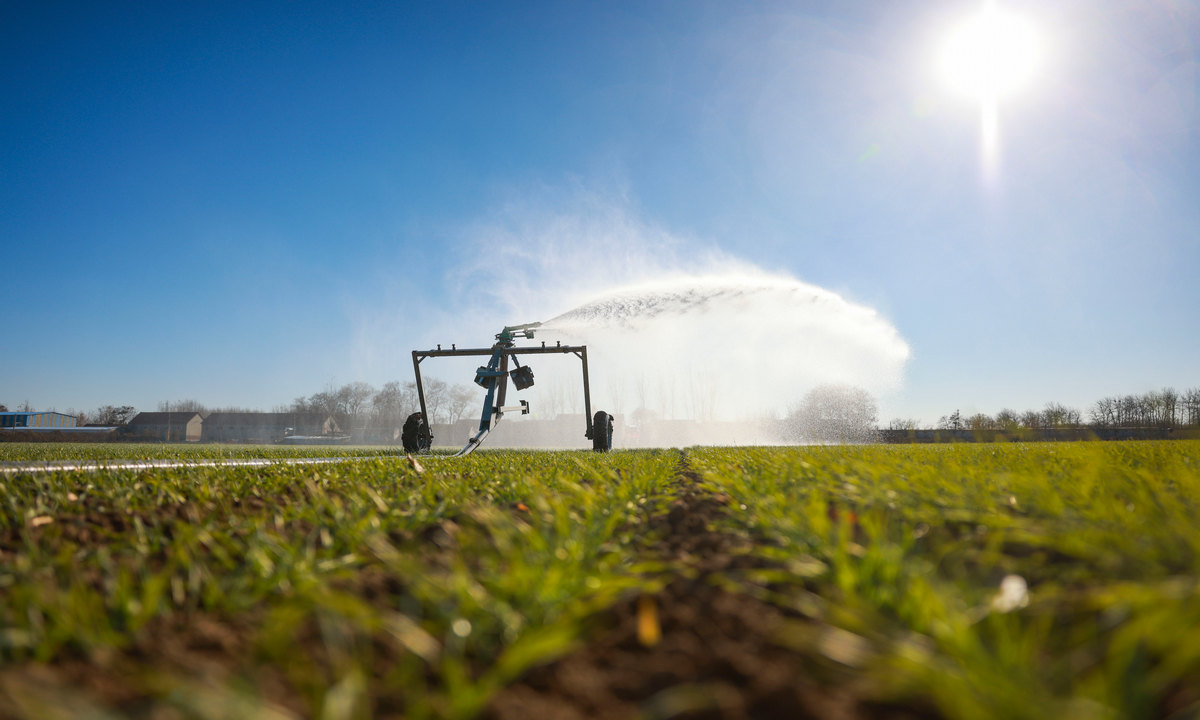
A sprinkler irrigates crops in Dongying, East China's Shandong Province on November 27, 2025. China's Ministry of Agriculture and Rural Affairs said in its latest crop update that more than 90 percent of the country's winter wheat has been sown, as many provinces move swiftly to advance autumn-winter planting. Photo: VCG
China's State Council has announced the 15th five-year plan (2026-30) for accelerating agricultural and rural modernization, outlining development goals, key tasks and policy measures while emphasizing the role of agricultural modernization in advancing Chinese modernization, according to a notice published by China's central government on Tuesday.
The plan was reviewed and adopted at a State Council executive meeting on May 15. A Xinhua News Agency report published the same day, citing an expert, described the document as a "construction blueprint" for agricultural and rural development during the 15th Five-Year Plan (2026-30) period, saying that it sends a clear signal of China's commitment to prioritizing agricultural and rural development and comprehensively advancing rural revitalization.
The plan is an important component of China's broader 15th Five-Year Plan framework. Its strategic orientation is clear: To advance the building of a strong agricultural nation, with comprehensive rural revitalization serving as a key vehicle for accelerating agricultural and rural modernization, Li Guoxiang, a research fellow at the Rural Development Institute of the Chinese Academy of Social Sciences, told the Global Times on Tuesday.
The plan outlines seven major development tasks, placing the improvement of agricultural production capacity and quality at the top of the agenda while emphasizing coordinated development between agriculture and ecological protection, as well as optimization of the supply structure. It also calls for continued consolidation of poverty alleviation achievements to ensure that large-scale poverty relapse does not occur.
The plan deploys a number of major projects, including the construction of high-standard farmland, the enhancement of agricultural science and technology innovation capabilities, and the development of warehouses, cold-chain logistics and fresh produce preservation facilities.
Li Guoxiang noted that these measures not only serve national strategic objectives but are also expected to generate more direct benefits in improving agricultural productivity, raising farmers' incomes and promoting rural development.
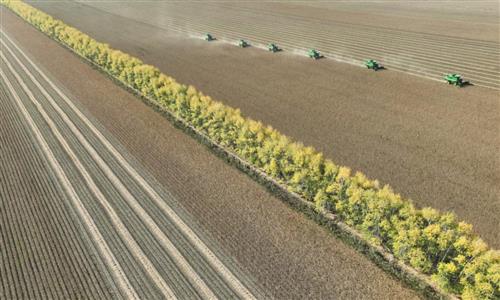
A key feature of the plan is its emphasis on strengthening agricultural technology and equipment support and achieving major breakthroughs in developing new quality productive forces in agriculture. Priority areas include tackling core technologies, accelerating the commercialization of scientific achievements, advancing the seed industry revitalization strategy, expanding the application of advanced agricultural machinery, and promoting the use of artificial intelligence (AI) in agriculture.
Li Chang'an, an economist at the University of International Business and Economics, said that the prominent placement of agricultural technology and equipment reflects a deeper implementation of China's strategy of prioritizing agricultural and rural development.
He added that China's agricultural technology capabilities still have significant room for improvement, while some agricultural products remain highly dependent on imports, and that ensuring food security and promoting high-quality agricultural development will require stronger technological innovation and modern agricultural equipment.
At the same time, AI, big data and other emerging technologies are being increasingly applied in production management, pest monitoring and precision farming, helping improve productivity and resource utilization, Li Chang'an said.
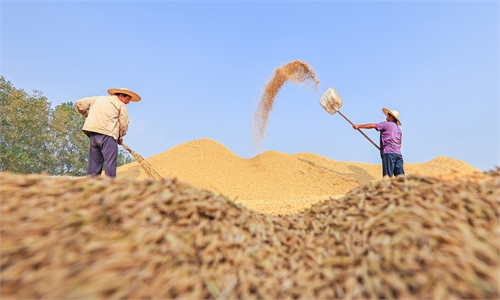
According to data from the National Bureau of Statistics, China's grain output reached 1.42975 trillion jin (714.88 million tons) in 2025, up 1.2 percent year-on-year. Grain production remained above 1.4 trillion jin for a second consecutive year, maintaining a record high level.
During the 14th Five-Year Plan (2021-25) period, China's annual grain output increased from 1.3657 trillion jin in 2021 to 1.42975 trillion jin in 2025, while per-capita grain availability rose from 483 kilograms to 500 kilograms. A report by the People's Daily said that with staple grains remaining largely self-sufficient and food security firmly safeguarded, the strong harvest results underscore the progress made in China's high-quality agricultural development.
In the first quarter of 2026, per capita disposable income of rural residents grew by 5.4 percent in real terms. Agricultural investment and rural consumption continued to rise steadily, with fixed-asset investment in the primary industry increasing by 15.9 percent year-on-year, and retail sales of rural consumer goods growing by 3.1 percent, according to official data.
Agriculture is a cornerstone of economic security, as food security underpins the basic livelihood of 1.4 billion people, helping to offset external uncertainties with domestic certainty; it is also a key engine for expanding domestic demand, as the full modernization of the rural population will unleash significant consumption potential and further drive China's domestic circulation, Su Jian, a professor at Peking University's School of Economics, told the Global Times on Tuesday.
Li Guoxiang said that supported by China's comprehensive policy support system, agricultural and rural modernization will make significant progress during the 15th Five-Year Plan period.
"Through financial support, broader participation from social stakeholders and strengthened talent cultivation, the plan's objectives can be effectively translated into tangible outcomes for agricultural and rural development," he noted.
RELATED ARTICLES