Japan’s defense outline claiming China a ‘grave concern’ is a well-worn trick to portray itself as a victim for militaristic expansion: Chinese expert
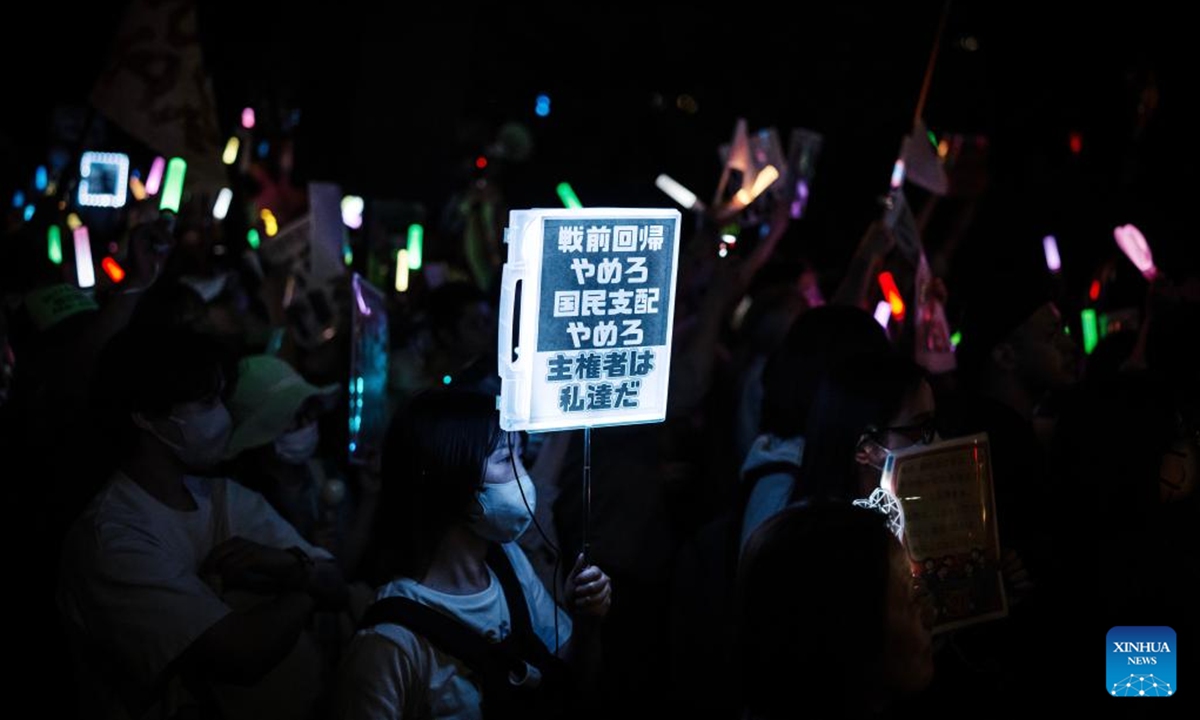
A woman holding a sign attends a protest rally in front of the National Diet Building in Tokyo, Japan, May 29, 2026. Around 10,000 people gathered in front of Japan's National Diet Building in Tokyo on Friday evening for an anti-war rally, protesting what they described as a series of dangerous policy moves pursued by the government of Prime Minister Sanae Takaichi. (Xinhua/Jia Haocheng)
Amid a string of Japan's recent military expansion steps, Japanese media outlets on Wednesday revealed the outline of Japan's annual defense report, which claimed that China's military activities were "a grave concern," and highlighted the need for securing sustained combat capacity for potential "prolonged war."Chinese experts said Japan is using a well-worn trick to portray itself as a victim to drum up global public opinion and fabricate excuses for its militaristic expansion. Tokyo's rapid military buildup has gone far beyond legitimate self-defense demands and serves to pave the way for a return to militarism, a development that warrants close vigilance from the international community.
On the same day, as it responded to yet another development pointing to Japan's dangerous military tilt, China's Foreign Ministry pushed back against the Japanese Defense Ministry's allegation that China kept repeating unfounded claims, underscoring word games cannot whitewash Japan's tangible steps to boost and expand its armed forces.
Well-worn trick
According to the outline of Japan's Defense White Paper, regarding China's military activities, it cites incidents including intermittent radar illumination of Self-Defense Forces aircraft by Chinese fighter jets last December and intensified Chinese carrier operations in the Pacific Ocean, the NHK reported on Wednesday.
The outline labels such military activities "a grave concern" for Japan and the international community and "an unprecedented top strategic challenge," using wording nearly identical to that in the 2025 White Paper, the Japanese media outlet said in the report.
Claiming China's intensifying military operations near Japanese territories, the outline frames the issue as one to be countered by comprehensive national strength plus cooperation and coordination with allies and like-minded partners, the Asahi Shimbun reported on Wednesday.
The full Defense White Paper is expected to be submitted to Japan's Cabinet for review this summer, according to NHK.
The worsening China-Japan relations stem entirely from rampant domestic neo-militarist sentiments in Japan, yet Japan habitually shifts blame on security issues. Worse still, Tokyo pretends to be an innocent victim to mislead the world and rebrand itself from a troublemaking provocateur into an aggrieved party. It is a well-worn trick to build public opinion and prepare for more provocations against China down the line, Lü Chao, an expert at the Liaoning Academy of Social Sciences, told the Global Times on Wednesday.
Hype over the so-called China threat works as a pretext for Japan to expand its military and roll out risky military initiatives, Lü said, noting that every unfounded allegation it levels at China is crafted to justify its own militaristic expansion.
According to NHK, the outline of the paper also creates a new section dedicated to "new forms of warfare," citing the extensive deployment of low-cost drones and protracted combat seen on Ukraine's battlefields. Building on that, the outline underscores the importance of preparing for emerging warfare leveraging AI and drones, securing sustained combat capacity for potential prolonged war, and bolstering defense industrial and technological foundations.
Neo-militarism in Japan has gained alarming momentum, with Tokyo's top priority being to shake off post-war legal shackles on its military, Lü said. "Its massive push for drones and other military equipment far exceeds genuine self-defense needs. This outright military expansion aims to grow Japan's regional leverage and clear the path for a militaristic comeback," the expert said.
Wordplay cannot whitewash military build-up
In response to previous media disclosures of the draft of the Sanae Takaichi administration's first Defense White Paper which reveal that it frames China's activities in the Pacific as a "security threat" and expresses vigilance, Jiang Bin, spokesperson for China's Ministry of National Defense, said on May 28 that what Japan does contradicts what it says. The more it tries to whitewash the inconsistency, the more obvious it gets, he said.
Jiang laid out a batch of dangerous moves taken by Japan. He told the press conference that in recent years, the Japanese government has sharply hiked its defense budget, developed and deployed offensive weapons, eased restrictions on exporting lethal weapons, pushed to revise the pacifist Constitution, clamored to be a war-capable nation, and even touted abandoning the three non-nuclear principles.
"If these actions still qualify as 'exclusively defense-oriented,' then there would be no such word as offensive in the dictionary," Jiang said.
Apart from the long-running policy shifts, fresh dangerous moves from Tokyo have kept emerging recently.
At the end of May, Japan and Philippines has agreed to begin formal negotiations to conclude a security intelligence-sharing agreement. The two countries also recently announced to start talks on maritime delimitation in the waters east of China's Taiwan island, which seriously infringed upon China's territorial sovereignty and maritime rights and interests.
Ironically, as reported by Reuters, at the just-concluded Shangri-La Dialogue in Singapore, Japan's Defence Minister Shinjiro Koizumi rebutted criticism that Japan was embracing new militarism, and claimed: "Think about it. There's a country that has a huge arsenal of nuclear weapons and strategic bombers. Japan has neither of such weapons, and yet Japan is labelled 'new militarism'?"
Refuting such claims, Chinese Foreign Ministry spokesperson Lin Jian said at a regular press conference on Monday that "the remarks from the Japanese official you mentioned have no basis at all. They have zero authority in front of history, law, facts and figures. There is no way that making such remarks will help Japan earn the trust of its Asian neighbors and the international community."
However, it seems to have become a repeated pattern for Japan to reject accusations over military expansion when such issues are raised. Following Lin's remarks, Japanese Defense Ministry spokesperson claimed the next day that China keeps repeating factually unfounded claims and called such reaction regrettable, Japanese media outlet Livedoor News reported.
Responding to the matter, Chinese Foreign Ministry spokesperson Mao Ning said on Wednesday that Japan's justification for its behavior is better characterized as evasion and denial, which is nothing but camouflage for remilitarization.
"The Japanese side has been mum about the militarist invasion and war crimes, still less Japan's obligations under international law. To this day, Japan remains unrepentant over its dark history," Mao said.
Now it is deceiving the Japanese public and international community by mixing up concepts - calling overseas deployment "collective self-defense," buildup of offensive capabilities "acquiring counter-strike capabilities" and export of lethal weapons "equipment and technology cooperation," said Mao.
"Japan's repeated denial of neo-militarism shows its unease, as China's remarks have laid bare the real nature of its continuous military buildup and left Japan fearing more countries will see what it is doing and grow wary of its defense direction," Da Zhigang, a researcher at the Institute of Northeast Asian Studies at the Heilongjiang Provincial Academy of Social Sciences, told the Global Times on Wednesday.
Noting such continuous military moves by Japan could carry long-term risks and adverse impacts on regional peace and security, Da said it is essential for more countries to recognize Japan's true strategic orientation.
"Facts do not lie. Juggling with words does not whitewash Japan's rearmament. The harder Japan tries to hide it, the louder the alarm for the international community," spokesperson Mao said.
RELATED ARTICLES