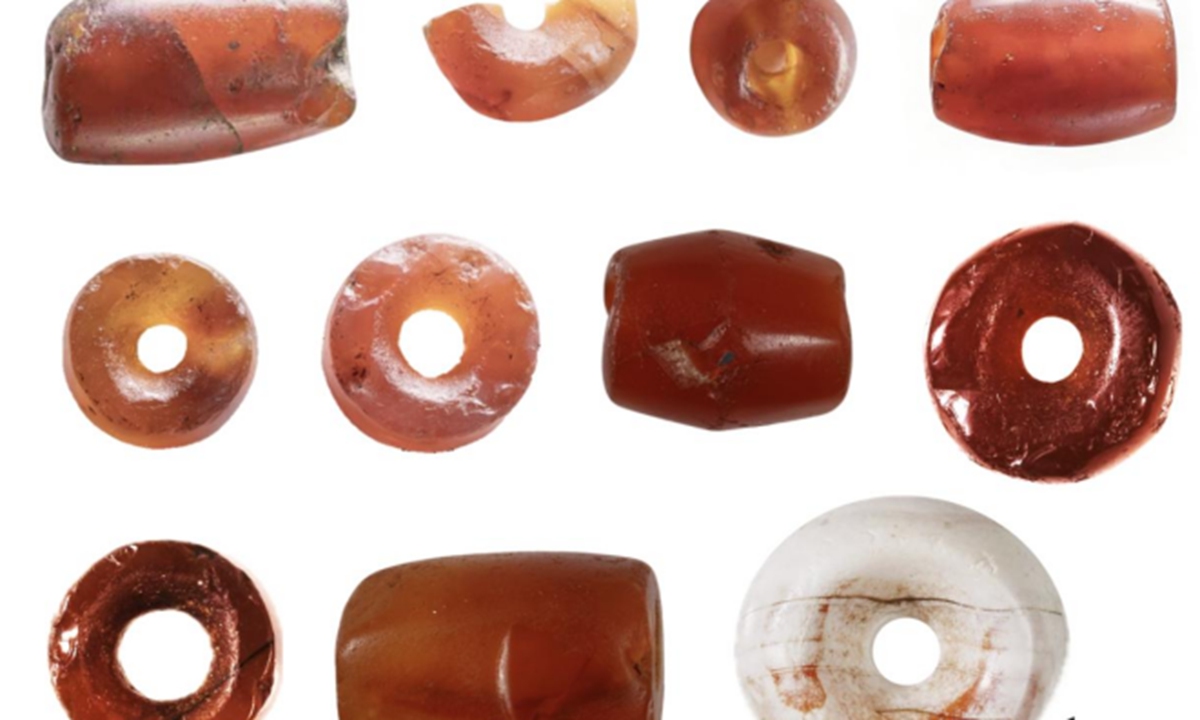
The carnelian beads unearthed from Sanxingdui ruins Photo: Xinhua News Agency
Chinese archaeologists have traced the origins of 11 carnelian beads unearthed from sacrificial pits at the Sanxingdui Ruins, revealing that more than 3,000 years ago, the ancient Shu civilization in Southwest China had already established stable and lasting exchange networks with the distant northern grasslands and the Loess Plateau. The study also found that these carnelian beads are the southernmost such artifacts discovered in China from that period, the Sichuan provincial cultural relics and archaeology research institute confirmed on Wednesday.
Discovered in the late 1920s in Guanghan, Sichuan Province, the Sanxingdui Ruins have been dubbed one of the world's greatest archaeological finds of the 20th century. Since 2022, over 400 sites have been identified, including high-level building foundations, ash pits, ash ditches, and stone artifacts production and processing sites at Sanxingdui. More than 4,000 artifacts, including pottery, jadeware and stoneware, have been unearthed, the Xinhua News Agency reported.
Experts pointed out that all the carnelian pieces were crafted into beads, with the most prominent characteristics being drilled holes. The beads' surfaces are polished, and signs of long-term wear from use are visible. Other relics such as ivory, gold wares, and bronze artifacts were unearthed from same pits, indicating that these beads were high-status items at the time, according to a report from CCTV News.
Carnelian is a type of microcrystalline quartz that contains iron oxide. It is bright red in color, with a fine and smooth texture. In ancient China, carnelian was very rare and considered a symbol of status and wealth. Because China did not have a tradition of using carnelian during the Stone Age, scholars have long believed that early carnelian beads in East Asia mostly came from long-distance trade with West Asia or South Asia, according to the Sichuan Media Group.
However, the new research on the carnelian beads found at Sanxingdui has changed this view. The study shows that the raw material for Sanxingdui's carnelian beads did not come from overseas, but from northern China, near the Yanshan Mountains and the Mongolian Plateau. These beads were not just jewelry but also key objects used to build social identity in the ancient Shu civilization.
Archaeologists conducted trace-element analysis on the carnelian beads and confirmed that the raw materials did not originate locally. Instead, they likely came from the Yanshan mountain range and areas north of it, more than 1,000 kilometers north of the Sichuan Basin. Researchers also compared the beads with carnelian artifacts excavated in Northwest China's Gansu Province, Shaanxi Province and Beijing that date to the same period, and found that they shared raw-material characteristics associated with northern regions.
This discovery shows that between 1500BC and 1000BC, an extensive and long-lasting trade and exchange network existed across the southern Mongolian Plateau, the Loess Plateau, the eastern Qinghai-Xizang Plateau, the Central Plains, and the Sichuan Basin, according to Xinhua.
Liu Jiancheng, an associate research fellow at the Sichuan provincial cultural relics and archaeology research institute, said that around 3,000 years ago, Sanxingdui society benefited from a long-distance interaction network that reached northern China and possibly even the Mongolian Plateau. This proves that during the Bronze Age, there was wide and deep cultural exchange across different regions of China and that the integrated and diverse character of Chinese civilization had already formed and developed thousands of years ago, Xinhua reported.
Liu said that the trace element analysis method and database built during this study will help researchers trace the origins of other rare resources from Sanxingdui, such as bronze, gold, cinnabar and jade. This will provide important support for fully understanding the ancient Shu civilization's resource management and exchange networks, according to the Sichuan Media Group.