Exclusive: Chinese-led HyperMillennium project marks country’s milestone in cosmological simulation and domestic supercomputing capabilities: insider
By and Ma Jun Published: Jun 03, 2026 07:59 PM


Photo: courtesy of the National Astronomical Observatories of the Chinese Academy of Sciences (NAOC)
An international research team led by Chinese scientists at the National Astronomical Observatories of the Chinese Academy of Sciences (NAOC) recently unveiled the first batch of findings of the largest-ever cosmological simulation ever performed, codenamed "HyperMillennium." Its achievements have been hailed by international peers as a "computational marvel."
It also marks an important milestone: China has truly begun to move to the forefront of digital simulation worldwide, project member Wang Qiao, a research fellow at the NAOC, told the Global Times in an exclusive interview. The achievements of the project mark a major leap for China's cosmological numerical simulations — from long-term reliance on foreign computing resources to conducting frontier research based on domestically developed independent systems, Global Times has learned.
The project uses PhotoNs, software independently developed by the NAOC team, and runs on domestic supercomputers. Over more than a decade, the team has continuously worked on algorithms, programming and optimization, eventually achieving long-duration computing capability using tens of thousands of accelerator cards at a domestic supercomputing center.
"In the past, the common approach was to import ready-made code from abroad, cooperate with domestic computing centers, pay for computing time and then finish the task. But this time is completely different — from the design of the scientific project and software development to deep integration with domestic hardware, everything was built independently from scratch. It can be said that this is a fully domestic, end-to-end solution, and one that has achieved a leading position in this field. It carries clear landmark significance," Wang said.
China's leading supercomputer manufacturer Dawning Information Industry Co. Ltd., or Sugon, has provided key computing and storage support for the project. During the project's long-cycle, high-intensity operation, it offered stable and reliable support for the continuous calculation of gravitational evolution involving ultra-large-scale dark matter particles. In the face of the PB-level massive data generated by the simulation, Sugon's storage system also enabled efficient data reading, writing and processing, as well as long-term secure preservation.
Wang also explained to the Global Times that conducting frontier research for the entire HyperMillennium project on domestically developed independent systems offers another key advantage. "Only by leading the project ourselves can we control its future direction," Wang said.
"Next, we plan to incorporate more physical processes into the simulations, such as adding more gas or magnetic fields. This will make the model more complex and require additional computing power. Now that we have established the current framework, we can build on it to further enrich the content and more self-consistently carry out the full-process simulation from dark matter to luminous galaxies. This is very important," Wang said.
According to a press release provided by the NAOC, the simulation covers a cube with a side length of 12 billion light-years and uses 4.2 trillion virtual dark matter particles. By applying a technique called N-body numerical simulation, the team accurately recreated how large-scale structures in the universe evolved over 10 billion years. In simple terms, they built a virtual universe inside a supercomputer, starting from just after the Big Bang and following the force of gravity step by step, read the release.
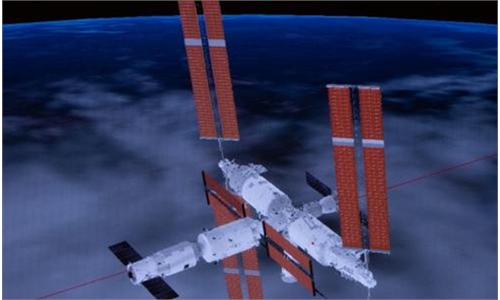
This provides theoretical support for research into dark matter and dark energy, and also offers strong support for new-generation galaxy survey programs, such as China Space Station Telescope and the European Space Agency's Euclid mission, according to the NAOC.
We are entering an era where surveys of enormous cosmological volumes have the potential to revolutionize our understanding of dark energy, cosmological inflation, and the properties of neutrinos, said Mike Boylan-Kolchin of the University of Texas at Austin, the US. The professor hailed the simulation a "computational marvel."
"For this to happen, we need advanced theoretical tools, and the HyperMillennium Simulation is a computational marvel that will help unlock fundamental physics from observations of the cosmos. It has an unprecedented range of volume and mass resolution, enabling detailed predictions about how huge numbers of relatively common galaxies are distributed across the cosmic web and the properties of inherently rare and interesting objects that are inaccessible with smaller volumes. The HyperMillennium Simulation will be a touchstone for the galaxy formation and cosmology communities for years to come," the professor said.
"The HyperMillennium simulation redefines what is nowadays possible in numerical cosmology. I am extremely impressed that the team could realize this incredibly large and highly accurate simulation. Its enormous statistical power allows us to carry out new precision test of the LambdaCDM cosmological model, something that is very important for the field," said Volker Springel, the director of the Max Planck Institute for Astrophysics in Germany.
By comparing a high-precision virtual universe with real-world observations, the HyperMillennium project provides important support for research into fundamental cosmological questions such as dark matter and dark energy, while deepening understanding of the laws governing galaxy evolution. At the same time, its simulation data will offer important scientific support for major sky survey projects, including the China Space Station Telescope, and the European Space Agency's Euclid space telescope, Wang explained.
"Although cosmological simulations may sound highly sophisticated and far from everyday life, they are in fact closely connected to the public," Wang explained. While the results of numerical simulations are essentially abstract data, they can be transformed through visualization into smooth, cinematic and visually striking images. These images can vividly show the history of cosmic evolution, large-scale structures and the formation of important celestial bodies, presenting a complete history of the universe, he said.
According to Wang, leveraging this capability, the Qianyan project has already partnered with the Beijing Planetarium, the Shanghai Astronomy Museum, several other science and technology museums, as well as institutions such as the China Academy of Art, to convert data into films, images and artistic creations for science popularization.
This approach can present the appearance of the universe to the public in a direct and credible way — supported by real data while also carrying artistic appeal. Therefore, it has positive significance in terms of both science communication and cultural outreach, he added.
RELATED ARTICLES