Blocking Chinese EVs a betrayal of US democracy
By Published: Jun 03, 2026 09:05 PM

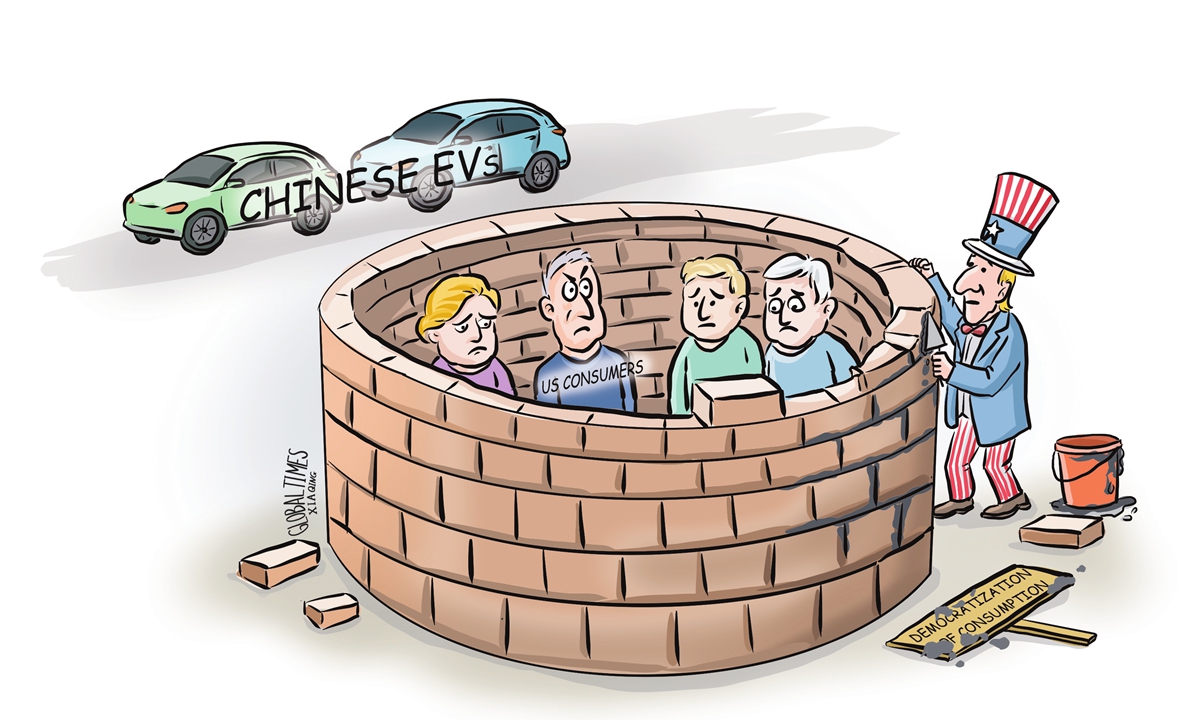
Illustration: Xia Qing/GT
"For decades, buying a new car was a milestone. Now, for many Americans, it's starting to look more like a luxury."This opening line from a CBS special report acts as a sharp scalpel, dissecting a surreal yet brutal reality of contemporary US society. In what was once proudly known as a "nation on wheels," owning a new car is devolving from a standard, expected part of everyday life for ordinary citizens into an exclusive privilege reserved for the few.
Peering beneath the surface of this commercial phenomenon into the depths of sociology and political economy reveals a thought-provoking paradox: Washington's current reliance on trade barriers to shut out Chinese automobiles may ostensibly protect domestic industries, but in reality, it is profoundly undermining the very foundations of US democracy.
To understand this logic, we must redefine the terms "democracy" and "human rights" in an everyday context. Beyond grand political narratives, democracy is far more than casting a ballot every four years, just as human rights extend beyond impassioned street corner speeches. In a modern commercial society, their most authentic and tangible manifestation is the "democratization of consumption."
This democratization of consumption means that regardless of social class or personal wealth, every individual possesses the equal right and purchasing power to enjoy the dividends of the era's most advanced industrial civilization and technological progress. The US, some 30 years ago, stood as the global beacon of this very concept.
Ever since Henry Ford made the Model T affordable for the average factory worker, the core logic of the US way of life has been leveraging mass industrial production to shatter class barriers and make a high-quality material life accessible to the general public. In that era, the automobile was the material guarantee of the right to freedom of movement and a profound symbol of civic dignity.
The US dismantles democracy. By imposing tariffs on Chinese electric vehicles (EVs), Washington claims it is protecting jobs. However, this approach shields Detroit's profits while forcing low-income citizens to subsidize corporate greed, raising car prices and class division. Is this not a betrayal of democracy and human rights?
In stark contrast, while the US erects isolationist walls across the Pacific, Chinese automakers on the other side of the ocean are spearheading a monumental global movement for "mobility equality."
Today's Chinese automotive industry has long moved past its reliance on cheap labor to cut costs. Instead, through comprehensive in-house R&D of core technologies, highly automated smart manufacturing and an incredibly robust supply chain ecosystem, it has unlocked an explosive wave of technological dividends.
What Chinese automakers are effectively doing is packing features once exclusive to top-tier luxury vehicles into vehicles that the average family can comfortably afford. This represents not just a technological triumph but a magnificent realization of technological egalitarianism.
Driven by this equality movement rooted in formidable industrial prowess, European consumers - historically known for their rigorous, even "picky" standards regarding automotive mechanical excellence - have begun to genuinely fall in love with Chinese cars.
To their pleasant surprise, European buyers are discovering that standard budgets no longer condemn them to the sparsely equipped "bare-bones" models offered by domestic brands. Chinese EVs present distinct advantages in space, features and overall value, perfectly catering to the practical needs of European families heading out for weekend getaways with heavy luggage.
Furthermore, they have earned the market's profound respect through outstanding mechanical performance and meticulous craftsmanship. When Europeans purchase Chinese vehicles today, they have long abandoned the old mindset of simply hunting for bargains associated with cheap consumer goods; instead, they are actively seeking exceptional quality built upon a foundation of ultimate cost-effectiveness.
Against the global backdrop of stubborn inflation and sluggish economic growth, Chinese automobiles offer a perfect solution for ordinary families in Europe - and indeed, around the world - to experience cutting-edge technology without emptying their life savings. This constitutes freedom from economic anxiety; it is a tangible human right that genuinely elevates the quality of life and personal happiness.
True democracy should never be built upon trade barriers designed to protect obsolete production capacities and monopolistic capital. Instead, it must be reflected in the ability of every hardworking, everyday citizen to afford a good car, allowing them to travel freely and with dignity across this increasingly expansive world.
History will ultimately prove that protectionist walls block not only foreign competitors but also the very path that leads a nation's own people toward a better life. In the end, the creations that truly resonate worldwide are invariably those dedicated to advancing equality, accessibility and well-being for all of humanity.
The author is a senior editor with the People's Daily and currently a senior fellow with the Chongyang Institute for Financial Studies at the Renmin University of China. dinggang@globaltimes.com.cn. Follow him on X @dinggangchina
RELATED ARTICLES