Inquiry launched into AUKUS deal including its impact on China-Australia ties; more Australians question sacrificing relations with Beijing for US interests: Chinese expert
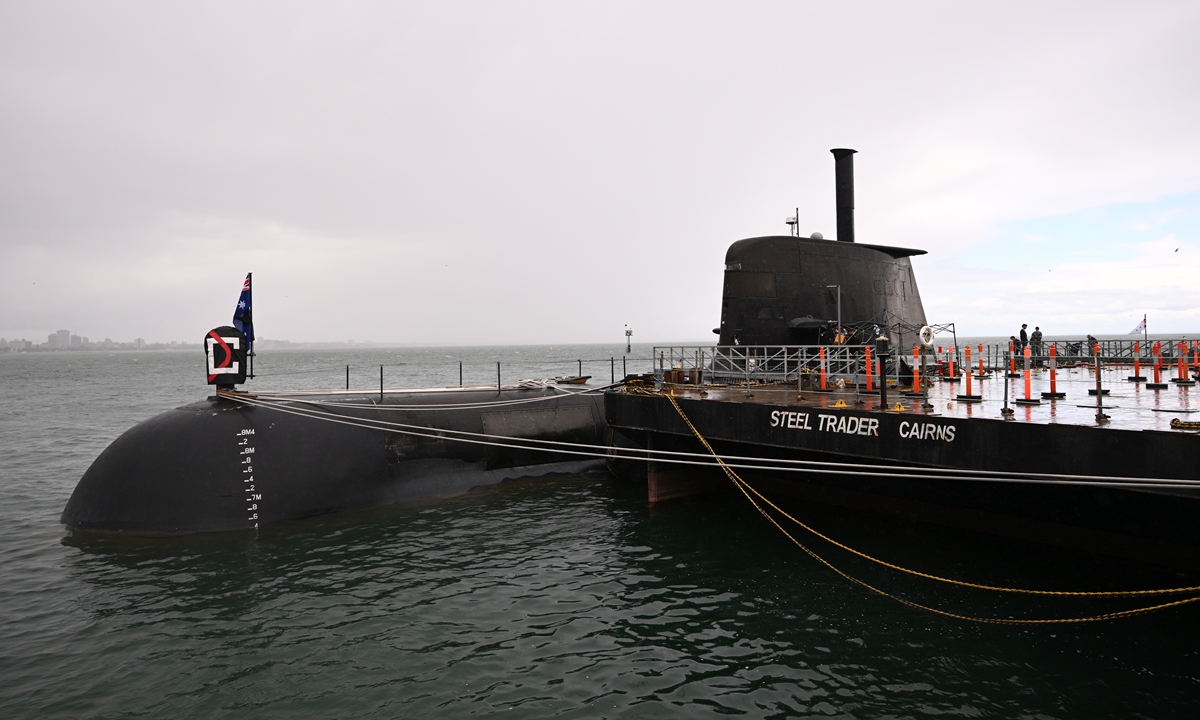
An exterior view of the HMAS Farncomb (SSG 74), a Royal Australian Navy Collins class submarine, in Melbourne, Australia, on September 4, 2025. Photo: VCG
Former Australian environment minister Peter Garrett will head up a crowd-funded review of the multi-billion-dollar AUKUS submarine deal, Australia's biggest ever defense project, with one of its questions including an examination of how the deal affects Australia's relations with China, BBC News reported. A Chinese expert said this reflects a growing number of voices within Australia questioning whether it is worthwhile to sacrifice relations with China in order to accommodate US interests.Launched by a group of Labor veterans and public figures concerned that proper scrutiny was not applied to the deal, the inquiry will hold public hearings and take written submissions before delivering a final report by October 30, the Guardian reported.
Garrett, who served as environment minister between 2007 and 2010, said the independent inquiry into the A$368 billion ($239 billion) deal - where Australia will buy second-hand US submarines to replace its ageing fleet - was "long overdue," the BBC reported.
He also said the inquiry would consider if the submarines can be delivered on time and on budget, how nuclear waste will be managed and if Australia's defense and strategic interests are well served by the deal, the Guardian reported.
This inquiry has dealt a blow to the AUKUS pact, while also reflecting concerns among some Australian Labor Party figures over the prospects of the AUKUS nuclear submarine program, its staggering costs, distrust of the US government, and the program's implications for Australia's sovereignty, Ning Tuanhui, an associate research fellow at the China Institute of International Studies, told the Global Times on Wednesday.
After Garrett's inquiry, Labor backbencher Ed Husic urged a new vote on the future of the AUKUS submarine pact, warning the deal as it stood could impact sovereignty, news outlet The Australian reported.
Ning said these developments have left the Anthony Albanese administration caught between internal rifts within its own party and relentless opposition censure, placing the government under mounting pressure from two flanks.
"This will likewise cast tangible headwinds over the administration's future efforts to advance the pact," he added.
The BBC reported that the inquiry will ask how the deal will affect Australia's relationship with China, its largest trading partner.
The inquiry specifically calls for an assessment of AUKUS's impact on China-Australia relations, indicating that some figures within Australia are rethinking whether sacrificing ties with China to align with US geopolitical objectives truly serves Australia's national interests, Chen Hong, director of the Asia-Pacific Studies Center at East China Normal University, told the Global Times.
The AUKUS deal was announced in September 2021, and while it is not explicitly stated, it is believed to be about countering China's growing presence in the so-called Indo-Pacific region, and about the South China Sea issue, according to a BBC report.
A growing number of Australians clearly see that the US prioritizes its own interests, not those of its allies, and the consensus is also deepening that relying on the Chinese market while proactively defining China as a potential adversary is a strategic contradiction, Chen added.
Concerns are growing within Australia over the US role in and commitment to the AUKUS pact. Husic warned that Australia needs a backup plan for the AUKUS submarine agreement, arguing that sluggish US production and the "transactional nature" of the current US administration have put the multibillion-dollar defense deal at risk, per BBC News.
Arthur Rorris, the secretary of the South Coast Labour Council, which opposes the establishment of a nuclear submarine base at Port Kembla, said the proposed base was never intended for Australian submarines but "would be ceded to the US navy as a staging post for their 7th fleet," the Guardian reported.
Australia's case underscores that tying one's strategic and economic fortunes to the US at steep costs may yield heightened troubles and lingering uncertainties, serving as a sobering wake-up call for Washington's other allies, Ning said.
RELATED ARTICLES