Understanding China is a required course for the likes of Fukuyama: Global Times editorial
Listen
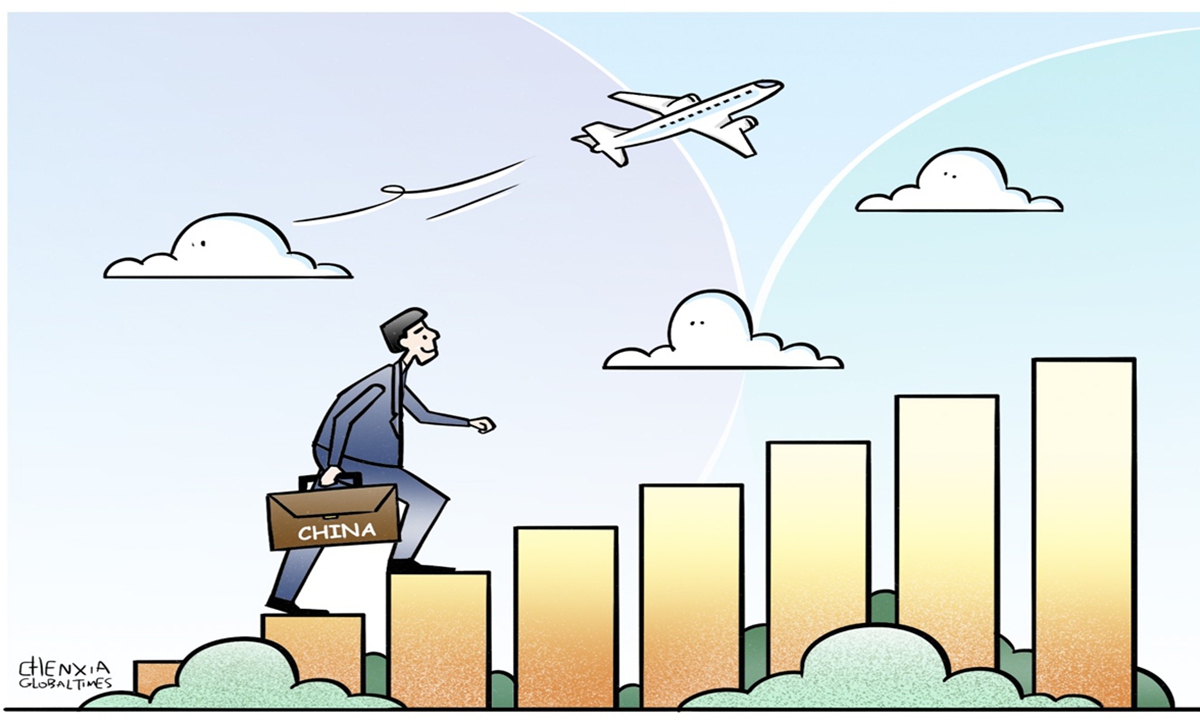
Illustration: Chen Xia/GT
US political scholar Francis Fukuyama, best known for his "End of History" thesis, recently acknowledged in an interview with the Frankfurter Allgemeine Zeitung that if China continues on its current development momentum, then the predictions he made about China four decades ago would prove to be wrong.
For Fukuyama, long regarded as one of the strongest advocates of "Western liberal democracy," this marked at least the second time in just over two months that he has publicly affirmed the "China model."
In April, he stated in a program that "the Chinese have created a pretty impressive system" and that it could become "a real alternative" to Western democracy. Although he has not completely abandoned the binary mindset of "democracy versus authoritarianism," Fukuyama's "End of History" thesis itself is undoubtedly coming to an end amid skepticism and reflection, while the "China model" is being seen, accepted, and learned from more and more around the world.
As one of the most influential political scholars, Fukuyama's "End of History" thesis has long been used by some in the West to attack socialist theories and discredit China's system. His recent shifts in attitude toward the "China model" are not isolated individual acts; they reflect a broader trend: Western intellectual elites, represented by Fukuyama, are increasingly being compelled by reality to take a fresh look at the world beyond their traditional assumptions.
Thomas Friedman, author of the book The World Is Flat, wrote that he "saw the future" in China and even suggested that some US Senators need to get out more and see the world for themselves. Jonas Nahm, a former senior economist with the White House Council of Economic Advisers, described "the power of China's political structure to command fast change from the top down" as a critical factor in its development. Within Western academic and policy circles, a cognitive shift that was once unimaginable is taking place: they have to face the fact that the so-called "Washington Consensus" is not a universal formula and that the world has not been running on the track they expected.
In reality, Western societies as a whole are undergoing a historic process of "rediscovering China." The backdrop to Fukuyama's admission of "wrong" predictions is the growing visibility, recognition, and adoption of China's achievements and China's solution on the global stage. Around the same time that Fukuyama remarked that China could become "a real alternative," a global survey conducted by Gallup in April similarly attracted widespread attention.
Covering more than 130 countries and approximately 130,000 respondents, the poll found that the approval rating of China's global leadership stood at 36 percent, surpassing the US' rating of 31 percent. It marked China's largest lead over the US in nearly two decades. Survey findings from institutions such as the Yusof Ishak Institute in Singapore, Ipsos, and Morning Consult also pointed to the same trend. This is neither accidental nor coincidental. Rather, it is a historic resonance of the world's renewed understanding of China.
The West has long been the most ideologically constrained and prejudiced against China. Almost all the pessimistic rhetoric and smears against the Chinese model and China's development achievements on the global stage come from Western societies. Yet the ideological barriers that once shaped these views are gradually eroding. A notable sign of this change is the growing popularity of China-related content on overseas, particularly Western, social media platforms.
From trends such as "China Travel" and the "Xiaohongshu cross-checking" phenomenon - which led many Western people to express amazement at the sense of safety in China - to viral topics such as "Becoming Chinese" and "Chinamaxxing" on overseas social media platforms, a large number of netizens have imitated and expressed their love for the Chinese way of life. Through these tangible and relatable ways, Chinese modernization has won over many young people in the West, and this growing wave of enthusiasm is steadily melting the hardened ice of ideology.
In a sense, it is historically inevitable that the Western intellectual community, long as the shaper of Cold War ideology, would loosen its prejudice against China, recognize China's development achievements, affirm the effectiveness of the Chinese model, and reflect on the limitations of Western democracy. Fukuyama's admission of "wrong" predictions can be seen as a sign of accelerating shift away from the state of willful ignorance that has long characterized Western intellectual circles' understanding of China, and is providing the necessary conceptual foundation for a new world order that is diverse, inclusive, and based on harmonious coexistence.
Over the past several decades, Western elites represented by Fukuyama viewed Western liberal democracy as the only path to modernization, while any attempt to pursue a different model was often labeled as an outlier or deviation from the norm. This monopoly over theory and discourse placed significant intellectual constraints on many Global South countries.
The success of Chinese modernization has not only created a miracle in the history of human development, but also brought about a profound ideological liberation to the world, breaking the myth that "modernization equals Westernization." An increasing number of Global South countries are confidently pursuing development paths tailored to their own national conditions, no longer doubting themselves or feeling inferior simply because their models differ from those of the West.
China's model is not intended to replace anyone, but rather to provide the world with more choices, giving people in all countries a stronger theoretical basis and practical reference for finding a development path that suits their own national conditions. History has not ended, and the evolution of human civilization continues. As an important participant and contributor to this process, China will continue working with all nations to write a new chapter of human development.
RELATED ARTICLES