FCC proposes new restrictions on Chinese companies in undersea internet cable; analysts say move to drive up costs for US customers
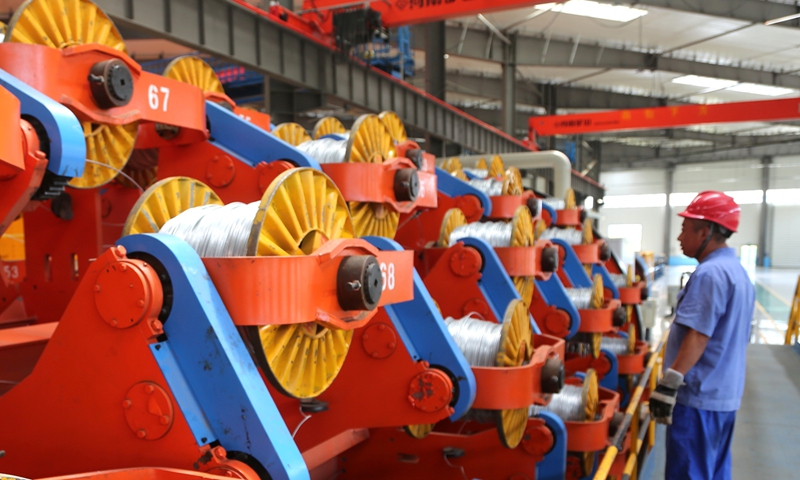
A worker produces submarine cables at a production base in Qingdao, East China's Shandong Province on August 8, 2024. The production base has been ramping up technological innovation to enhance market competitiveness in both the domestic and overseas markets. Photo: VCG
The US Federal Communications Commission (FCC) said on Wednesday it plans to propose rules that will make it harder for Chinese companies to provide equipment and fast-track approvals for trusted US tech firms, according to a Reuters report. The report noted that the new rules come amid growing national security concerns voiced by some US officials over submarine communications cables.
Chinese observers have criticized the new FCC rule as another typical example of protectionism targeting Chinese companies under the disguise of so-called "national security."The move risks isolating the US in global digital connectivity, particularly in the era of artificial intelligence (AI), and could backfire on the US economy, analysts warned, stressing the exclusion of Chinese firms - which offer products of high quality at affordable cost - will significantly drive up costs for American consumers and businesses.
The new rule is expected to expand the scope of a ban FCC issued last year, which at that time targeted specific Chinese companies — including Huawei, ZTE, China Telecom, and China Mobile — that the US listed as so-called "companies deemed to pose threats to US national security."The new rules would broaden the prohibition to cover equipment from China or any other "foreign adversary" in submarine cable systems, the Reuters report said.
According to the Reuters report, the FCC said it was planning to require licenses for the first time for operators of submarine line terminal equipment, which perform the most critical function of a submarine cable system by connecting to US terrestrial facilities. The US has established a network of more than 400 subsea cables that handle nearly all international internet traffic.
The FCC requires companies that operate cables to guard against espionage and other security incidents and strictly monitor compliance with national security and data security. Operators would also have to agree not to use foreign equipment that could pose security risks, the Reuters report said.
Zhou Mi, a senior researcher at the Chinese Academy of International Trade and Economic Cooperation, told the Global Times on Thursday that the FCC's new rule — like the previous one — lacks any factual basis or credible evidence regarding the so-called national security. He slammed the move as a typical protectionism that aims to set up entry barriers and use administrative measures to exclude high-quality market players from other countries.
The Reuters report noted that US companies such as Facebook parent Meta and Alphabet unit Google are likely to benefit from the process to get quicker approval to operate additional undersea cable systems to handle growing internet traffic.
However, Chinese industry insiders have drawn a comparison between Chinese and US suppliers. They point out that Chinese cable companies offer high-quality products at competitive costs, along with strong maintenance capabilities, giving them significant advantages in the international market.
"Thus FCC's new rule will directly reduce the range of viable options for US submarine cable projects, resulting in higher construction costs and project delays," Xiang Ligang, director-general of the Zhongguancun Modern Information Consumer Application Industry Technology Alliance, told the Global Times on Thursday.
Xiang stressed that for the US market, which urgently needs bandwidth expansion and infrastructure upgrades, this means the pace of its digital infrastructure development will be artificially slowed. "Ultimately, the first to bear the brunt will be the operational efficiency and growth potential of the US digital economy," Xiang said.
Zhou stressed that while the US remains a major information technology market, excluding Chinese players would make international coordination on the standards of undersea data transmission more difficult for other countries. In the long term, this restrictive measure is likely to further isolate the US in global information connectivity, turning it into a digital island, he warned.
RELATED ARTICLES