IN-DEPTH / IN-DEPTH
Green leap: How Kekeya in Xinjiang turns deserts into oases and ecology into economic gains
Editor's Note:
"Building an ecological civilization concerns the well-being of the people and the future of the nation."
Chinese President Xi Jinping, also general secretary of the Communist Party of China (CPC) Central Committee and chairman of the Central Military Commission, pointed out: "Respecting, adapting to, and protecting nature is essential for building China into a modern socialist country in all respects."
As outlined in the 15th Five-Year Plan (2026-2030) for national economic and social development, securing major breakthroughs in strategic tasks of overall importance to Chinese modernization and making major new progress in the Beautiful China Initiative are set as key objectives.
The Global Times is launching a series of articles titled "BeautifulChinaING." From the perspectives of the beauty of nature, the beauty of system and the beauty of lifestyle, the series uses both Chinese and international cases as entry points. Through field reporting and video storytelling, it explores how green development has become a defining feature of Chinese modernization while showcasing China's role as a responsible major country providing global public goods.
In this installment, as the World Environment Day falls on June 5, we speak with farmers in Kekeya, nestled on the northern edge of the formidable Taklimakan Desert in Xinjiang Uygur Autonomous Region. Through their stories, we catch a glimpse of how this once desolate wasteland has blossomed into a flourishing desert oasis, spawning a lucrative fruit industry that boosts local households' income.
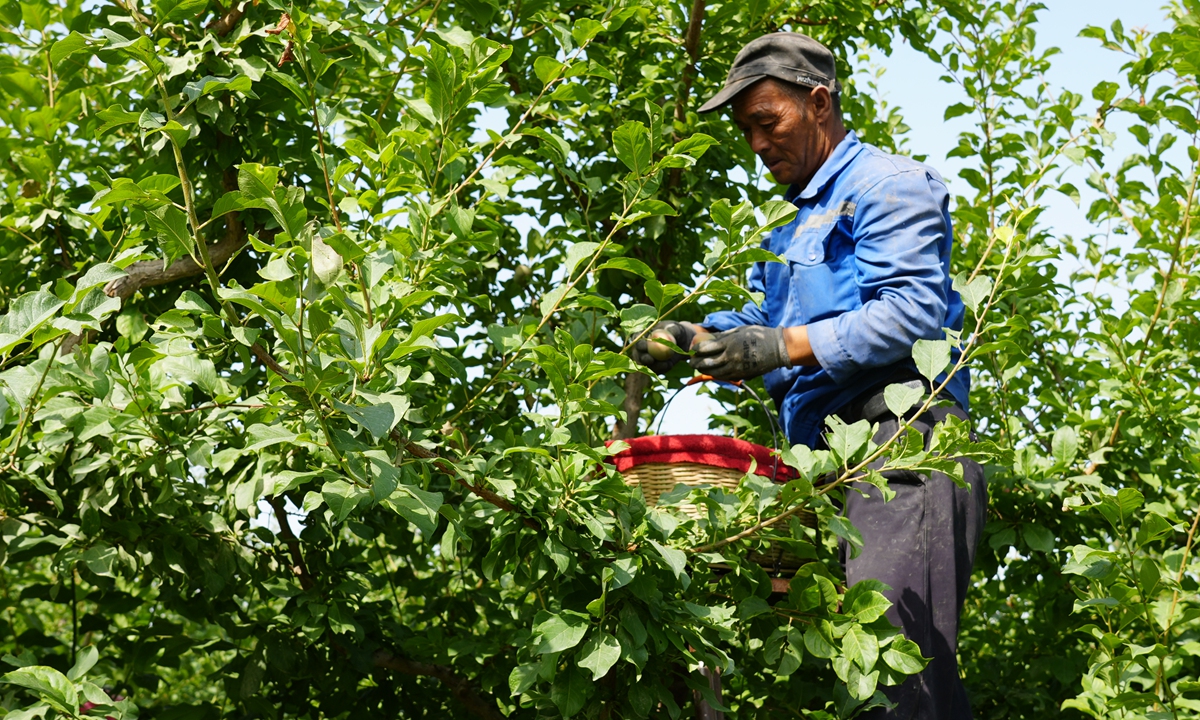
As June rolls around, apples enter the fruit bagging season. Every single day, 51-year-old local fruit farmer Xu Dewen patrols his apple groves in Kekeya, Wensu County in Aksu Prefecture, Northwest China's Xinjiang Uygur Autonomous Region. "Growing apples is no easy feat," he told the Global Times. Apparently, all the hassle in growing apples, however, melts away into pure joy whenever he watches his young fruits swell day by day.
Nestled on the northern edge of the formidable Taklimakan Desert - which is often referred to as the "Sea of Death" - Kekeya was once notorious for its tumultuous weather and ceaseless sandstorms.
When Xu first arrived here, 17 years ago, the land was barren and depleted. When seasonal winds picked up, frigid gusts whipped up towering sandstorms dozens of meters high, capable of wiping out local fruit orchards in an instant.
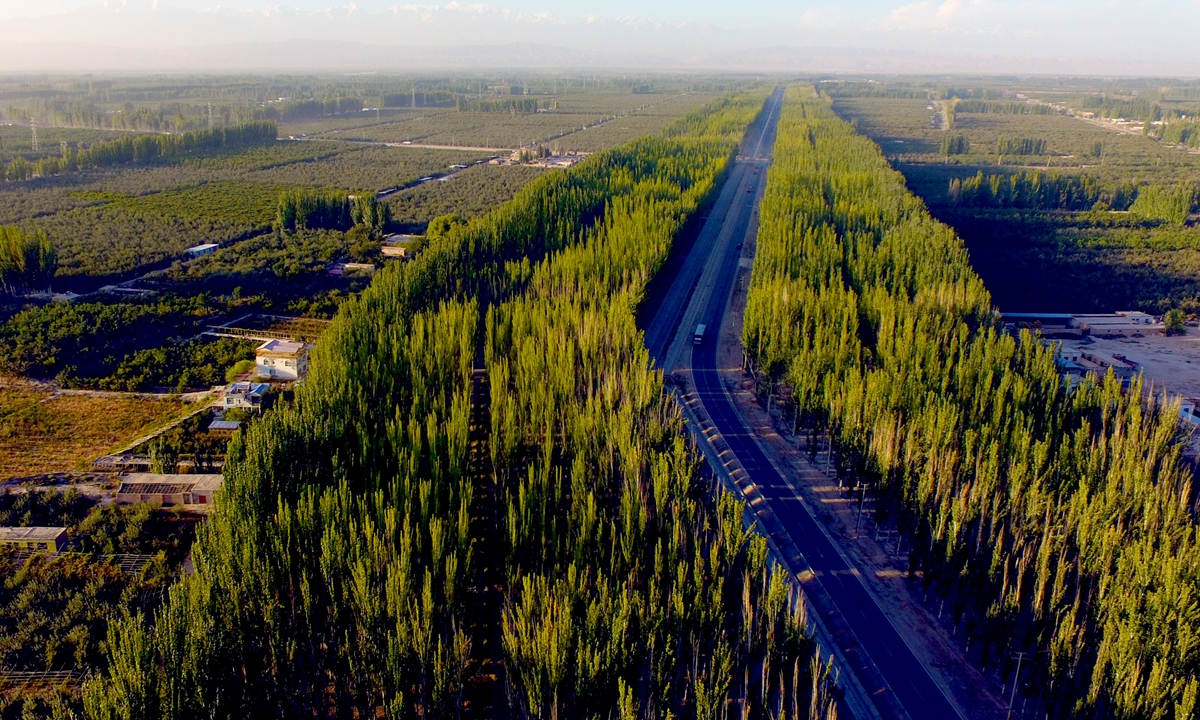
To improve local ecology and protect local farmers' orchards, in 1986, the Aksu prefecture authority launched an afforestation project in Kekeya. Over the following three decades, generations of locals pitched in to build a sprawling man-made forest spanning more than a million mu (nearly 67,000 hectares) amid endless sand dunes. This green barrier did far more than hold back desert winds: it nurtured the famed Aksu crystal sugar heart apples, alongside a thriving lineup of red dates, walnuts, apricots and other orchard crops.
Thanks to this sweeping ecological turnaround, Aksu has become a place that is famous for its fruits, forest and tourism. Once an area of barren wastelands, it is now a national benchmark for Xinjiang's ecological restoration and sustainable green growth.
Farmers like Xu, who left their hometowns to lease orchard land and join sand control efforts in Kekeya, have lived through the area's extraordinary transformation from arid desert to fertile farmland.
Sugar heart apples grown on desert
According to working staff from Wensu County, crystal sugar heart apples have an extended growing cycle and are delicate: New buds risk frost damage in spring, developing fruits suffer from wind-blown sand in summer, and ripe crops face sudden hailstorms in autumn - making successful cultivation on rocky desert terrain an uphill battle.
Xu still remembers the hardship in the early years after he started to plant apples in Kekeya. Extreme weather was the biggest problem. "From March through May, right when apple trees bloom, ferocious sandstorms would strike without warning. One brutal storm could strip blossoms off branches, leaving harvests entirely at the mercy of unpredictable weather," Xu recalled.
Poor soil quality paired with outdated farming infrastructure compounded his struggles.
Crystal sugar heart apple trees demand steady water and nutrients, yet Kekeya's soil was heavily saline, compacted and thin, unable to retain moisture or fertilizer. Saplings grew stunted, bore sparse, misshapen fruit, with low survival rates and painfully long waits before first harvests. Meanwhile, with no proven farming expertise available, early growers had to learn everything through trial and error. Windbreaks and irrigation channels were few and far between; wasteful flood irrigation drained precious water while worsening soil salinity, leaving fruit trees chronically starved of water and nutrients.
High input costs brought meager returns, year after year. Many migrant orchard owners got discouraged, packed up and left the place. Xu said he also considered giving up and leaving.
But gazing at his 18-mu apple orchard built with his blood, sweat and savings, Xu resolved to stay put. Answering the village's call for ecological renewal, he joined other farmers to plant and nurture poplars, oleasters and populus euphratica around the orchards to form windproof green belts. He also pitched in to level uneven ground, neutralize saline soil and dig irrigation ditches, enriching depleted land with organic fertilizer to gradually turn unforgiving badlands into prime apple-growing fields.
Meanwhile, Xu also worked hard to sharpen his farming skills. He signed up for free village-run agricultural workshops held by local governments and picked the brains of seasoned local growers. By day, he tracked fruit tree growth patterns in his orchard; by night, he studied frost prevention, pruning, pest control and post-storm recovery techniques, gradually mastering the fine points of growing signature crystal sugar heart apples suited to Kekeya's unique climate.
By steadily restoring the local ecosystem while refining orchard management, Xu kept his farm afloat and witnessed the desert slowly turn lush and productive.
Today, Xu's orchard brings him around 200,000 yuan ($29,520) in net profit every year. Sandstorms have become rare, limited to just a handful of days each April. Having rooted his life here for years, he says he could never bear to leave Kekeya behind.
Kinship rooted in walnuts
Xu's story is not uncommon in Kekeya. Local fruit farmers combat desertification while growing crops. They protect commercial fruit forests with shelterbelts of ecological trees and sustain ecological afforestation with earnings from cash-crop plantations. This forms a vital sustainable solution to curb desert expansion across the Aksu prefecture. It is also the bond behind Zhao Wuzhong and Muhedan Tuerxun, known as the "Walnut Brothers" among the locals, who forged their friendship through walnuts and grew prosperous thanks to the crop.
The Walnut Brothers' story traces back to 1996, when Zhao left Nanchong in Southwest China's Sichuan Province to earn a living in Xinjiang.
In 2000, Aksu rolled out a desert greening initiative backed by a favorable government policy: Whoever develops, manages, and invests in woodland reaps all the benefits. Attracted by the policy, Zhao poured all his life savings into leasing 35 mu of barren wasteland in Kekeya, planting walnut saplings alongside his hopes for a promising future.
Zhao met warm, easy-smiling Muhedan in 2001 at a fruit-growing technical training course hosted by the local government. Muhedan has decades of experience growing walnuts and Zhao often asked him questions about growing walnuts.
In 2002, as the young walnut trees were thriving, a ferocious sandstorm ravaged Zhao's orchard. Staring at broken branches and saplings buried beneath drifting sand, Zhao sank into despair and planned to return to Sichuan.
Though financially strained himself, Muhedan gave Zhao 10,000 yuan to help him get back on his feet. "I would not have come through this hard time without brother Muhedan's help," Zhao told the Global Times.
With Muhedan's encouragement and support, Zhao regained his resolve, diving deep into walnut cultivation and refining orchard management practices year after year. Zhao's walnut trees bore their first fruit in 2005, netting him 10,000 yuan. By 2007, his annual net earnings from walnuts exceeded 50,000 yuan. Thanks to upgraded management and improved cultivars, walnut yield climbed from an initial 100 kilograms to over 300 kilograms today. In the years since, Zhao has cleared all outstanding debts and bought a new apartment and a car.
Like Xu, Zhao also joined the team to afforest Kekeya. The gradually improving ecology in the area promotes full nutrient accumulation in walnuts, yielding thin-shelled, plump-kernel nuts with superior flavor and overall quality compared to past harvests.
Not only did Zhao's walnut orchard gradually develop, but also the whole local walnut industry continued to expand. According to data provided by the Wensu County government, 800,000 mu of walnut forests in the county churn out roughly 200,000 tons of nuts annually; local thin-shell walnuts deliver a kernel yield rate of up to 65 percent. Now, the county's local walnut acreage averages half a hectare per capita, and the booming fruit forest industry has brought tangible economic gains to local farmers.
'Green bank'
Decades of persistent efforts have transformed Kekeya's once barren desert into an expansive green ocean. According to the Xinhua News Agency, the region's forest coverage rate climbed from 3.35 percent in the early 1980s to 9.08 percent today, with desertified land cut by 1.4 million mu. Sandstorm-prone days dropped from over 100 annually three decades ago to roughly 30 at present, and days with good air quality account for 62.2 percent of the year. Annual rainfall has risen from 60 millimeters in the 1980s to around 120 millimeters, while ambient air humidity has increased by 17.5 percent, marking a notable upgrade in overall ecological quality.
Economic fruit plantations now make up 86 percent of the entire Kekeya Desert Afforestation Project, enabling positive, mutually reinforcing gains across ecology, economy and social welfare. As of 2022, Aksu Prefecture boasted 4.5 million mu of land under featured fruit cultivation; local farmers earned an average of 5,669 yuan from fruit growing per capita, accounting for 26.25 percent of their total annual net income, according to Xinhua.
Through years of continuous efforts and struggles, Kekeya's green transformation goes beyond restoring local ecosystems: the fruit industry has evolved into a sustainable "green bank" that generates steady earnings, with premium products such as walnuts, Aksu crystal sugar heart apples, and red jujubes gaining widespread recognition.
Once a barren expanse, Aksu has also become a popular camping destination for travelers all over the country. Xu said as the tourism industry grows in recent years, he is exploring integrating his apple orchard with the tourism market, including pick-your-own services.
The Walnut Brothers also have their own plans. The pair have co-launched their own walnut brand, Wenbalang. They also aim to expand cultivation, setting up a farmers' cooperative. "We want to lead more local villagers to earn wealth and prosperity in this desert oasis in Kekeya," Zhao told the Global Times.
"Building an ecological civilization concerns the well-being of the people and the future of the nation."
Chinese President Xi Jinping, also general secretary of the Communist Party of China (CPC) Central Committee and chairman of the Central Military Commission, pointed out: "Respecting, adapting to, and protecting nature is essential for building China into a modern socialist country in all respects."
As outlined in the 15th Five-Year Plan (2026-2030) for national economic and social development, securing major breakthroughs in strategic tasks of overall importance to Chinese modernization and making major new progress in the Beautiful China Initiative are set as key objectives.
The Global Times is launching a series of articles titled "BeautifulChinaING." From the perspectives of the beauty of nature, the beauty of system and the beauty of lifestyle, the series uses both Chinese and international cases as entry points. Through field reporting and video storytelling, it explores how green development has become a defining feature of Chinese modernization while showcasing China's role as a responsible major country providing global public goods.
In this installment, as the World Environment Day falls on June 5, we speak with farmers in Kekeya, nestled on the northern edge of the formidable Taklimakan Desert in Xinjiang Uygur Autonomous Region. Through their stories, we catch a glimpse of how this once desolate wasteland has blossomed into a flourishing desert oasis, spawning a lucrative fruit industry that boosts local households' income.
An aerial view of the afforest project in Kekeya, the Wensu County in Aksu Prefecture, Northwest China's Xinjiang Uygur Autonomous Region Photo: VCG
As June rolls around, apples enter the fruit bagging season. Every single day, 51-year-old local fruit farmer Xu Dewen patrols his apple groves in Kekeya, Wensu County in Aksu Prefecture, Northwest China's Xinjiang Uygur Autonomous Region. "Growing apples is no easy feat," he told the Global Times. Apparently, all the hassle in growing apples, however, melts away into pure joy whenever he watches his young fruits swell day by day.
Nestled on the northern edge of the formidable Taklimakan Desert - which is often referred to as the "Sea of Death" - Kekeya was once notorious for its tumultuous weather and ceaseless sandstorms.
When Xu first arrived here, 17 years ago, the land was barren and depleted. When seasonal winds picked up, frigid gusts whipped up towering sandstorms dozens of meters high, capable of wiping out local fruit orchards in an instant.
To improve local ecology and protect local farmers' orchards, in 1986, the Aksu prefecture authority launched an afforestation project in Kekeya. Over the following three decades, generations of locals pitched in to build a sprawling man-made forest spanning more than a million mu (nearly 67,000 hectares) amid endless sand dunes. This green barrier did far more than hold back desert winds: it nurtured the famed Aksu crystal sugar heart apples, alongside a thriving lineup of red dates, walnuts, apricots and other orchard crops.
Thanks to this sweeping ecological turnaround, Aksu has become a place that is famous for its fruits, forest and tourism. Once an area of barren wastelands, it is now a national benchmark for Xinjiang's ecological restoration and sustainable green growth.
Farmers like Xu, who left their hometowns to lease orchard land and join sand control efforts in Kekeya, have lived through the area's extraordinary transformation from arid desert to fertile farmland.
Sugar heart apples grown on desert
According to working staff from Wensu County, crystal sugar heart apples have an extended growing cycle and are delicate: New buds risk frost damage in spring, developing fruits suffer from wind-blown sand in summer, and ripe crops face sudden hailstorms in autumn - making successful cultivation on rocky desert terrain an uphill battle.
Xu still remembers the hardship in the early years after he started to plant apples in Kekeya. Extreme weather was the biggest problem. "From March through May, right when apple trees bloom, ferocious sandstorms would strike without warning. One brutal storm could strip blossoms off branches, leaving harvests entirely at the mercy of unpredictable weather," Xu recalled.
Poor soil quality paired with outdated farming infrastructure compounded his struggles.
Crystal sugar heart apple trees demand steady water and nutrients, yet Kekeya's soil was heavily saline, compacted and thin, unable to retain moisture or fertilizer. Saplings grew stunted, bore sparse, misshapen fruit, with low survival rates and painfully long waits before first harvests. Meanwhile, with no proven farming expertise available, early growers had to learn everything through trial and error. Windbreaks and irrigation channels were few and far between; wasteful flood irrigation drained precious water while worsening soil salinity, leaving fruit trees chronically starved of water and nutrients.
High input costs brought meager returns, year after year. Many migrant orchard owners got discouraged, packed up and left the place. Xu said he also considered giving up and leaving.
But gazing at his 18-mu apple orchard built with his blood, sweat and savings, Xu resolved to stay put. Answering the village's call for ecological renewal, he joined other farmers to plant and nurture poplars, oleasters and populus euphratica around the orchards to form windproof green belts. He also pitched in to level uneven ground, neutralize saline soil and dig irrigation ditches, enriching depleted land with organic fertilizer to gradually turn unforgiving badlands into prime apple-growing fields.
Meanwhile, Xu also worked hard to sharpen his farming skills. He signed up for free village-run agricultural workshops held by local governments and picked the brains of seasoned local growers. By day, he tracked fruit tree growth patterns in his orchard; by night, he studied frost prevention, pruning, pest control and post-storm recovery techniques, gradually mastering the fine points of growing signature crystal sugar heart apples suited to Kekeya's unique climate.
By steadily restoring the local ecosystem while refining orchard management, Xu kept his farm afloat and witnessed the desert slowly turn lush and productive.
Today, Xu's orchard brings him around 200,000 yuan ($29,520) in net profit every year. Sandstorms have become rare, limited to just a handful of days each April. Having rooted his life here for years, he says he could never bear to leave Kekeya behind.
An apple farmer works in an orchard in Kekeya, Wensu County in Aksu, Xinjiang. Photo: Courtesy of Wensu County government
Kinship rooted in walnuts
Xu's story is not uncommon in Kekeya. Local fruit farmers combat desertification while growing crops. They protect commercial fruit forests with shelterbelts of ecological trees and sustain ecological afforestation with earnings from cash-crop plantations. This forms a vital sustainable solution to curb desert expansion across the Aksu prefecture. It is also the bond behind Zhao Wuzhong and Muhedan Tuerxun, known as the "Walnut Brothers" among the locals, who forged their friendship through walnuts and grew prosperous thanks to the crop.
The Walnut Brothers' story traces back to 1996, when Zhao left Nanchong in Southwest China's Sichuan Province to earn a living in Xinjiang.
In 2000, Aksu rolled out a desert greening initiative backed by a favorable government policy: Whoever develops, manages, and invests in woodland reaps all the benefits. Attracted by the policy, Zhao poured all his life savings into leasing 35 mu of barren wasteland in Kekeya, planting walnut saplings alongside his hopes for a promising future.
Zhao met warm, easy-smiling Muhedan in 2001 at a fruit-growing technical training course hosted by the local government. Muhedan has decades of experience growing walnuts and Zhao often asked him questions about growing walnuts.
In 2002, as the young walnut trees were thriving, a ferocious sandstorm ravaged Zhao's orchard. Staring at broken branches and saplings buried beneath drifting sand, Zhao sank into despair and planned to return to Sichuan.
Though financially strained himself, Muhedan gave Zhao 10,000 yuan to help him get back on his feet. "I would not have come through this hard time without brother Muhedan's help," Zhao told the Global Times.
With Muhedan's encouragement and support, Zhao regained his resolve, diving deep into walnut cultivation and refining orchard management practices year after year. Zhao's walnut trees bore their first fruit in 2005, netting him 10,000 yuan. By 2007, his annual net earnings from walnuts exceeded 50,000 yuan. Thanks to upgraded management and improved cultivars, walnut yield climbed from an initial 100 kilograms to over 300 kilograms today. In the years since, Zhao has cleared all outstanding debts and bought a new apartment and a car.
Like Xu, Zhao also joined the team to afforest Kekeya. The gradually improving ecology in the area promotes full nutrient accumulation in walnuts, yielding thin-shelled, plump-kernel nuts with superior flavor and overall quality compared to past harvests.
Not only did Zhao's walnut orchard gradually develop, but also the whole local walnut industry continued to expand. According to data provided by the Wensu County government, 800,000 mu of walnut forests in the county churn out roughly 200,000 tons of nuts annually; local thin-shell walnuts deliver a kernel yield rate of up to 65 percent. Now, the county's local walnut acreage averages half a hectare per capita, and the booming fruit forest industry has brought tangible economic gains to local farmers.
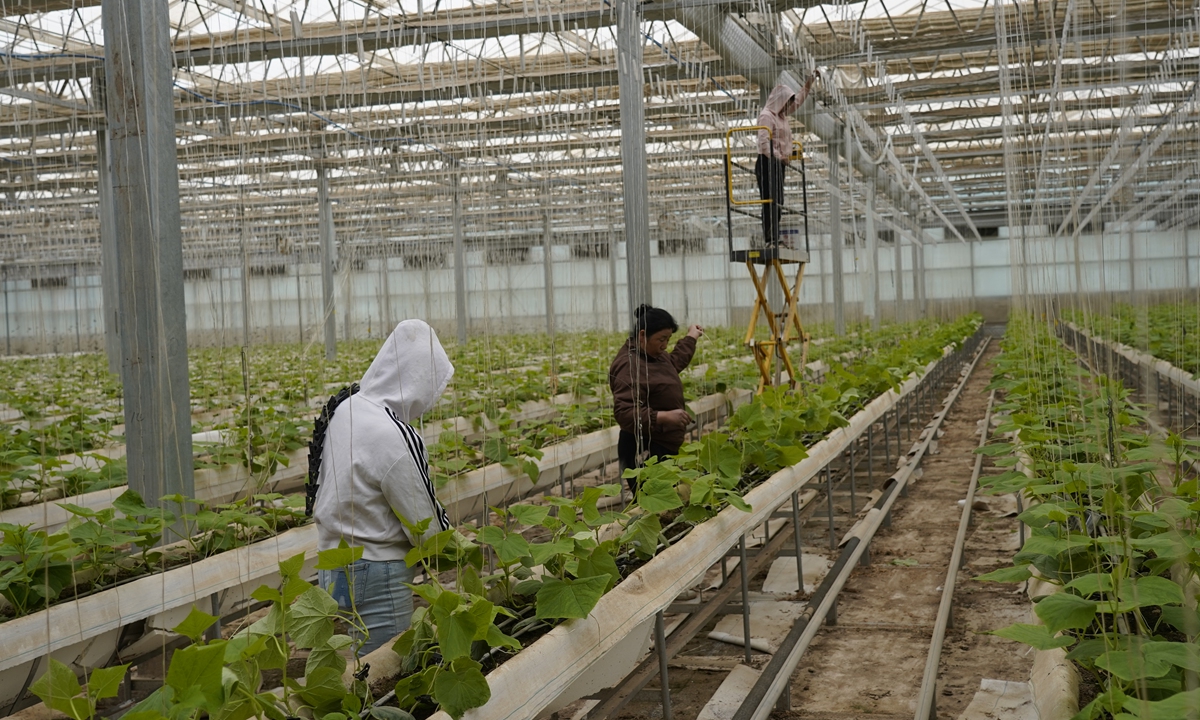
Fruit farmers work in greenhouses in Kekeya, Wensu County in Aksu Xinjiang. Photo: Courtesy of Wensu County government
'Green bank'
Decades of persistent efforts have transformed Kekeya's once barren desert into an expansive green ocean. According to the Xinhua News Agency, the region's forest coverage rate climbed from 3.35 percent in the early 1980s to 9.08 percent today, with desertified land cut by 1.4 million mu. Sandstorm-prone days dropped from over 100 annually three decades ago to roughly 30 at present, and days with good air quality account for 62.2 percent of the year. Annual rainfall has risen from 60 millimeters in the 1980s to around 120 millimeters, while ambient air humidity has increased by 17.5 percent, marking a notable upgrade in overall ecological quality.
Economic fruit plantations now make up 86 percent of the entire Kekeya Desert Afforestation Project, enabling positive, mutually reinforcing gains across ecology, economy and social welfare. As of 2022, Aksu Prefecture boasted 4.5 million mu of land under featured fruit cultivation; local farmers earned an average of 5,669 yuan from fruit growing per capita, accounting for 26.25 percent of their total annual net income, according to Xinhua.
Through years of continuous efforts and struggles, Kekeya's green transformation goes beyond restoring local ecosystems: the fruit industry has evolved into a sustainable "green bank" that generates steady earnings, with premium products such as walnuts, Aksu crystal sugar heart apples, and red jujubes gaining widespread recognition.
Once a barren expanse, Aksu has also become a popular camping destination for travelers all over the country. Xu said as the tourism industry grows in recent years, he is exploring integrating his apple orchard with the tourism market, including pick-your-own services.
The Walnut Brothers also have their own plans. The pair have co-launched their own walnut brand, Wenbalang. They also aim to expand cultivation, setting up a farmers' cooperative. "We want to lead more local villagers to earn wealth and prosperity in this desert oasis in Kekeya," Zhao told the Global Times.
RELATED ARTICLES