China to cut retail prices of gasoline, diesel starting Friday, second reductions this year
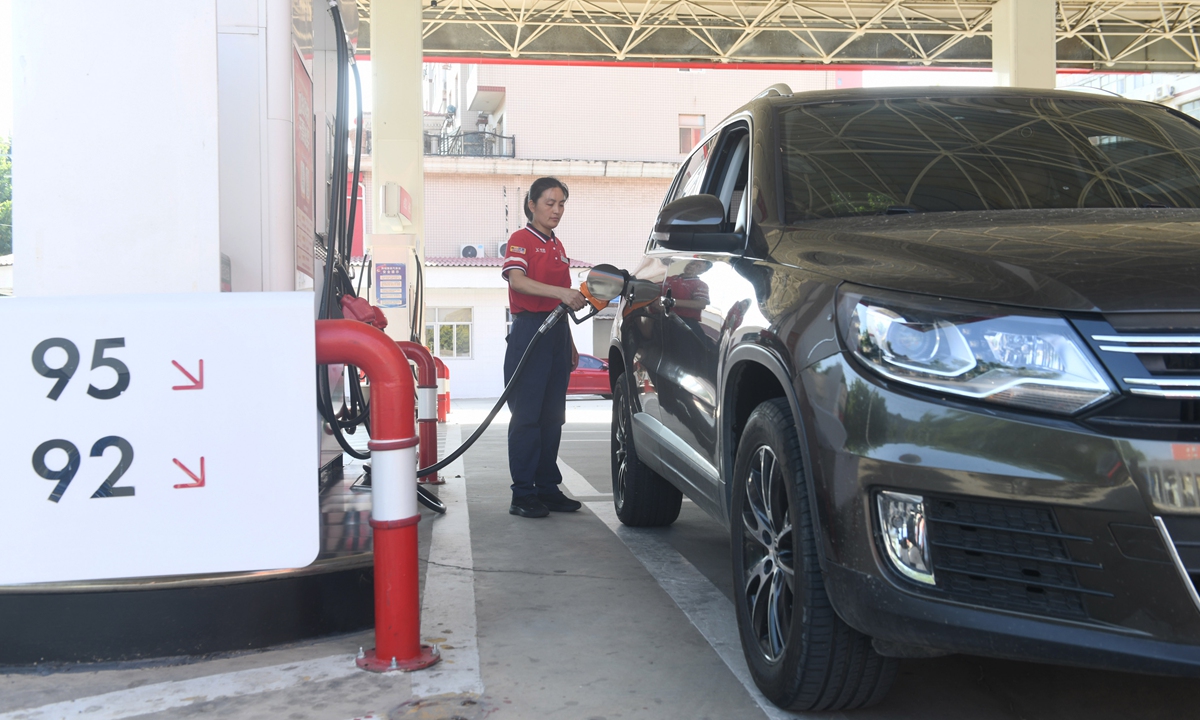
A worker refuels a car at a gas station in Shijiazhuang, North China's Hebei Province on June 4, 2026. Photo: VCG
According to the NDRC, since the domestic refined oil price adjustment on May 21, international crude oil prices have fluctuated downward and recently shown some recovery. In accordance with the changes in international oil prices, starting from Friday, the domestic prices of gasoline and diesel will be reduced by 525 yuan ($77.55) per ton and 505 yuan per ton, respectively.
On a national average, 92-octane gasoline, 95-octane gasoline, and 0# diesel prices have been reduced by 0.41 yuan, 0.44 yuan, and 0.43 yuan per liter respectively. Filling up a 50-liter tank with 92-octane gasoline will save 20.5 yuan, CMG reported.
The NDRC said that China National Petroleum Corporation, China Petrochemical Corporation, China National Offshore Oil Corporation, and other crude oil processing enterprises are required to properly organize the production and distribution of refined oil products, ensure stable market supply, and strictly implement national price policies. Relevant local authorities should strengthen market supervision and inspection, severely punish any behavior that fails to comply with national price policies, and maintain normal market order.
Since the beginning of this year, affected by geopolitical conflicts, international energy prices have surged significantly. While some countries have experienced soaring oil prices and supply shortages, China's energy resource supply has remained stable and orderly, demonstrating strong resilience, CMG said.
Tian Lei, director of the economic center at the energy research institute of the Academy of Macroeconomic Research, said in the CMG report that China has diversified oil and gas import sources and sufficient corporate inventories. The vast market's flexibility and regulatory capacity have effectively mitigated short-term fluctuations.
China has established a large-scale petroleum strategic reserve, which has stabilized market expectations, Tian said, noting that the country's energy strategy is based on domestic sources.
According to Tian, the energy self-sufficiency rate has remained above 80 percent for a long time, the installed capacity of renewable energy power generation accounts for over 60 percent, and its share of total electricity generation is around 35 percent.
"Renewable energy is accelerating its transition to become a major energy source. China firmly holds its energy security in its own hands," Tian noted.
Global Times
RELATED ARTICLES