China’s ‘new-energy plus electrification’ strategy forms buffer against crude supply shocks
Nation’s new energy plus electrification strategy forms buffer against crude supply shocks
By Yang Shasha, and Song Shengxia Published: May 15, 2026 09:54 PM
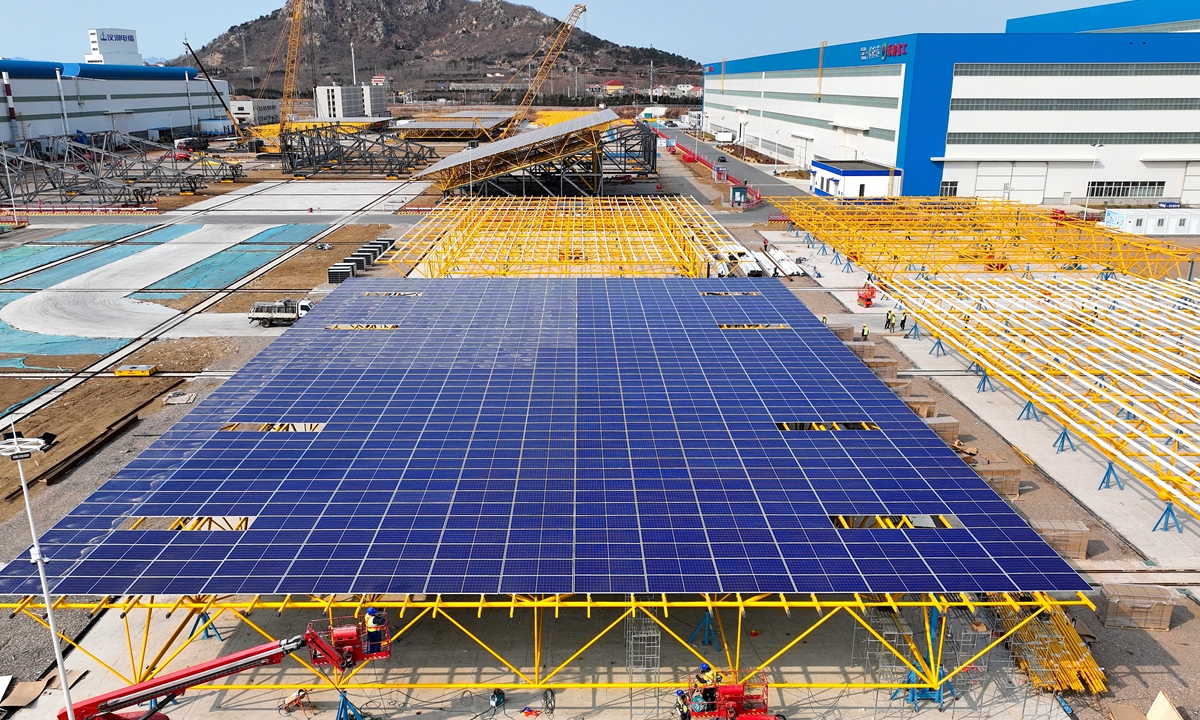
Workers assemble photovoltaic panels at an offshore photovoltaic project on February 18, 2025 in Qingdao, East China's Shandong Province. File photo: VCG
Editor's Note:
China is demonstrating remarkable resilience in the face of international energy shocks. From electric heavy-duty trucks shuttling back and forth in the mining areas in Central China to the major natural gas pipeline artery running through Central Asia, and to the cooperation between Chinese and Western energy companies - a tectonic energy transformation is taking place. This is not merely a transition in energy technology but also a journey of transformation and development for China's energy industry, moving from self-transformation to collaboration and now toward leading global transformation. Experts interviewed by the Global Times believe that against the backdrop of global geopolitical turbulence and profound shifts in the energy supply landscape, China, through its coordinated strategy of new-energy development and electrification, has carved out a unique path that balances development needs with energy security. This path is also providing valuable experience and insights to countries around the world.
In a phosphate mine in Yichang, Central China's Hubei Province, a total of 50 electric heavy-duty trucks made by Dongfeng Motor Corporation are transporting materials back and forth in the pit.
Since the mine officially launched China's first "zero-carbon mine transportation corridor" around August 2025, the trucks are entirely powered by electricity, rather than diesel fuel.
"These 'electric giants' require only two hours of charging to operate fully loaded for eight consecutive hours, with each vehicle reducing carbon emissions by approximately 60 tons annually. The entire fleet is projected to cut emissions by about 3,000 tons per year," a company representative with Dongfeng Motors Corporation told the Global Times on Thursday.
An electrification wave that offers a buffer
Such example of transport electrification is not alone in China. As a major consumer of fossil fuels such as oil and diesel, industrial transport vehicles in China are being gradually replaced with electric ones in a shift that has reduced reliance on fossil fuels.
Meanwhile, at an inland river port in East China's Jiangsu Province, a total of 36 XCMG pure electric dump trucks have replaced conventional diesel-engine-powered heavy-duty trucks, shuttling between docks, storage yards, and transfer points. Their energy costs have plummeted by 47 percent compared to diesel trucks, saving a single fleet over 2 million yuan ($294,000) in annual operating costs for the port, per a post on the Chinese engineering equipment maker's website in December, 2025.
In addition to the country's new-energy vehicle fleet, which is the world's largest, from mines to ports, oil consumption is being redefined in China. The case has not gone unnoticed by international media outlets.
The DW, in a report dated May 9, noted that the conflict in Iran has sparked the biggest energy shock yet, forcing Asia to rethink oil and gas, and "China's electrostate model suddenly looks like the future."
Yasir Habib Khan, president of the Institute of International Relations and Media Research in Pakistan, told the Global Times on Thursday that after turbulence in the Strait of Hormuz exposed the risks of oil supply disruptions, a grim reality has been sensitized that if efforts are not intensified to help switch traditional energy sources with new alternative energy dynamics, dream of global energy security will falter.
Lu Ruquan, president of the CNPC Economics and Technology Research Institute, told the Global Times on Thursday that the current situation in the Strait of Hormuz has evolved in unexpected ways, rattling the global energy sector and intensifying discussions over energy security.
"Among the world nations, China has set an example of becoming first electro-state from Petrostate by super-igniting its economy with solar, wind, hydro and battery storage infrastructure with minimizing its dependency on fossil fuel," Khan said.
"Yet, for China, the issue of energy security is highly sensitive, but we are not vulnerable," Lu said.
Lu said that China's energy stability reflects three underlying factors that are intertwined and work together to safeguard against extreme scenarios: ample domestic energy production, substantial strategic reserves, and overseas operations that are performing well.
"Of course, more importantly, China's new-energy sector is also rapidly expanding."
Analysts believe that the essence of China's energy security being "sensitive but not vulnerable" lies in the country having one of the world's best energy substitution capabilities. Deep electrification has reshaped China's energy security framework, enabling China to maintain strategic focus amid volatile geopolitical situations.
Against the backdrop of geopolitical turbulence and disruptions to global energy supply chains stemming from tensions in the Strait of Hormuz, China has forged a distinctive path that balances development needs with energy security through a coordinated "new energy plus electrification" strategy - a path that now offers valuable lessons for nations worldwide, analysts said.
Path of cooperation
Lu, who grew up in rural areas in East China's Jiangsu Province, still remembers studying in the 1970s and 1980s by the flickering light of a kerosene lamp with a curvy glass chimney, once widely used in the country. The fragile yet indispensable lamps were once sold in China by US oil giant Standard Oil, which entered the Chinese market a century ago with the slogan "Oil for China's Lamps."
After China's reform and opening-up, Standard Oil returned to China as ExxonMobil. In 2007, it formed a joint venture with Sinopec, Saudi Aramco, and the Fujian provincial government to build an integrated refining and ethylene project - China's first fully integrated Chinese-foreign project in refining, chemicals, and marketing. In 2020, ExxonMobil launched a $10 billion wholly owned ethylene project in Huizhou, South China's Guangdong Province, which came on stream in 2025.
Lu noted that China and the US have never had a direct structural rivalry in the energy sector; rather, they have experienced a "differentiated competition." When the US was the world's largest oil importer, China's economy was still small; when China became the largest importer, the US had turned into a major exporter, creating a complementary resource-and-market relationship.
Moreover, the two countries' cooperation in third markets is significant, covering regions from South America to Middle East. In Guyana's Stabroek block, ExxonMobil, Hess Corp, and Chinese energy major CNOOC have made a series of major deepwater oil discoveries, with daily output reaching about 650,000 barrels per day and expected to exceed 1.3 million barrels per day by the end of 2027. Such cases demonstrate strong commercial ties and rational cooperation that transcend short-term political volatility.
As the global energy transition deepens, dependence on critical minerals such as copper, lithium and cobalt is pushing countries worldwide to deepen their cooperation.
Jin Lei, a professor at China University of Petroleum, told the Global Times on Friday that China is transforming from a pure resource buyer into a core participant in the supply chain. Leveraging its strong smelting and processing capabilities for rare earths and other resources, as well as its advantages across the downstream industrial chain, China is not only involved in overseas mining investment and development but also helps resource-rich countries extend their local value chains through technology exports and infrastructure construction, thereby strengthening the resilience and stability of global critical mineral supply chains.
Cross-border pipeline
While the tension around the Strait of Hormuz continues, another cross-border energy artery - the China-Central Asia natural gas pipeline - has operated safely for 17 years.
Launched in December 2009, it binds four countries (China, Turkmenistan, Uzbekistan, and Kazakhstan) on a single platform. Its pipeline operation coordination committee, with a permanent secretariat, meets every six months to align data, scheduling, and issue resolution - a compelling example of multilateral energy governance.
In Iraq, the Halfaya oilfield project, led by CNPC together with Malaysia's Petronas and France's Total, shows another model. Rather than seeking full control, the Chinese side formed an international joint operating body, integrating Chinese technology, services, and manufacturing capacity. It achieved the fastest and best execution among all peer projects in Iraq, becoming a model for post-war reconstruction.
During the massive blackout in Spain last year, European peers frequently asked Chinese experts a question: "With China adding over 430 million kilowatts of wind and solar capacity in a single year - more than coal - how do you keep the grid so stable?"
A senior expert in China's power system told the Global Times on Friday on condition of anonymity that China's answer lies in using coal-fired power for peak shaving and leveraging energy storage facilities.
"Like a cow with multiple stomachs, when renewable energy is abundant, we store the excess; when renewables dip, we release from storage and ramp up coal-fired power," the expert said, noting that China is willing to share its experience in stabilizing grids and lowering costs, while remaining open to learning from others.
"Although countries may have differences over specific technical pathways, the overall trend is one of cooperation and exchanges," the expert emphasized. "China has lowered the barrier to global green transition through its technological contributions. We are willing to share 'China's experience' in stabilizing power grids and reducing costs, while always maintaining an attitude of mutual learning."
"Chinese economic survivability has inspired many Asian developing nations, especially Pakistan, to insulate its economy against oil shocks," Khan said.
"Pakistan is among the beneficiaries of affordable, high-quality Chinese-made solar panels and systems. Over the last few years, Pakistan's solarization has helped the country save more than $12 billion in fuel imports. At current market prices, this would also help the country save about $6.3 billion this year," Khan said.
China is now undergoing a new phase of energy transition, moving from fossil fuels to a low‑carbon or even zero‑carbon system. By leveraging its vast domestic market to build industrial competitiveness, China has propelled the entire photovoltaic (PV), battery, and electric vehicle (EV) value chains onto the global stage, analysts said.
According to a report by the CNPC ETRI in December 2025, China, as the world's largest energy producer and consumer, as well as a leader in green technology, is steadily contributing to a fair, balanced and inclusive global energy governance system.
The nation is becoming a stabilizer for global energy security, a bridge for the green transition, and a source of innovation for the future of global energy, the report said.
From electric heavy-duty trucks operating in mining areas to photovoltaic panels sailing across oceans, and to energy-storage power stations in the deserts of Africa, "Made in China" has become a fundamental enabler of the global energy transformation.
The new-energy-plus-electrification revolution, spearheaded by China, is reshaping the global energy landscape.
RELATED ARTICLES