Asia’s economic engine continues to gain steam, fueled by regional integration, innovation
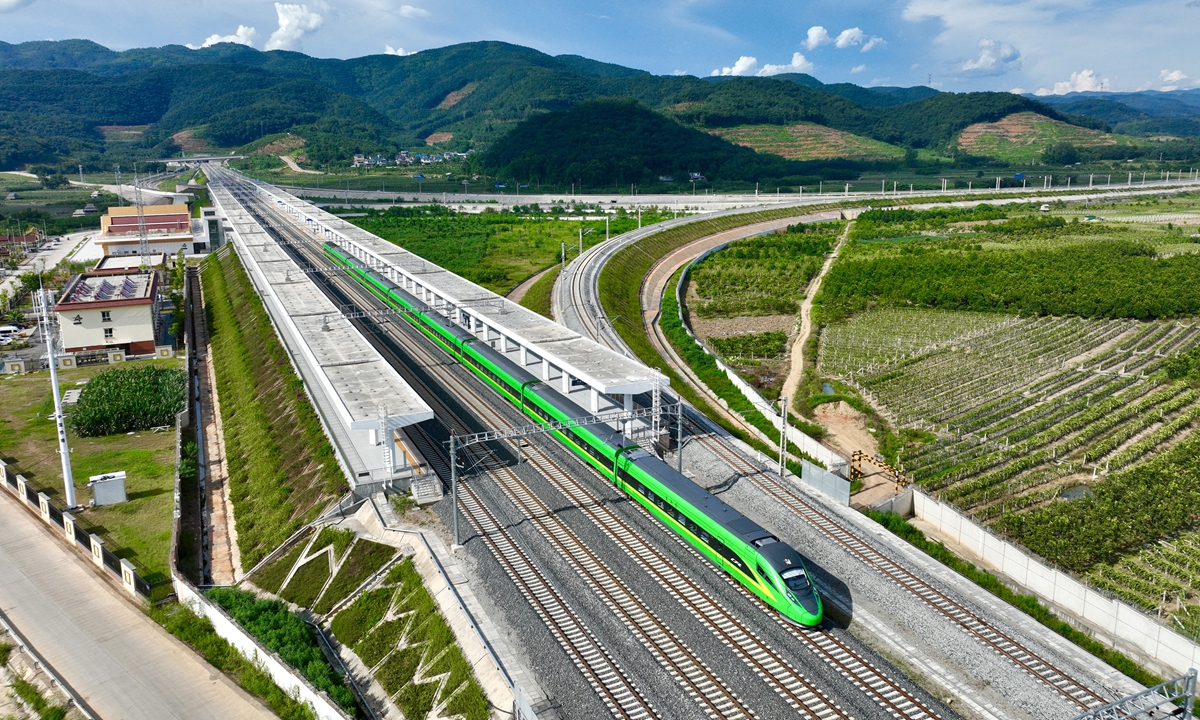
A bullet train runs along the China-Laos Railway. File photo: VCG
Editor's Note:
As the main driver of global growth, with an expansion of 5 percent last year, Asia's economic growth is drawing global attention. But the tense situation in the Strait of Hormuz continues to disrupt energy supplies, impacting Asia's economic resilience. In a recent interview, the Global Times (GT) spoke with Ong Tee Keat (OTK), president of the Belt and Road Initiative (BRI) Caucus for Asia-Pacific and former deputy speaker of the lower house of the Malaysian Parliament, discussing Asia's changing economic growth pattern, the deepening ties among Asian countries, and the region's economic outlook at a time when the global economy faces rising uncertainties.
GT: Do you think China-ASEAN cooperation is evolving beyond traditional trade to a deeper stage of industrial, supply-chain and economic integration? What does this mean for Asia's broader economic outlook?
OTK: Absolutely. China-ASEAN cooperation has been evolving far beyond the traditional trade in goods, although bilateral trade remains robust. Having reoriented supply chains across the region after the COVID-19 outbreak, a strategy that encompasses a China-centric production network with synergistic division of labor across Southeast Asia is witnessing the gradual co-evolution of an integrated economic ecosystem. The integrated supply chain is envisaged to entail research and development alongside high-end component manufacturing in China, assembly and packaging in one of the ASEAN member states such as Malaysia or Vietnam, before products are ready to be shipped to markets across the region and beyond.
For Asia, this means the growth engine is shifting from pure export orientation to one driven by regional demand and collaborative innovation. Asia is becoming not just a factory for the world, but a self-sustaining organism with a huge consumer market, complete supply chains, and considerable innovative power. This dramatically enhances the region's resilience to external shocks and anchors its role as a stabilizer for global economic growth.
GT: As the development of the China-ASEAN Free Trade Area version 3.0 continues to advance, how do you view the opportunities emerging in areas such as the green economy, digital economy and regional innovation cooperation?
OTK: The China-ASEAN Free Trade Area version 3.0 goes beyond mere tariff reduction. With the emphasis on digital trade, green transformation and e-commerce, the upgraded FTA is poised to turn the region into a potential incubator for tomorrow's economy, instead of purely harnessing its market potential for Chinese products.
In the digital economy, beyond market access lie core opportunities in rule-making and cross-border data flow facilitation.
Similarly, the green transformation is set to herald a new era for Southeast Asia, characterized by co-creation of green standards, carbon markets and energy infrastructure, following the influx of Chinese green products into the region.
In recent years, nickel processing by Chinese companies in nickel-rich Indonesia has ignited interest in investments in green resources in some ASEAN member states, paving way for the new battery supply chain to take shape in Southeast Asia.
Parallel to this, the coming onshore of Chinese e-commerce platforms, mobile payment technology, and cloud services is envisaged to facilitate millions of ASEAN small and medium-sized enterprises plugging into the global digital economy.

Ong Tee Keat. Photo: Courtesy of OTK
GT: Chinese consumer brands such as HEYTEA, Mixue and Pop Mart are increasingly being seen as lifestyle and cultural brands among younger generations in other Asian countries. What does this shift reveal about changing consumption trends across Asia?
OTK: The paradigm shift in favor of Chinese consumer and cultural brands among young people in Asia marks the enhanced acceptability of Chinese brands in a market that has long been dominated by Western brands. It's a manifestation of resonance with an Eastern lifestyle and aesthetic, alongside cultural confidence, catalyzed by the growing soft power and economic prowess of China across the world.
It also points to a reconstruction of social capital where consuming these brands has become a form of social currency representing trendiness and personality, in addition to providing objects for emotional attachment.
GT: Chinese companies are increasingly bringing technology, digital platforms and localized operations to Southeast Asia. How could this influence the region's long-term industrial upgrading and economic competitiveness?
OTK: The Chinese companies venturing into Southeast Asia are generally expected to bring along their technology forte, data-driven processes, supply chain management, digital platforms and localized operations, alongside their versatility and adaptability to the region. Through astute and pragmatic strategizing, this helps fill the industrial infrastructure gaps in the host countries, for instance: investments in smart logistics and digital payment systems will directly upgrade logistics efficiency and financial inclusion, thus enhancing economic competitiveness.
Alongside this, cautious handling of competition through differentiation and efficiency vis-a-vis homegrown enterprises in the region may also help breed a more dynamic start-up scene with a local innovation ecosystem taking shape. In this context, collaboration through joint ventures with local partners is a better bet and generally deemed more inclusive, pre-empting the naysayers from labeling the coming onshore of Chinese companies as an act of "neo-colonialism."
GT: Against the backdrop of the fifth anniversary of the China-ASEAN Comprehensive Strategic Partnership, and the continued release of dividends from both the China-ASEAN Free Trade Area and the RCEP, do you think the deepening interconnection of trade, industrial, supply-chain and value-chain ties between China and Southeast Asia is making regional economic integration more sustainable and resilient in the long run?
OTK: The multi-layered China-ASEAN partnership, notably the Comprehensive Strategic Partnership alongside CAFTA 3.0 and the the Regional Comprehensive Economic Partnership (RCEP), is the key ballast central to bilateral economic integration, which is not solely dictated by market forces.
Theoretically, the institutional architecture, bound by rules, is able to provide institutionalized resilience across China and the bloc with a shock-resistant buffer where the diversified and interwoven industrial and supply chain networks are unlikely to be disrupted in their entirety, should any single node be disrupted by natural disasters or geopolitical shocks.
That being said, this distributed form of resilience remains distant so long as the utilization rate of RCEP rules remains unimpressively low and the full potential of the China-ASEAN Comprehensive Strategic Partnership is yet to be unleashed.
Currently, robust bilateral trade is primarily attributed to merchandise trade under the CAFTA vis-a-vis the RCEP, while intra-ASEAN trade remains stagnant at below 25 percent of the total trade volume.
GT: At a time when the global economy faces rising uncertainties, how could deeper industrial and consumption cooperation between China and ASEAN contribute to Asia's future economic growth, stability and regional cooperation?
OTK: Deeper industrial and consumption cooperation between China and ASEAN is, in itself, a coveted stabilizer to the entire Asia-Pacific regional economic integration amid heightening uncertainties and fragmentation.
Under the RCEP framework, if the industrial prowess of East Asia were to match perfectly with Southeast Asia's resource endowment, empowered production capacity and market potential, forming a stable and mutually supportive system, the resilience of this open regionalism could effectively hedge against demand recessions or any geopolitical uncertainties impacting the region. The prerequisite now is that the RCEP must unshackle itself from the current competition vis-a-vis the ASEAN +1 FTA (i.e. CAFTA ) which has been dominating China-ASEAN trade.
Being the largest FTA in the world, the RCEP provides a benchmark for open regionalism, starkly contrasting with rising protectionism. Its economic dividend is a strong pull to other economies within the region in pursuit of shared prosperity. A case in point is the applications to join the RCEP by the Hong Kong Special Administrative Region, Bangladesh, Sri Lanka, and Chile, which see the vast potential of the FTA.
From the perspective of security, no other assurances or deployment of troops and military installations could ever better anchor regional security and stability than shared prosperity through inclusive economic growth. This looks set to chart the future trajectory of the Asia-Pacific if the stakeholders stay undistracted amid the current global dynamics.
RELATED ARTICLES