World’s first prefabricated computing power hub launched, ‘cutting token cost by 30%’
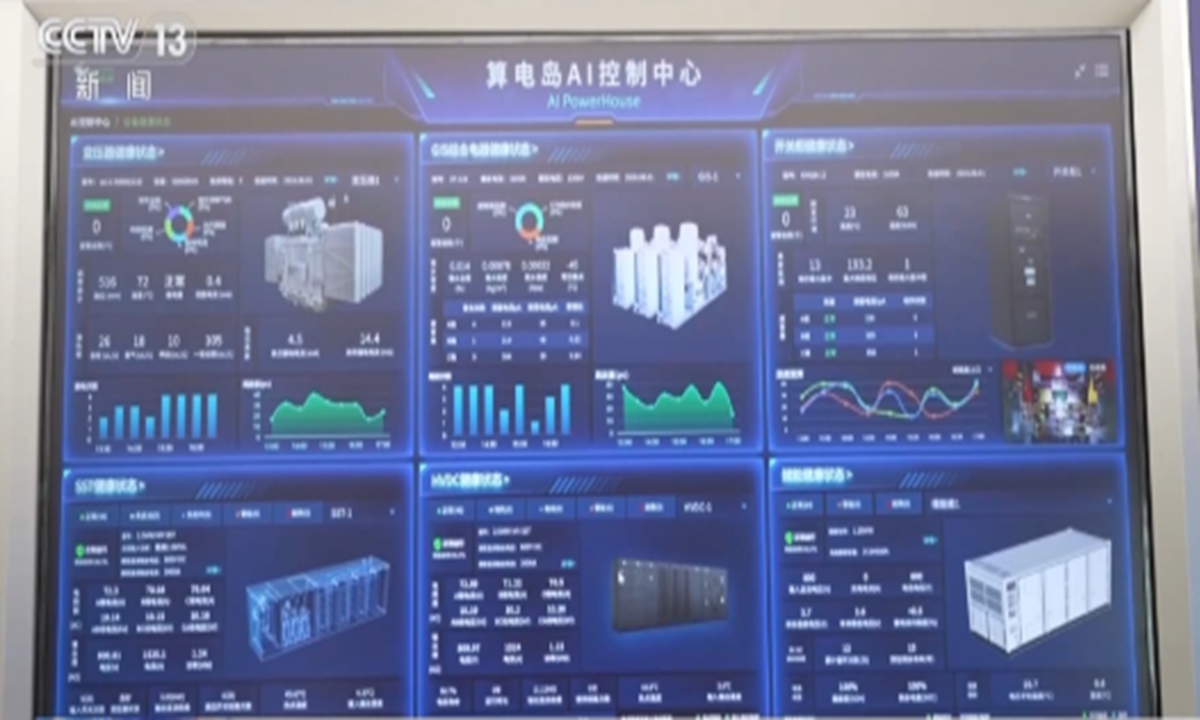
Photo: Screenshot from a report by CCTV News
The world's first prefabricated computing power hub has been launched, providing a faster and more cost-effective solution for building and powering data centers, according to a CCTV News report on Sunday.
Located in Qingdao, East China's Shandong Province, the hub can reduce land use by more than 30 percent and overall costs by 20 percent. It can be completed in about five months, ensuring a stable power supply for a computing center while cutting construction costs by nearly 80 percent, the report said.
Unlike conventional hubs, the new hub supports direct green power connection, enabling 100 percent green energy consumption and lowering the electricity cost per token by about 30 percent. It also integrates energy storage control, creating a dedicated power-computing collaborative intelligent system that synchronizes and precisely matches electricity and computing power, which could lead to reduced computing power prices, the report said.
The hub uses virtual simulation to finalize all construction details before construction actually begins—planning everything thoroughly first, then building. The construction is carried out using prefabricated modules, which are ultimately integrated to complete deployment, Pan Helin, a member of the Information and Communication Economy Expert Committee of the Ministry of Industry and Information Technology, told the Global Times on Sunday.
This approach shortens the construction cycle, accelerates computing power deployment, and reduces costs, enabling large-scale rollout. Through scientific planning, prefabrication, and integrated installation, a mature investment model has been established, significantly easing the token supply-demand imbalance, Pan added.
The computing power hub is essentially the energy hub and power fortress of the computing center, also known as its "heart," providing stable and continuous power. The stability of power supply and energy efficiency of the base will determine the overall performance of the computing power center.
For a computing power center, even a second-level power interruption can have very detrimental consequences for high-intensity computing tasks, causing massive resource losses and severely disrupting business operations. The new hub features multiple redundant circuits to ensure nearly 100-percent power supply reliability, according to the CCTV News.
Zhou Jun, executive president of Qingdao TGOOD Electric Co, said in the report that the company ensures that each device is connected to three independent power sources, providing excellent electricity reliability.
The design withstands external grid fluctuations, absorbs graphic processing unit computing load impacts, and ensures safe and stable operation even in the event of equipment failure, Zhou added.
Zhou said that by integrating green power connection, energy storage for peak load shifting, computing-power collaboration, and intelligent operation and maintenance, the hub could reduce the electricity cost per token by 30 percent, the Science and Technology Daily reported on Sunday.
The prefabricated computing power hub has been connected to an enterprise's self-built data center. It is expected to be deployed in national-level data center clusters and regional computing power centers in the second half of this year, providing an efficient, low-carbon, and rapidly replicable model for computing hubs at various levels.
As the scale and standardization of computing power infrastructure across the country continue to accelerate, the pricing of computing power from various sources is becoming increasingly affordable now.
Recently, several companies announced permanent price reductions for computing power, with DeepSeek and Xiaomi MiMo slashing the prices, with the largest reduction approaching 99 percent. This greatly reduces the cost of using artificial intelligence in various scenarios such as daily high-frequency question answering, web design, and code programming, allowing various lightweight and routine AI applications to break free from the constraints of high barriers to entry and high costs.
China's three major telecom operators have already launched "token packages" tailored for individual consumers.
Chinese experts said that lower computing power charges will boost inclusive AI development, and model iteration, while giving individuals and businesses access to top-tier models, which will greatly assist start-ups, spur innovation, and help spread AI dividends across all industries.
RELATED ARTICLES