Chinese cities make forays into space computing, likely the next frontier of AI race
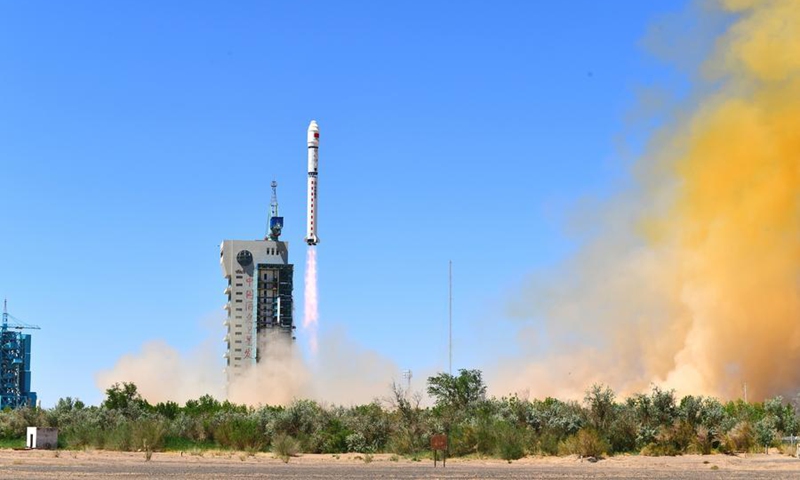
A Long March-2D carrier rocket carrying a space computing satellite constellation blasts off from the Jiuquan Satellite Launch Center in northwest China on May 14, 2025. (Photo by Wang Jiangbo/Xinhua)
Chinese cities are accelerating their push into space-based computing, with Beijing, Tianjin and Chengdu in Southwest China's Sichuan Province rolling out dedicated research institutes and joint innovation centers in an effort to secure a strategic foothold in what industry observers see as a new frontier of artificial intelligence (AI) infrastructure.
Space-based computing, which integrates aerospace, energy, computing and AI, is drawing growing industry attention as a possible answer to the mounting pressure on ground-based computing infrastructure amid surging AI demand, analysts said.
Beijing established its first space computing innovation center on Monday, the Beijing-based Securities Times reported. The center will adopt a company-plus-alliance model and focus on six key areas across the space computing industrial chain, aiming to connect the full stack of chips, hardware, platforms, AI, networks, and applications, creating a coordinated industrial system for space computing, said the report.
On Sunday, the Global Times learned from GalaxySpace, a privately-owned space company, that a space computing research institute was recently set up in Beijing E-Town aimed at ramping up tech innovation including space-borne computing chips and inter-satellite laser communications, space-based energy and thermal management, integrated space-ground networking, and setting space security standards.
On May 29, at the World Intelligence Expo 2026 in North China's Tianjin Municipality, the National Supercomputing Center in Tianjin joined with relevant companies and institutes to establish a joint consortium for space digital intelligence infrastructure.
The consortium will concentrate on building an integrated space-ground computing infrastructure, targeting breakthroughs across modular and scalable computing payloads, high-performance on-board chips, in-orbit intelligent operation and management, space computing software stacks, integrated energy-thermal control systems, flexible space solar arrays, and satellite-ground mission coordination, the China News Service reported.
On March 26, Chengdu-based aerospace company ADAspace, in collaboration with the small and medium-sized enterprises development promotion center of the Ministry of Industry and Information Technology (MIIT), launched the world's first space-based computing power cloud service platform for enterprises, named Prometheus, the Xinhua News Agency reported.
The plan aims to build a network of 1,000 satellites and begin commercial operations by 2030, with more than 95 percent of the satellites dedicated to inference computing, and to complete the full 2,800-satellite network by 2035, according to Xinhua.
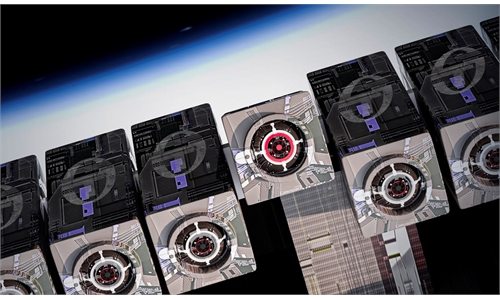
Space-based computing, or orbital computing, refers to deploying chips, servers and data-processing hardware aboard satellites, enabling raw data to be processed in orbit rather than transmitted back to Earth. The push for the technology is gaining urgency as terrestrial data centers face mounting constraints in energy consumption, heat dissipation, and land availability amid the explosive growth of AI.
"The construction of space-based computing infrastructure is significant, as it will fundamentally alter the global supply pattern of computing power," Xiang Ligang, director-general of the Zhongguancun Modern Information Consumer Application Industry Technology Alliance, told the Global Times on Tuesday.
Xiang noted that AI is driving a surge in demand for computing power, adding that ground-based computing power faces bottlenecks in energy consumption and heat dissipation, while space-based computing, with its solar power and wide-area coverage, can relieve these pressures.
Industry analysts predict that by 2030, the global space-based computing market will exceed $1 trillion.
The MIIT has pledged support for forward-looking research on space-based computing, calling for the gradual establishment of a standards system covering hardware, software, networking and security, and promoting the research and development of technologies and products such as space-borne radiation-resistant chips and inter-satellite laser communications, Xinhua reported.
In addition to China, other countries have been working on the space computing industry. US-based SpaceX plans to deploy a new non-geostationary orbit system of up to 1 million satellites, according to the US Federal Communications Commission. Japan's space agency JAXA, and iQPS, a Japanese private satellite company, have achieved in-orbit image processing of synthetic aperture radar data, an official statement said.
China is "already at the forefront globally in terms of engineering implementation and commercial space deployment," and ranks among the world's top players in space computing exploration, said Xie Lina, deputy director of the Cloud Computing and Big Data Research Institute under the China Academy of Information and Communication Technology (CAICT), state broadcaster CCTV reported.
She noted that to reduce the cost of launching satellites into orbit, the industry is accelerating its efforts to develop reusable rocket technology and promote standardized, modular satellite design and mass production. Overall, space computing power is still in its early stages of development, requiring a pragmatic approach and collaborative innovation to ensure the industry's steady and healthy growth.
According to preliminary estimates by CAICT, the scale of China's space computing power industry is expected to exceed 250 billion yuan ($36.6 billion) by 2030.
RELATED ARTICLES