‘We are increasingly seeing value-added benefits’ of Chinese investment in Indonesia
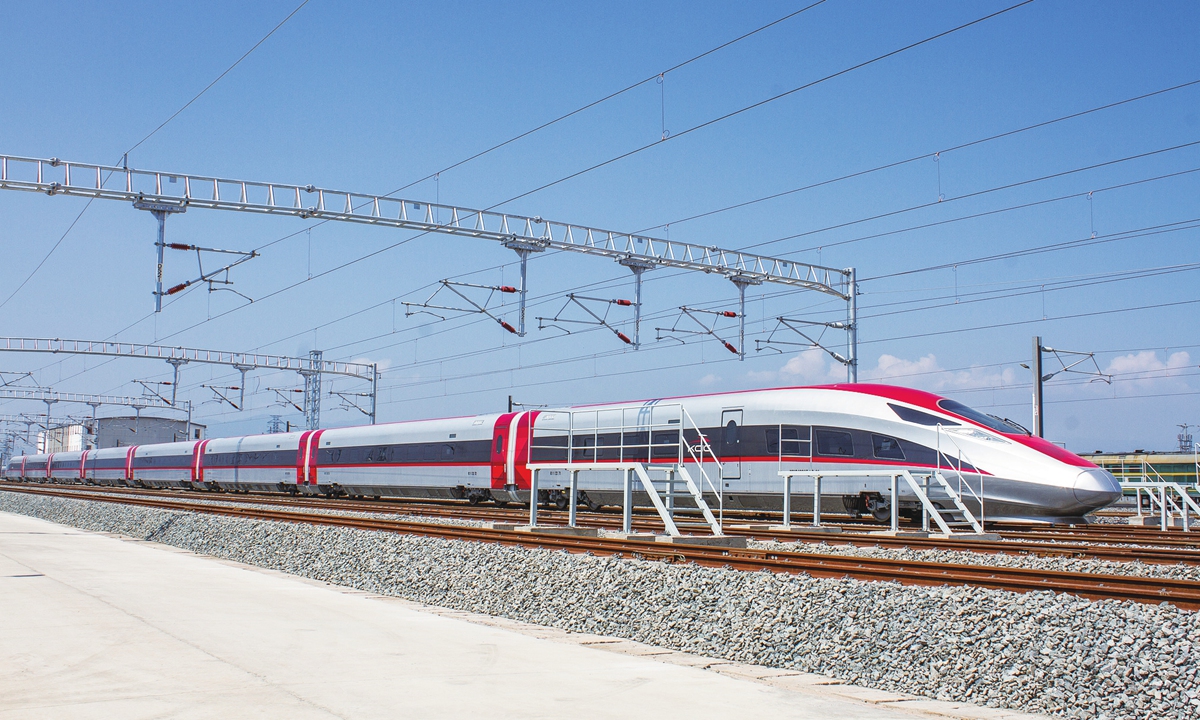
Electrical Multiple Units train seen at Tegalluar depot station on June 22, 2023 in Bandung, West Java, Indonesia. File photo: VCG
Editor's Note:
"We can go to Bandung for a meeting or even for a meal and then come back on the same day. A lot of people are doing that now," Mari Elka Pangestu (Pangestu) told Global Times (GT) reporter Li Aixin in an exclusive interview, underscoring the changes brought about by the Jakarta-Bandung High-Speed Railway and China-Indonesia cooperation. Pangestu is a professor of international economics at the University of Indonesia, board member of the Centre for Strategic and International Studies, Jakarta, and former Indonesian minister of trade. During her recent think tank dialogues in Beijing, hosted by the China Institute for Innovation and Development Strategy (CIIDS), she offered insightful perspectives on the future of China-US-Southeast Asia trilateral cooperation, while reflecting on the evolving China-Indonesia partnership.
GT: During your recent academic exchange activities in China, are there any viewpoints that particularly caught your attention?
Pangestu: Obviously, everybody has been talking a lot about the China-US summit in May. Everybody appreciated that it led to a stabilization of bilateral ties. The conversations in think tank dialogues have been trying to identify areas where the two sides can actually cooperate.
Ten years ago, one of the key areas where China and the US could cooperate was climate change. That is still an important area for cooperation. The other one that has come up more recently is on AI governance. Tensions and issues will continue, but the question is whether the two sides can still find areas for cooperation.
Whatever happens between China and the US has an impact on the rest of the world, on Southeast Asia in particular. For us, it's always the case that we need to navigate the relationship between China and the US.
We don't want to have to take sides, as both China and the US are vital trading, investment, and security partners for us. We would like to maintain good engagement and good relations with both.
GT: Are there any specific areas of cooperation in the China-US-Southeast Asia trilateral ties where you see potential for the future?
Pangestu: We would like to have a more diversified global supply chain in a number of areas, whether it's green energy, renewable energy, electric vehicles (EVs), other manufacturing, or even services.
GT: What actionable steps can be taken to promote trilateral cooperation among China, the US, and ASEAN?
Pangestu: I think we have to start by doing it bilaterally first of all.
With China, there is already a stronger institutional framework through ASEAN-China mechanisms, including the ongoing upgrade of the ASEAN-China Free Trade Agreement (FTA). We hope to see China adopt a more comprehensive approach, including increasing investment in local content in our countries. We also hope for more soft cooperation in areas that will build better long-term relations, such as technology development and sharing, digital cooperation, and AI, as well as education and training. China really has a lot to offer in these fields to help us.
On the US side, we would hope that in whatever tariff or trade policies they introduce, they realize it cannot simply be an ASEAN-US arrangement that excludes China or other countries. Hopefully, the US will recognize that what they want - greater regional diversification - should also include China.
The US also needs critical minerals. It doesn't really have a clear battery manufacturing plan, nor a competitive EV industry. Can they envision a path where, given their future need for EVs, they invest together with Southeast Asia, China, and other partners in this region, to produce for export back to the US, or even manufacture some of it in the US itself?
GT: In terms of China-Indonesia ties, you have witnessed multiple critical stages of the relationship. When you look back, what do you consider is the most landmark moment?
Pangestu: Historically speaking, it starts with the resumption of China-Indonesia diplomatic ties in 1990.
We had a lot of very intense bilateral meetings during my tenure as trade minister starting in 2004. It was also around that same period that we reached an agreement on the ASEAN-China FTA in 2005. The China agreement was the first FTA that ASEAN had. I was the one who signed the agreement in front of our two leaders. This opened up trade and cooperation at both the bilateral and ASEAN levels. It led to our trade with China growing dramatically, and helped create a more balanced relationship, along with increased Chinese investment in Indonesia.
China is ASEAN's largest trading partner, and ASEAN is China's largest trading partner. In the last 10 years especially, we have seen a significant change in the nature of Chinese investments coming into Indonesia. In the past, Chinese investments were looking for resources. But over the past decade, the focus has shifted toward processing and value-added activities.
One of the standout success stories is nickel: from nickel mining to smelting, then to processed minerals, and more recently to battery precursors used in electric vehicles. EV investments have also started coming in.
GT: Is there any particular project, agreement, or development that has left a particularly strong impression on you?
Pangestu: Probably one of the flagship projects, if you talk about Indonesia-China relations, is the high-speed train. It's a great project symbolically between the two countries. It's a source of pride for Indonesians to have a high-speed train in Indonesia. And we hope that this can be extended to Surabaya, which would be really a game changer for Indonesia.
I've taken the train many times. The first time anybody takes it, they put the bottle of water upside down and say, "Look, it doesn't shake." The fact is that we can go to Bandung for a meeting or even for a meal and then come back on the same day. A lot of people are doing that now.
What we learned from each other through this project is the importance of investing in the capabilities of Indonesians from the Chinese side, whether it's helping us build the railway system, undertaking the operations maintenance, manufacturing the trains or components, or sharing the necessary technology.
We also discovered that even with the advanced technology you have, when you implement it in a different country with a different climate and geographical conditions, you still learn a lot - particularly how to adapt your technology to our local situation. So there was mutual learning on both sides.
The whole nickel processing all the way to the potential for batteries and EVs is also another good example of Chinese investment, where we are increasingly seeing the value-added benefits, along with job creation and local capacity building that goes with these investments.
There are a lot of Chinese EVs on the streets, especially after the recent energy crisis. The sales of EVs have really gone up a lot. There are a number of Chinese brands in Indonesia.
GT: From the ASEAN perspective, how have Southeast Asians' perceptions toward China evolved in recent years?
Pangestu: China is our most important trading partner. And one of the results of the ASEAN-China FTA is that ASEAN has been China's largest trading partner in recent years. And China has been ASEAN's largest trading partner for a longer time. But it shows the importance of ASEAN for China and China for ASEAN.
We have seen positive growth in both trade and investment. The issue that often comes up is whether it is balanced. We want investments to come in and strengthen local content and value in supply chains.
The other thing that has happened more recently is that we are seeing Chinese investments coming in not just for manufacturing, processing resources, and things that we just talked about. They're also coming into the consumer and retail sectors.
Everybody knows now about Mixue, the Chinese ice cream, and Luckin and Tomoro Coffee, and there are all these Chinese cosmetic brands.
Increasingly, people are seeing more and more Chinese products in their daily lives. This has helped bring people-to-people ties closer.
There is a large number of Indonesians and people from other parts of Southeast Asia studying in China. And there is some really good cooperation in various areas, including in the mining and metal industry, where we have been sending our people to study in your universities, and in health as well. Our health minister has been very active in sending doctors here to study and learn about Chinese technology, health equipment, and health technologies.
RELATED ARTICLES