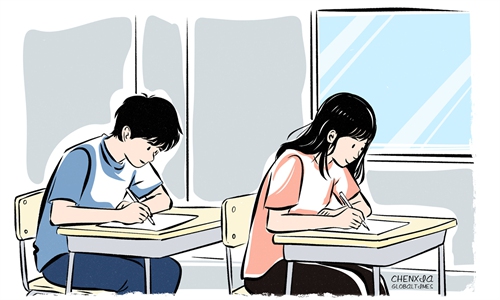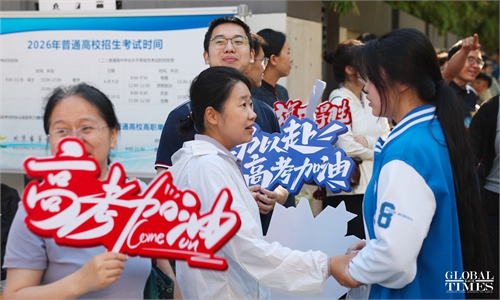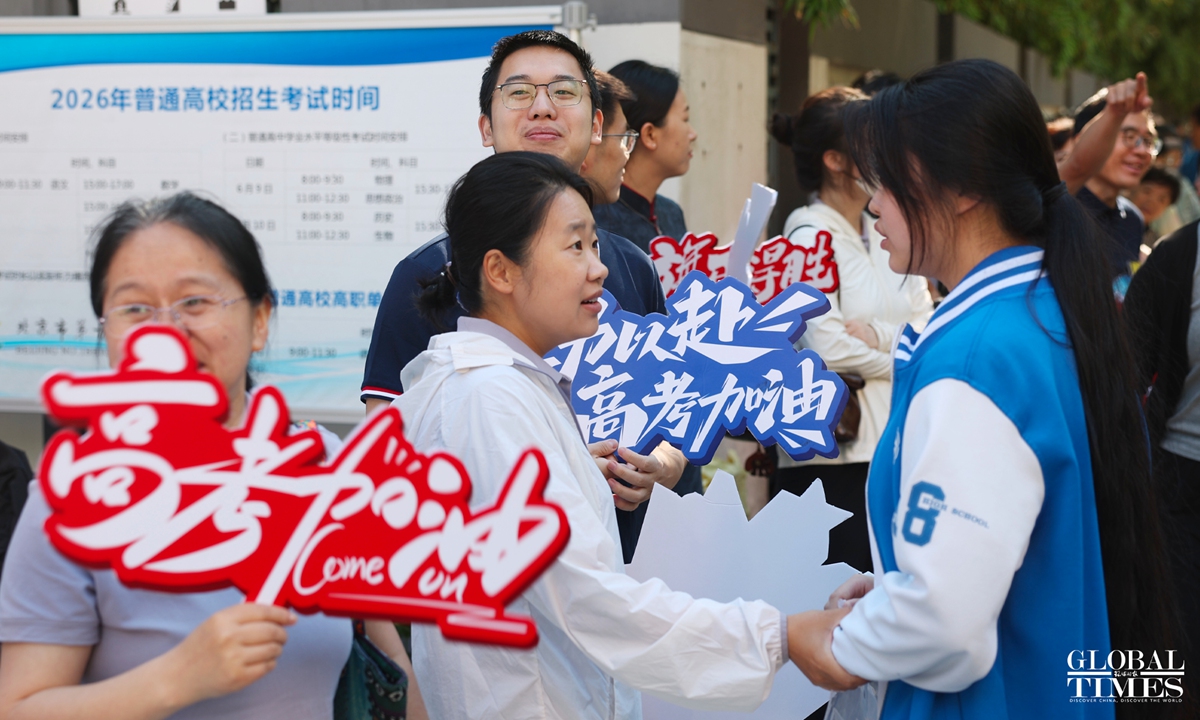
Students arrive at the exam sites of Beijing No. 18 High School, accompanied by their teachers and parents, for the 2026 national college entrance exam, also known as the gaokao, on the morning of June 7, 2026. Photo: Cui Meng/GT
June 7 marked the first day of the 2026 National College Entrance Examination (gaokao), with 12.9 million candidates entering examination rooms to write the chapter of their youth. Since its resumption in 1977, nearly half a century ago, the gaokao system has remained China's most credible and widely recognized talent selection mechanism, conveying the positive value that "effort always pays off and hard work always leads to a bright future." It not only illuminates the trajectories of countless individuals' destinies but also deeply intertwines with and resonates with the grand blueprint of China's path to modernization.
This year marks the start of China's 15th Five-Year Plan. The outline of the Plan emphasizes the need for "education that meets the people's expectations," making the integrated development of education, science and technology, and talent a key strategic deployment. The gaokao, as the core link in the selection, cultivation, and delivery of higher-level talent, is an indispensable part of the high-quality educational system and a concrete practice of aligning with national development needs and serving the overall strategic layout. The public's emphasis on education has always been a vital factor in China's national strength; and the high-quality development of education, in turn, injects momentum into national development.
The development of new quality productive forces demands outstanding scientists, engineers, and master craftsmen who can adapt to future industrial trends and break through the bottlenecks of core technologies. This year, many "Double First Class" universities have explicitly expanded their undergraduate enrollment, focusing on areas urgently needed by the nation, such as intelligent manufacturing and embodied intelligence. The Ministry of Education recently released the 2026 catalog of undergraduate majors for colleges and universities, adding 38 new majors including low-altitude economy and management, resource and environmental auditing, fiber science and intelligent manufacturing, and agricultural robotics. These majors directly address core national needs such as speeding up high-level technological self-reliance, meaning that China's higher education is proactively empowering Chinese modernization from the talent cultivation perspective, providing solid talent and intellectual support for national strategies. Policies guiding the expansion of high-quality undergraduate enrollment, reducing the risk of being placed in a different major, and increasing the rate of fulfilling student preferences also help universities optimize their disciplinary layout, tilting toward basic disciplines, emerging interdisciplinary fields, and areas urgently needed by national strategies.
In recent years, the gaokao has placed greater emphasis on assessing key abilities. The focus of the exam has shifted from "answering questions" to "problem-solving," highlighting critical thinking, subject-specific literacy, and innovative potential. This is also a positive response to the requirement of 15th Five-Year Plan for cultivating innovative talent. Notably, the number of gaokao candidates this year has decreased compared to last year. Two important reasons for this are the earlier diversion of students into vocational schools, as well as gaokao reforms and the popularization of higher education, which have led many previous candidates to rationally abandon the idea of repeating the exam. This change also aligns with the 15th Five-Year Plan outline's direction of building a stronger educational system and constructing a modern vocational education system, reflecting a transformation in China's education from quantitative expansion to qualitative improvement, while the channels for talent development provided by society are becoming increasingly diverse and comprehensive.
Compared to previous years, this year's gaokao saw both profound changes and unchanged core principles. What remained unchanged were the core principles of fairness and impartiality and society's respect for education and knowledge. This year's examination venues placed greater emphasis on intelligent security checks and anti-cheating measures using AI technology, representing a timely guarantee for the fairness of talent selection. Early on the morning of June 7, all 7,981 examination centers nationwide operated in an orderly manner, with public security, traffic management, and health departments working together to ensure smooth operations. Services such as noise control, transportation services for examinees, and support for special groups have become standard practice. When every procedure could withstand scrutiny, and every examinee was treated equally, this is the simple yet moving embodiment of delivering "education that meets the people's expectations."
By integrating the individual into the greater good, youth gain their brightest foundation. During the 15th Five-Year Plan period, Chinese modernization will require a massive influx of innovative talent and high-quality laborers. Those who can integrate their professional expertise into the nation's urgent needs will shine brightly on the professional stage.
For gaokao candidates, combining their personal destinies with the national development strategy is a path that carries the deepest expectations and is most likely to realize one's life value. More and more aspiring Chinese youth are confidently sailing toward the intersection of personal value and national rejuvenation, using knowledge as their vessel and hard work as their oars.
The gaokao reflects individual destinies and, more importantly, the grand blueprint of the nation's future. A Chinese poem states, "I will mount a long wind some day and break the heavy waves, and set my cloudy sail straight and bridge the deep, deep sea." We wish every candidate academic success. The gaokao is a new starting point in life; the future belongs to every dream chaser who holds the country dear and works with relentless diligence.
RELATED ARTICLES