Chinese FM expresses deep concern over renewed Iran-Israel clashes
April ceasefire fails to stabilize situation amid multi-party conflicts: Chinese expert
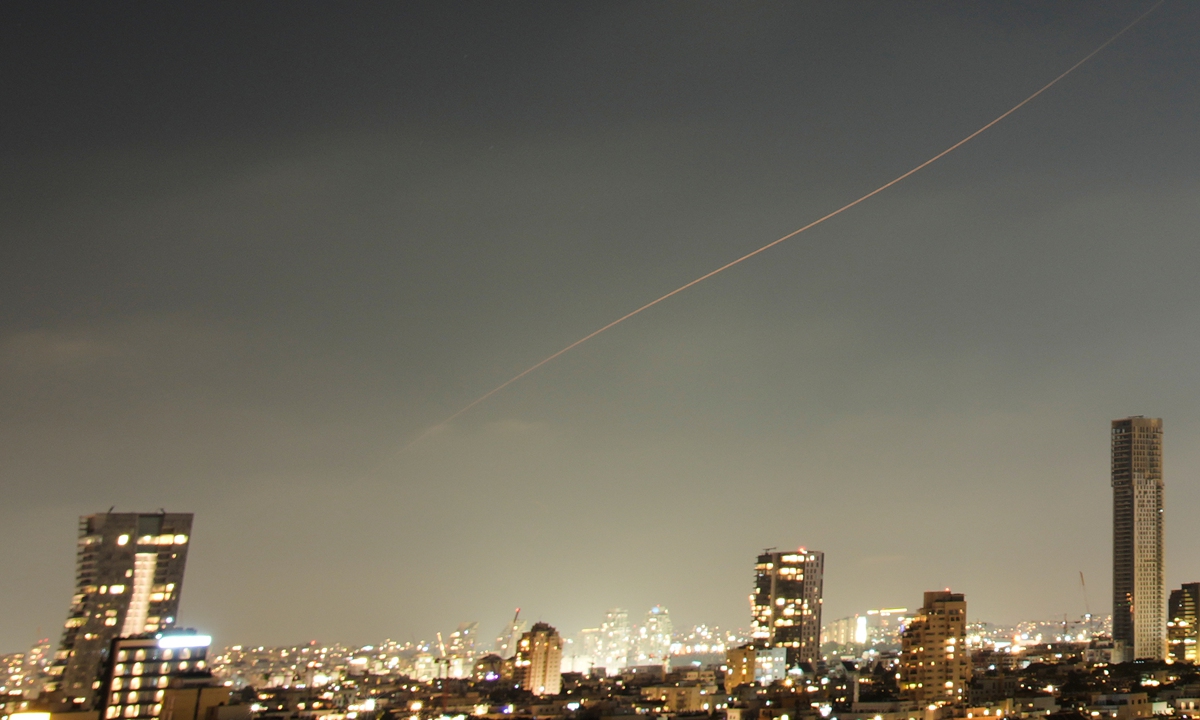
A projectile streaks through the sky over central Israel during an Iranian missile attack, Sunday, June 7, 2026. Photo: VCG
In the wake of the fresh rounds of military strikes between Iran and Israel, the first time the two sides have launched attacks on each other's territory since the ceasefire came into force two months ago, the Chinese Foreign Ministry on Monday expressed deep concern over the regional situation, stressing that the return of war serves no one's interests.
When asked to comment on Iran and Israel launching strikes against each other over the weekend, Chinese Foreign Ministry spokesperson Lin Jian told a regular press conference that "We hope relevant parties will continue to implement the ceasefire, keep the negotiation going, resolve disputes through political and diplomatic means, achieve a comprehensive and lasting ceasefire at an early date and create necessary conditions for restoring peace and tranquility in the Middle East and Gulf region."
Chinese analysts said that the latest round of reciprocal exchanges of fire between Iran and Israel may stem from April's ceasefire deal being merely a provisional arrangement with limited binding power. They noted that maneuvering among multiple regional players has likely further heightened instability across the region.
The latest round of strikes between Israel and Iran, which CNN described as "the worst escalation since the April truce," started as the Israeli air force began a series of airstrikes in Beirut's southern suburbs in Lebanon on Sunday afternoon. Two people were killed and 11 others injured in the airstrike, the Xinhua News Agency reported, citing a preliminary toll reported by Lebanon's National News Agency (NNA).
Iran's Revolutionary Guard Corps (IRGC) said: "This operation is not a passing event, but rather the beginning of a full week of continuous strikes." In a statement, it added: "Waves of missiles and drones will continue to be launched around the clock for the next seven days until the enemy is deterred and ceases its crimes," the Guardian reported.
The mutual exchanges of strikes extended to Monday, as the Israeli military said its Air Force struck "several targets" at the petrochemical complex in Mahshahr, southwestern Iran, while the IRGC said its aerospace forces targeted two "important and strategic" Israeli air bases in retaliation for Israel's attacks earlier in the day against the Gulf country.
Later on Monday, Iran's main military command, Khatam al-Anbiya Central Headquarters, said a "painful" response was given to Israel, announcing the cessation of the country's operations, the semi-official Fars news agency reported.
Chinese embassies in Iran, Israel and Saudi Arabia on Monday each released urgent safety advisories, reminding Chinese citizens in regional countries to strengthen security precautions and remain vigilant.
Sun Degang, director of the Center for Middle Eastern Studies at Fudan University, told the Global Times on Monday that the flare-up two months on may suggest that the latest ceasefire has only eased tensions briefly instead of bringing enduring peace, with deep-seated structural divides persisting between several parties, Sun said.
Chinese analysts noted that the current uneasy regional situation may come down to this being a multi-party conflict, rather than merely a bilateral row between Israel and Iran.
US President Donald Trump called for a halt in tit-for-tat strikes between Iran and Israel, CNN reported. "Israel and Iran must immediately stop 'shooting'," the US President wrote on Truth Social early Monday.
In a phone call Sunday, Trump reportedly told Israeli Prime Minister Benjamin Netanyahu to hold off launching a retaliatory attack on Iran. Citing a US official quoted by Axios, Reuters reported that Trump told Netanyahu during the call to refrain from further strikes because "we are close to doing something good in terms of a deal."
Yemen is also counted among the various sides entangled in this regional standoff. The Houthis, an Iran-backed militant group that controls much of the country, declared a ban on Israeli ships in the Red Sea, threatening a key bypass route to the Strait of Hormuz, Bloomberg reported.
Liu Zhongmin, a professor at the Middle East Studies Institute of Shanghai International Studies University, told the Global Times on Monday that the deep-seated factor behind this renewed regional unrest may lie in the reality that while diplomatic negotiations are mainly unfolding between Washington and Tehran, the standoff is entangled with overlapping tensions between various parties, which may have woven an intricate multi-party web of regional conflicts, highlighting growing uncertainty.
RELATED ARTICLES