IN-DEPTH / IN-DEPTH
Xi’s reply letter encourages student docents to further share patriotic stories, carry forward revolutionary traditions
Inheriting red legacy
By By and in Shanghai Published: Jun 09, 2026 10:25 PM


Editor's Note:
Chinese people believe that letters are as valuable as gold. For thousands of years, letters, across mountains and oceans, have been delivering the writers' sentiments and conveying friendship and expectations.
Chinese President Xi Jinping, also general secretary of the Communist Party of China (CPC) Central Committee and chairman of the Central Military Commission, has managed to find time to reply to some letters from different sectors of society and different parts of the world despite his busy work schedule.
Through these letters, he has corresponded with people from all walks of life on numerous occasions, part of a series of excellent stories of China in the new era.
The Global Times traced and contacted some of the recipients of these letters to hear their inspiring stories and their understanding of modern China.
In this installment, we turn our attention to a group of Chinese teenagers who volunteer as student docents at the country's red-themed revolutionary memorial sites, telling the stories and spirit of the CPC and China's development.
"We received a special letter!" A burst of delighted voices filled the classroom as 10-year-old Yan Zhiling and his classmates gathered around, their eyes sparkling with excitement.
Chinese President Xi Jinping recently sent a reply letter to student docents at the Memorial Hall of the First National Congress of the CPC and the Nanhu Revolutionary Memorial Hall, which are both the memorials of the birthplaces of the CPC. In the letter, he offered words of encouragement to the docents, who are members of the Chinese Young Pioneers (CYP), and extended festive greetings to them and to children nationwide, the Xinhua News Agency reported.
As a student docent at the Memorial Hall of the First National Congress of the CPC after school, Yan Zhiling was reminded of the moment he and several other young peer docents had sat down to write the letter together. "We wrote it very carefully, stroke by stroke, making sure every character was neat and tidy," he recalled.
"When we learned that we got the reply letter, we were overjoyed," the fourth-grader told the Global Times. "This letter was the most precious Children's Day gift we received."
A warm, inspiring reply
In his reply, Xi said that he was pleased to learn that the students had fostered a deep affection for the Party, the country and socialism, and had grown and learned a lot through recounting the Party's history, revolutionary stories and heroic deeds at the site of the First National Congress of the CPC in Shanghai and beside the Red Boat on Nanhu Lake in Jiaxing, East China's Zhejiang Province, Xinhua reported.
These words of encouragement felt both warm and deeply inspiring to Yan Zhiling. Yan Zhiling has always had a special affection for stories about the Party and the country's revolutionary history and development, especially the ones his father used to tell him, such as stories of the Party's early members holding its first national congress in Shanghai in 1921. Growing up surrounded by such vivid accounts, the young boy quietly planted a seed in his heart.
When the "Honglaba" (red loudspeaker) club at Shanghai Huangpu Luwan No. 1 Central Primary School recruited new members, Yan Zhiling signed up straight away.
The club mainly organizes students to use their spare time to tell Party history stories to child visitors at red-themed revolutionary sites and museums in Shanghai, such as the school's nearby Memorial Hall of the First National Congress of the CPC. After a period of training, Yan Zhiling became one of its members.
Other cities also have student docents like these. In April, members of the "Honglaba" club took part in a study-and-exchange visit with student docents at the Nanhu Revolutionary Memorial Hall in Jiaxing. In 1921, to evade pursuit by the reactionary forces, the last session of the First CPC National Congress was held on a boat on Jiaxing's South Lake. Both Shanghai and Jiaxing are witnesses of the moving stories of the CPC's early development.
During the study-and-exchange visit, young docents from the two cities gathered together, chattering excitedly as they exchanged tips and experiences from their work. From their own stories to their shared ideals, as the conversation deepened, so did their excitement. An idea then naturally took shape: Why not write a letter, reporting what they had learned and how they had grown through their work as student docents?
They began writing the letter at the end of April. By early May, the letter had been sent. To their surprise, they soon received the reply.
The young docents erupted with excitement the moment the reply letter arrived. "I felt so proud and moved. He is so busy, yet he still cares about the growth of ordinary Young Pioneers like us," said Li Ruicheng, a fifth-grader, also from Shanghai Huangpu Luwan No. 1 Central Primary School.
"The reply was filled with the Party and the country's earnest hopes for our younger generation," Yan Jiacheng, a student docent from Jiaxing Experimental Primary School, told the Global Times. "I will use my own voice to open the curtain on revolutionary stories, sharing these stories with more people."
'Let children tell'
In 2021, a nationwide initiative was launched to encourage CYP members across the country to study the Party's history and share these stories as docents at revolutionary memorial venues, according to Xinhua.
Since the initiative was launched, many red-themed museums and memorial sites across China have increasingly been visited by young student docents wearing the iconic red scarves of the CYP, as patriotic education moves beyond textbooks and into real-life practice. The "Honglaba" club is one representative example of this growing student docent team.
According to Chen Lili, a counselor (teacher) of the CYP work committee at Shanghai Huangpu Luwan No. 1 Central Primary School, the club was originally created with a simple goal: "to let children tell Party history stories to other children."
Chen noticed that in some red heritage venues, the standard adult-style commentary was often difficult for younger audiences to fully grasp, with language that could feel overly formal and abstract. The school then cooperated with the Memorial Hall of the First National Congress of the CPC, and invited professional docents of the memorial to help refine the scripts, translating them into child-friendly language. "In this way, the Party history told by children feels much closer to their peers' way of thinking, and is easier for children of the same age to understand," Chen told the Global Times.
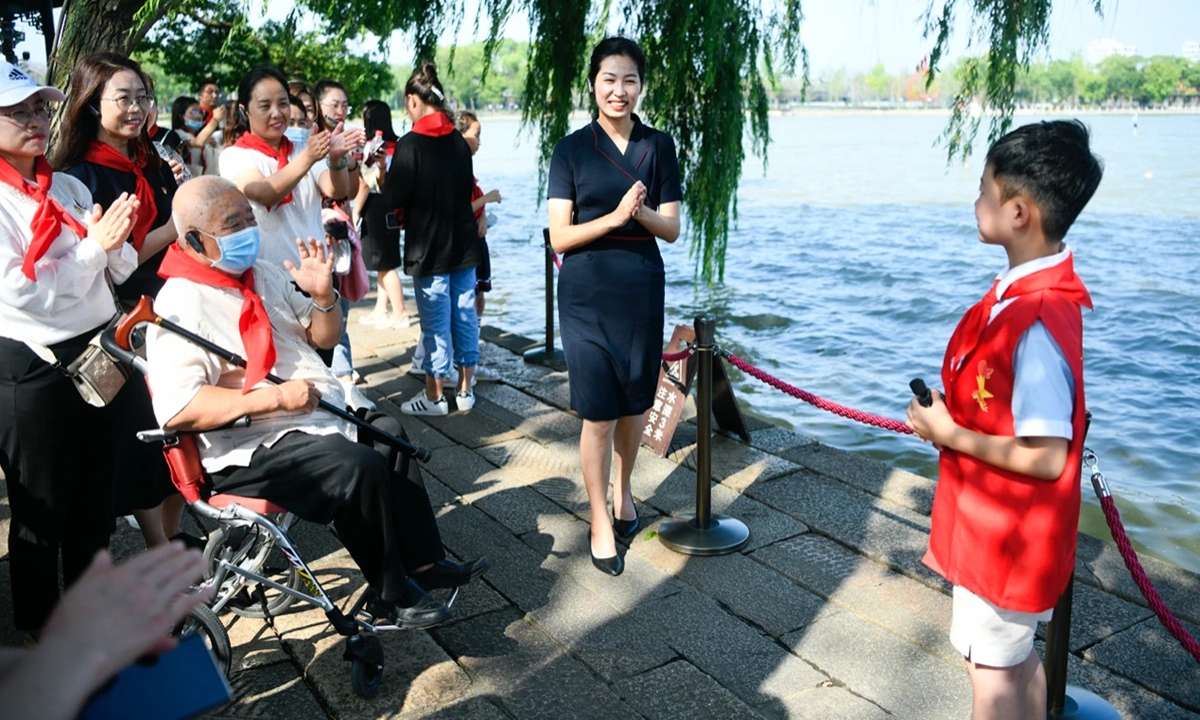
The experience of giving these talks has also become a rewarding journey for the pupil docents themselves. Chen said that through repeated on-site presentations, the transformation in these students has been striking: they have grown bolder, more confident and far more comfortable speaking in public. Children who once shied away from addressing a crowd are now able to stand calmly before dozens of visitors and deliver their talks with ease, she added.
When asked about the changes brought by serving as student docents, the children's eyes lit up. "I now truly understand what the Party's forebears went through, and I have a deeper grasp of these revolutionary stories and the spirit behind them," said Li, who has been a docent for four years. "I'm not just memorizing lines - I'm telling these moving stories naturally, from the heart."
Jiang Qingyue from Jiaxing Experimental Primary School, who has been a student docent in Jiaxing for three years, agreed. She told the Global Times that the experience has strengthened her character and deepened her sense of patriotism.
"I'm no longer simply reciting words; I'm speaking about the Party's memorable years with reverence and sincerity, carrying forward the original aspiration of the red spirit," she said.
Carrying the legacy forward
This year marks the 105th anniversary of the founding of the CPC and the Party's cause calls for unremitting efforts across generations. The reply letter encouraged the children to hold high the banner of the CYP and follow the Party, carry forward revolutionary traditions, enrich their knowledge and capabilities, build strong characters, grow into children devoted to the Party and the people, and carry the baton of history forward on the new journey, reported Xinhua.
This letter has planted the seed of inheriting the red legacy in the hearts of the young student docents, allowing it to take root and flourish as part of their lives and growth. "This seed reminds us to love our country, never bow to difficulties, and, as we grow up, stay true to our beliefs and ideals and become useful people," said Yan Zhiling.
How can more children be encouraged to take part, and how can red stories be told in a more vivid and far-reaching way? Some red heritage sites are continuing to explore new ideas and innovations.
For the Nanhu Revolutionary Memorial Hall, for instance, the experience for its student docents goes beyond standard guided tours. The venue has also staged immersive productions themed on revolutionary history, allowing the young docents to step into roles, relive history at close range and deepen their understanding of the revolutionary spirit, the Global Times learned from the venue.
For the student docents of the Memorial Hall of the First National Congress of the CPC, the script has expanded far beyond one version. In addition to the original Putonghua version, there are now English, Shanghai dialect, comic-strip and kuaiban (a traditional Chinese performance art that combines rhythmic clapping with storytelling) versions, making the stories of the Party's history more vivid and engaging, said Yang Yu, director of the memorial's publicity and education department.
"This kind of entertaining, educational approach helps children remember and understand the Party's stories much better - something even many adults can't achieve," Yang told the Global Times.
The English version has been equally heartening, Yang said. She recalled seeing a student docent at the memorial telling foreign visitors the story of the Party's founding in simple, but engaging, English. After the talk, the foreign audience applauded warmly. "Later, I asked the young docent how he felt, and he said he was very proud, saying, 'I just want foreign children to learn about our CPC's story, and I also want them to know how proud I am as a Chinese child.'"
Yang added that the memorial will continue to attract more teen students to join the effort to share the story of the Party's founding and development, "so that more children can tell the story in their own innocent, childlike voices, and more young listeners can become storytellers."
Chinese people believe that letters are as valuable as gold. For thousands of years, letters, across mountains and oceans, have been delivering the writers' sentiments and conveying friendship and expectations.
Chinese President Xi Jinping, also general secretary of the Communist Party of China (CPC) Central Committee and chairman of the Central Military Commission, has managed to find time to reply to some letters from different sectors of society and different parts of the world despite his busy work schedule.
Through these letters, he has corresponded with people from all walks of life on numerous occasions, part of a series of excellent stories of China in the new era.
The Global Times traced and contacted some of the recipients of these letters to hear their inspiring stories and their understanding of modern China.
In this installment, we turn our attention to a group of Chinese teenagers who volunteer as student docents at the country's red-themed revolutionary memorial sites, telling the stories and spirit of the CPC and China's development.
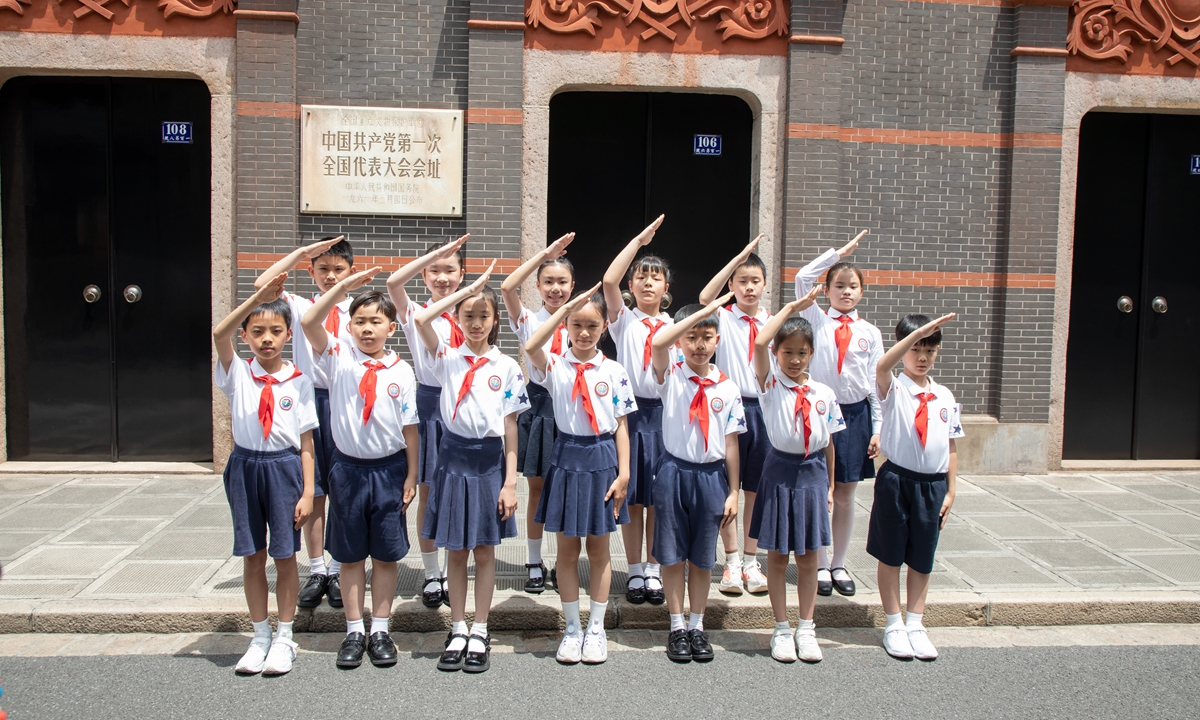
Student docents from "Honglaba" club salute in front of the Memorial Hall of the First National Congress of the CPC in Shanghai on June 1, 2026. Photo: Courtesy of the Memorial Hall of the First National Congress of the CPC in Shanghai
"We received a special letter!" A burst of delighted voices filled the classroom as 10-year-old Yan Zhiling and his classmates gathered around, their eyes sparkling with excitement.
Chinese President Xi Jinping recently sent a reply letter to student docents at the Memorial Hall of the First National Congress of the CPC and the Nanhu Revolutionary Memorial Hall, which are both the memorials of the birthplaces of the CPC. In the letter, he offered words of encouragement to the docents, who are members of the Chinese Young Pioneers (CYP), and extended festive greetings to them and to children nationwide, the Xinhua News Agency reported.
As a student docent at the Memorial Hall of the First National Congress of the CPC after school, Yan Zhiling was reminded of the moment he and several other young peer docents had sat down to write the letter together. "We wrote it very carefully, stroke by stroke, making sure every character was neat and tidy," he recalled.
"When we learned that we got the reply letter, we were overjoyed," the fourth-grader told the Global Times. "This letter was the most precious Children's Day gift we received."
A warm, inspiring reply
In his reply, Xi said that he was pleased to learn that the students had fostered a deep affection for the Party, the country and socialism, and had grown and learned a lot through recounting the Party's history, revolutionary stories and heroic deeds at the site of the First National Congress of the CPC in Shanghai and beside the Red Boat on Nanhu Lake in Jiaxing, East China's Zhejiang Province, Xinhua reported.
These words of encouragement felt both warm and deeply inspiring to Yan Zhiling. Yan Zhiling has always had a special affection for stories about the Party and the country's revolutionary history and development, especially the ones his father used to tell him, such as stories of the Party's early members holding its first national congress in Shanghai in 1921. Growing up surrounded by such vivid accounts, the young boy quietly planted a seed in his heart.
When the "Honglaba" (red loudspeaker) club at Shanghai Huangpu Luwan No. 1 Central Primary School recruited new members, Yan Zhiling signed up straight away.
The club mainly organizes students to use their spare time to tell Party history stories to child visitors at red-themed revolutionary sites and museums in Shanghai, such as the school's nearby Memorial Hall of the First National Congress of the CPC. After a period of training, Yan Zhiling became one of its members.
Other cities also have student docents like these. In April, members of the "Honglaba" club took part in a study-and-exchange visit with student docents at the Nanhu Revolutionary Memorial Hall in Jiaxing. In 1921, to evade pursuit by the reactionary forces, the last session of the First CPC National Congress was held on a boat on Jiaxing's South Lake. Both Shanghai and Jiaxing are witnesses of the moving stories of the CPC's early development.
During the study-and-exchange visit, young docents from the two cities gathered together, chattering excitedly as they exchanged tips and experiences from their work. From their own stories to their shared ideals, as the conversation deepened, so did their excitement. An idea then naturally took shape: Why not write a letter, reporting what they had learned and how they had grown through their work as student docents?
They began writing the letter at the end of April. By early May, the letter had been sent. To their surprise, they soon received the reply.
The young docents erupted with excitement the moment the reply letter arrived. "I felt so proud and moved. He is so busy, yet he still cares about the growth of ordinary Young Pioneers like us," said Li Ruicheng, a fifth-grader, also from Shanghai Huangpu Luwan No. 1 Central Primary School.
"The reply was filled with the Party and the country's earnest hopes for our younger generation," Yan Jiacheng, a student docent from Jiaxing Experimental Primary School, told the Global Times. "I will use my own voice to open the curtain on revolutionary stories, sharing these stories with more people."
'Let children tell'
In 2021, a nationwide initiative was launched to encourage CYP members across the country to study the Party's history and share these stories as docents at revolutionary memorial venues, according to Xinhua.
Since the initiative was launched, many red-themed museums and memorial sites across China have increasingly been visited by young student docents wearing the iconic red scarves of the CYP, as patriotic education moves beyond textbooks and into real-life practice. The "Honglaba" club is one representative example of this growing student docent team.
According to Chen Lili, a counselor (teacher) of the CYP work committee at Shanghai Huangpu Luwan No. 1 Central Primary School, the club was originally created with a simple goal: "to let children tell Party history stories to other children."
Chen noticed that in some red heritage venues, the standard adult-style commentary was often difficult for younger audiences to fully grasp, with language that could feel overly formal and abstract. The school then cooperated with the Memorial Hall of the First National Congress of the CPC, and invited professional docents of the memorial to help refine the scripts, translating them into child-friendly language. "In this way, the Party history told by children feels much closer to their peers' way of thinking, and is easier for children of the same age to understand," Chen told the Global Times.
A student docent at the Nanhu Revolutionary Memorial Hall in Jiaxing, East China's Zhejiang Province, tells visitors stories of the Red Boat. Photo: Courtesy of the publicity department of the CPC Nanhu District Committee
The experience of giving these talks has also become a rewarding journey for the pupil docents themselves. Chen said that through repeated on-site presentations, the transformation in these students has been striking: they have grown bolder, more confident and far more comfortable speaking in public. Children who once shied away from addressing a crowd are now able to stand calmly before dozens of visitors and deliver their talks with ease, she added.
When asked about the changes brought by serving as student docents, the children's eyes lit up. "I now truly understand what the Party's forebears went through, and I have a deeper grasp of these revolutionary stories and the spirit behind them," said Li, who has been a docent for four years. "I'm not just memorizing lines - I'm telling these moving stories naturally, from the heart."
Jiang Qingyue from Jiaxing Experimental Primary School, who has been a student docent in Jiaxing for three years, agreed. She told the Global Times that the experience has strengthened her character and deepened her sense of patriotism.
"I'm no longer simply reciting words; I'm speaking about the Party's memorable years with reverence and sincerity, carrying forward the original aspiration of the red spirit," she said.
Carrying the legacy forward
This year marks the 105th anniversary of the founding of the CPC and the Party's cause calls for unremitting efforts across generations. The reply letter encouraged the children to hold high the banner of the CYP and follow the Party, carry forward revolutionary traditions, enrich their knowledge and capabilities, build strong characters, grow into children devoted to the Party and the people, and carry the baton of history forward on the new journey, reported Xinhua.
This letter has planted the seed of inheriting the red legacy in the hearts of the young student docents, allowing it to take root and flourish as part of their lives and growth. "This seed reminds us to love our country, never bow to difficulties, and, as we grow up, stay true to our beliefs and ideals and become useful people," said Yan Zhiling.
How can more children be encouraged to take part, and how can red stories be told in a more vivid and far-reaching way? Some red heritage sites are continuing to explore new ideas and innovations.
For the Nanhu Revolutionary Memorial Hall, for instance, the experience for its student docents goes beyond standard guided tours. The venue has also staged immersive productions themed on revolutionary history, allowing the young docents to step into roles, relive history at close range and deepen their understanding of the revolutionary spirit, the Global Times learned from the venue.
For the student docents of the Memorial Hall of the First National Congress of the CPC, the script has expanded far beyond one version. In addition to the original Putonghua version, there are now English, Shanghai dialect, comic-strip and kuaiban (a traditional Chinese performance art that combines rhythmic clapping with storytelling) versions, making the stories of the Party's history more vivid and engaging, said Yang Yu, director of the memorial's publicity and education department.
"This kind of entertaining, educational approach helps children remember and understand the Party's stories much better - something even many adults can't achieve," Yang told the Global Times.
The English version has been equally heartening, Yang said. She recalled seeing a student docent at the memorial telling foreign visitors the story of the Party's founding in simple, but engaging, English. After the talk, the foreign audience applauded warmly. "Later, I asked the young docent how he felt, and he said he was very proud, saying, 'I just want foreign children to learn about our CPC's story, and I also want them to know how proud I am as a Chinese child.'"
Yang added that the memorial will continue to attract more teen students to join the effort to share the story of the Party's founding and development, "so that more children can tell the story in their own innocent, childlike voices, and more young listeners can become storytellers."
RELATED ARTICLES