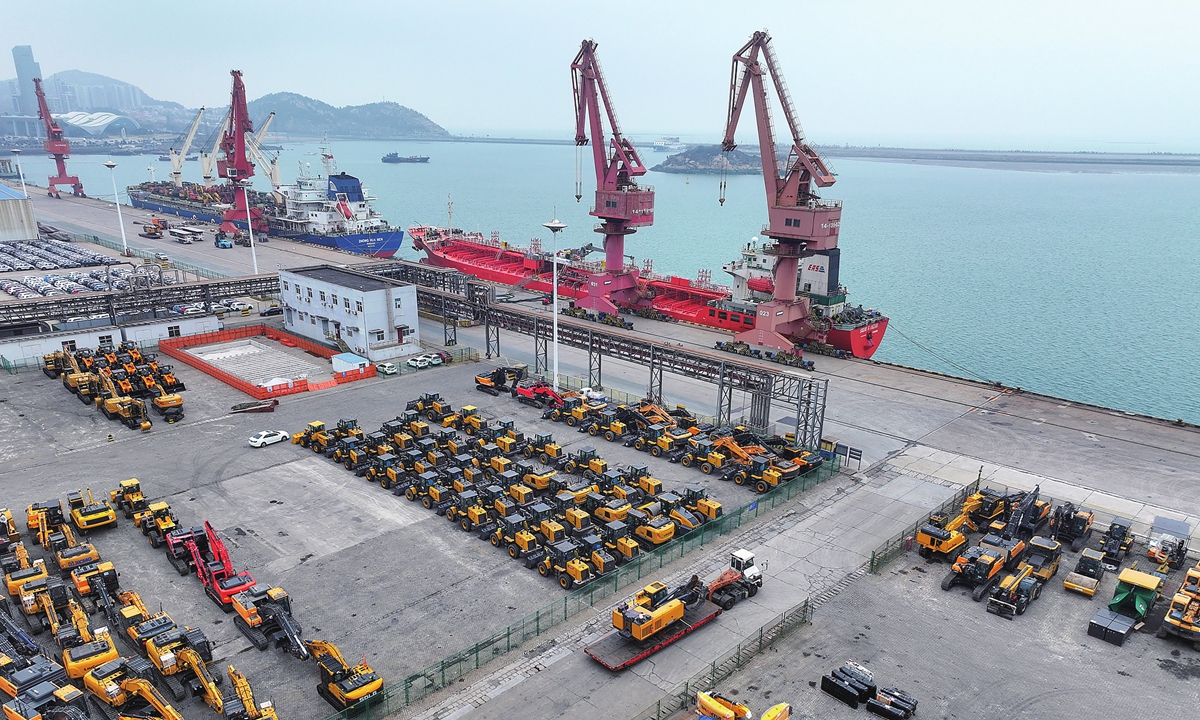
Cargo ships berth at Lianyungang Port in East China's Jiangsu Province, loading construction vehicles and machinery for export. Photo: VCG
Data from the China Construction Machinery Association showed that in the first five months of this year, China's new-energy construction machinery exports maintained strong momentum. For example, the country exported 1,232 electric loaders during the period, up 208 percent year-on-year, CCTV News reported on Tuesday.This surge in green machinery exports comes as nations worldwide race to accelerate their green transitions. Yet some Western forces keep hyping a groundless "economic threat" narrative and pushing for trade restrictions against China - claims that fall apart, especially in the new-energy field.
China's new energy construction machinery exports, in reality, provide mature, cost effective, and highly adaptable solutions to a global need that is both urgent and tangible. They provide hardware support for the establishment of local new-energy industries and green infrastructure upgrades across diverse economies.
This process helps countries cut transformation costs, shorten industrial cultivation cycles, and advance the global green upgrading of manufacturing industries. This is also why countries from Africa to the Middle East, and from Southeast Asia to Latin America, are importing Chinese construction machinery, solar panels, and battery production lines.
Booming overseas sales of new-energy construction machinery are merely a microcosm of the profound structural upgrade of China's exports. From the perspective of global supply chains, intermediate goods and high‑end equipment have become pivotal components of China's exports, forming key supporting links in worldwide production networks. China is no longer merely the assembler and exporter of finished consumer goods; it plays a far more central role in the production chain. A significant portion of the components that keep factories running in other countries and the machinery that underpins their industrial upgrades, is made in China.
This structural transformation clearly demonstrates that Chinese manufacturing is not a threat but a stabilizer of global industrial cooperation. Those who call for restrictions on Chinese exports are not only ignoring market realities - they are also slowing down their own countries' green transitions and industrial upgrades. Disrupting supply chains raises the cost of accessing key equipment, and ultimately, the harm falls on their own businesses and consumers.
The value of Chinese exports extends beyond the production side to the consumer end as well. At a time of persistently high global inflation, consumer demand for Chinese products has shown strong resilience. Chinese consumer goods, with their high cost‑effectiveness, have effectively eased the pressure of rising living costs for ordinary people around the world.
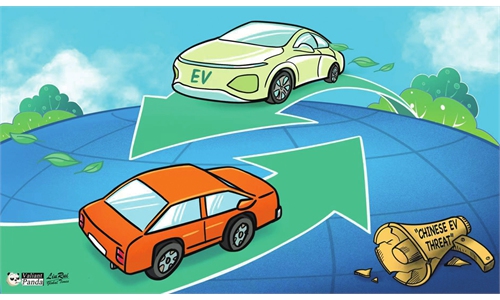
NBC News reported on Tuesday that high gasoline and car prices have driven Chinese electric vehicles (EVs) into US consumer focus. While Chinese EVs have yet to officially enter the US market, this is not the first time that US media outlets have noticed their growing appeal among American consumers.
This phenomenon speaks volumes: market demand for Chinese products arises from consumers' real needs and their own rational choices. When living costs rise, people naturally gravitate toward what they can actually afford.
Putting both sides together, and the picture is clear. On one hand, Chinese exports deliver high-end equipment that empowers global industrial upgrading. On the other hand, they provide affordable consumer goods that ease the cost-of-living burden on households. The dual value of China's exports is unmistakable.
Yet, some Western forces, ignoring market laws and the common interest of the global community, keep stoking fear over Chinese exports and ramping up trade protectionism. Such short-sighted political moves will not contain China's industrial development; instead, they will backfire on their own economies and people.
At a time when the global economy struggles with a weak recovery and persistent inflation, all countries are in urgent need of stable, efficient and affordable supply chain support. Chinese exports are growing precisely because they meet that need. From electric loaders to EVs, and from intermediate components to finished consumer products, the data demonstrates China's role as a provider of development momentum and a contributor of global industrial chain stability.
Framing Chinese exports as a threat contradicts both the economic facts and the real interests of companies and consumers worldwide. In today's deeply interconnected global economy, recognizing the positive value of China's exports and upholding an open, cooperative trade environment is the rational choice that serves everyone's interests.
RELATED ARTICLES