China-Latin America and Caribbean ties: Beyond trade, toward shared prosperity and mutual learning between civilizations
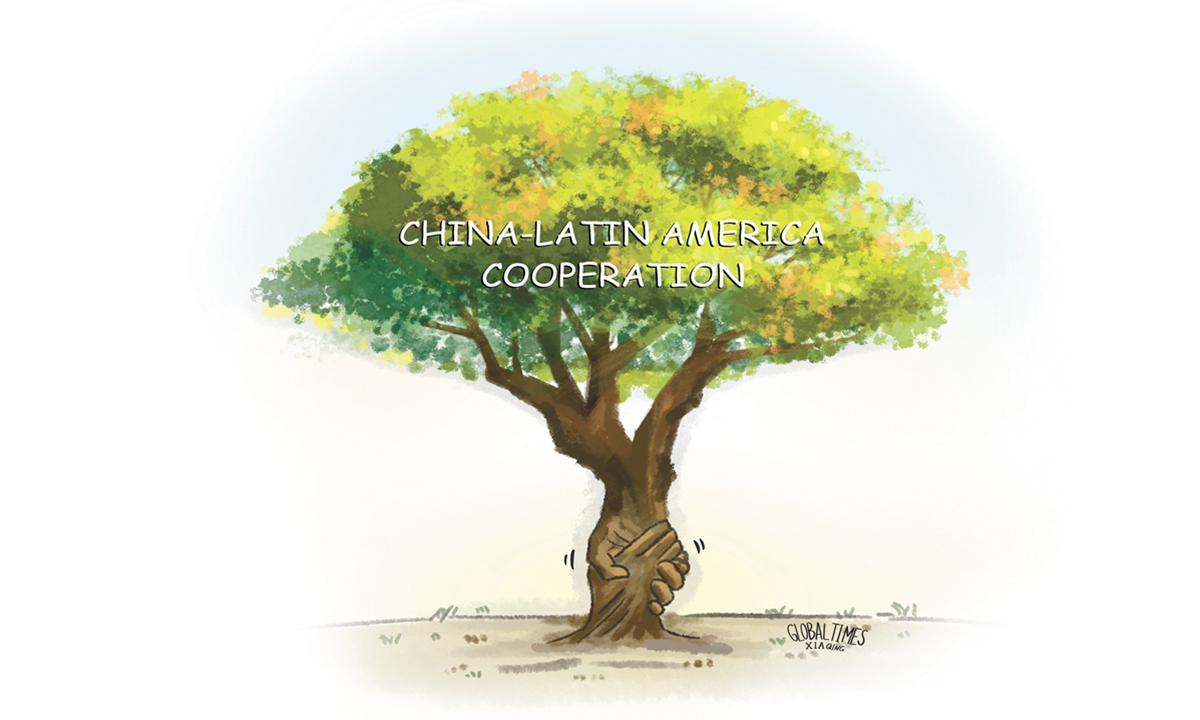
Illustration: Xia Qing/GT
Amid a global landscape marked by geopolitical frictions and resurgent hegemonism, the deepening partnership between China and Latin America and Caribbean (LAC) countries has emerged as a beacon of mutually beneficial cooperation. While surging trade volumes naturally draw widespread attention, the true value of China-LAC engagement stretches far beyond economic figures. It fosters equal respect, revamps regional infrastructure, boosts endogenous driving forces and capabilities for development and pioneers a brand-new form of international cooperation and sharing future, rewriting LAC countries' centuries-old trajectory of being exploited by external forces.
For centuries since the colonial era, LAC countries endured plunder, suppression and unequal subjugation. Successive external powers imposed their ideologies and systems on the region, leaving deep historical scars. The Monroe Doctrine and the subsequent Big Stick policy turned the region into a backyard for geopolitical rivalry, trapping local nations in long-term poverty, turmoil and over-reliance on Western markets. Against this historical backdrop, China stands out as the first global power to engage LAC countries on the fundamental principles of equality, mutual respect and non-interference in internal affairs. This marks an unprecedented civilizational interaction. China respects LAC countries' diverse political systems, historical traditions and cultural heritage, never seeking dominance or ideological imposition. Such sincere respect has laid a solid emotional and cultural foundation for bilateral ties, enabling two time-honored civilizations to communicate on an equal footing and learn from each other, rather than the one-sided subjugation that haunted the region for generations.
Robust trade cooperation is a solid starting point, yielding tangible gains for both sides. Data from the General Administration of Customs showed that China-Latin America trade value had reached 3.93 trillion yuan (about $565.28 billion) in 2025. Complementary economic structures underpin this thriving trade: LAC countries supply abundant mineral resources, agricultural products and energy, while China exports high-tech goods, equipment and manufactured products. This dynamic trade landscape has diversified LAC countries' export markets, reduced their long-standing over-dependence on North American and European economies, and greatly enhanced its ability to withstand global financial shocks. During the 2008 financial crisis, steady trade and continuous investment from China helped LAC countries avoid a sharp rise in poverty and inequality, a vivid testament to the resilience brought by diversified partnerships.
What transforms short-term trade gains into long-term vitality is the joint upgrade of regional infrastructure and the steady improvement of LAC countries' independent development capabilities. For decades, poor connectivity and backward logistics have shackled the region's development potential. The Belt and Road Initiative (BRI) addresses this long-standing bottleneck head-on. It drastically cuts logistics costs for commodities exports and advances South American regional integration. Beyond infrastructure, in-depth cooperation in mining, new energy and manufacturing helps LAC countries break away from the old model of merely exporting raw materials. BRI does not just build roads, ports and factories; it cultivates local talent, transfers advanced technologies and empowers LAC countries to grasp its own development initiative.
Most profoundly, China-LAC cooperation is jointly exploring and practicing a new form of human civilization. The old global order, featured by bloc confrontation, hegemony and Neo-colonial exploitation, is gradually fading, while a new path of win-win cooperation is taking shape. China's modernization experience, which balances economic growth, social equity and environmental protection, combines opening-up with independent innovation, offers a valuable reference for LAC countries seeking development paths suited to their national conditions.
In an era where the so-called New Monroe Doctrine attempts to redivide spheres of influence and stoke confrontation, China and LAC countries jointly uphold multilateralism and oppose bloc politics. Their partnership proves that different civilizations, systems and development models can coexist harmoniously and achieve common progress through dialogue and collaboration.
The wave of globalization further helped LAC countries mitigate social conflicts and upgrade industrial structures. Over the past four decades, fading ideological barriers and deepening global interconnectivity have enabled LAC countries to embrace its longest period of political stability, economic growth and poverty reduction in modern history. In recent decades, most LAC countries have maintained smooth government transitions and steady institutional progress. Regional poverty rates have declined remarkably, and the United Nations Millennium Development Goals have been partially fulfilled. Remarkable progress has also been achieved in narrowing inequality, improving education and medical services.
China-LAC relations are no longer a simple economic partnership. They represent a successful practice of equal mutual learning between civilizations, capability-driven sustainable development and joint creation of a new sharing future. As the Global South rises collectively, this mutually beneficial bond will continue to grow stronger, lighting up a promising future for all nations pursuing independent development and shared prosperity.
Liu Jinlong is professor and director of China-Brazil Joint Research Centre for Exchanges and Mutual Learning Between Civilizations, Renmin University of China. Velia Govaere is professor of Universidad Estatal a Distancia (UNED), Costa Rica. opinion@globaltimes.com.cn
RELATED ARTICLES