South Korea should develop relations with China and the US in parallel, based on its own fundamental and long-term interests: Chinese ambassador
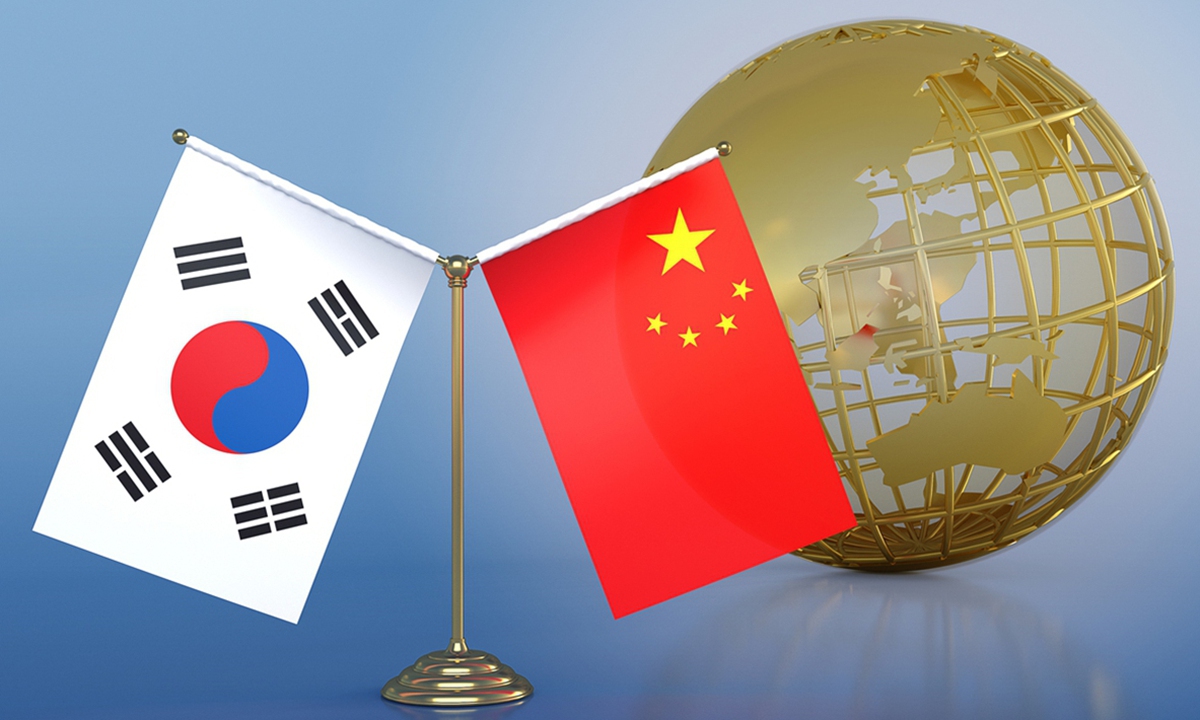
China South Korea Photo:VCG
China and South Korea are strategic partners, while South Korea and the US are allies. We hope the South Korean side will proceed from its own fundamental and long-term interests, and develop its relations with China and the US in parallel, said Chinese Ambassador to South Korea Dai Bing in an interview with the Korea Daily published on Wednesday, in response to a question regarding what role the Chinese side hopes the South Korean side to play against the backdrop of China-US strategic competition.
It's believed South Korea has the wisdom and capability to do so, Dai said, according to the Chinese transcript published on the official WeChat account of the Embassy of China in Korea on Wednesday. Dai noted that in bilateral fields such as scientific and technological cooperation, as well as collaboration in industries like semiconductors — areas where both sides have mutual needs and shared interests — China and South Korea should advance cooperation in an open, upright, and confident manner.
During the interview, Dai also further shared his perspective on deepening technological cooperation between China and South Korea.
In recent years, Korean society has shown strong interest in China’s technological progress and has studied China’s approaches to talent development, policy support, and industrial cultivation. While many have urged South Korea to take full advantage of its proximity and deep presence in China to enhance cooperation, some remain apprehensive, fearing China’s strong competitiveness and third-party interference, Dai said, in response to a question regarding whether South Korea’s perception of China affects its objective evaluation of Chinese technology and bilateral cooperation, as well as the efforts the governments of both sides should make.
“New technologies like artificial intelligence (AI) are advancing and updating at an extremely fast pace, meaning cooperation opportunities can be fleeting… The wave of global industrial innovation will not pause, nor will China’s rapid development wait for others,” Dai said, while urging governments of both sides to strengthen their guidance, and all sectors of society to actively support and participate, so that both countries can follow the trend of the times, deepen cooperation, and better achieve common development.
Currently, the industrial chains of China and South Korea are deeply intertwined, having long formed a community of shared interests in which “you are in me, and I am in you,” Dai said. He noted that although it is true that industrial competition between the two countries has intensified in recent years, it is also true that the strategic and mutually beneficial nature of bilateral cooperation remains unchanged. He pointed to an emerging new normal, in which there is competition within cooperation and cooperation within competition between China and South Korea.
With regards to which fields has the greatest potential for scientific andtechnological cooperation, Dai said that China and South Korea are both global leaders in technological development, each with its own distinctive strengths, and the two countries can fully achieve complementary advantages and deliver mutual benefit and win-win outcomes.
According to Dai, from late last year to early this year, the leaders of both countries conducted mutual visits within a short span of two months, which has opened a new chapter in bilateral relations and created favorable conditions for deepening scientific and technological cooperation between the two countries.
Dai suggested that both sides should continue to deepen and solidify existing cooperation, fully tap the potential in traditional areas of collaboration. At the same time, in line with the consensus reached by the leaders of the two countries, both countries should actively expand and strengthen cooperation in high-tech fields such as AI, biomedicine, green and environmental protection, so as to elevate the quality and level of bilateral cooperation.
Global Times
RELATED ARTICLES