Taiwan region reportedly mulls new chip sales ban on Chinese mainland, aligning with US measures; analyst slams it as another move to curry favor with Washington
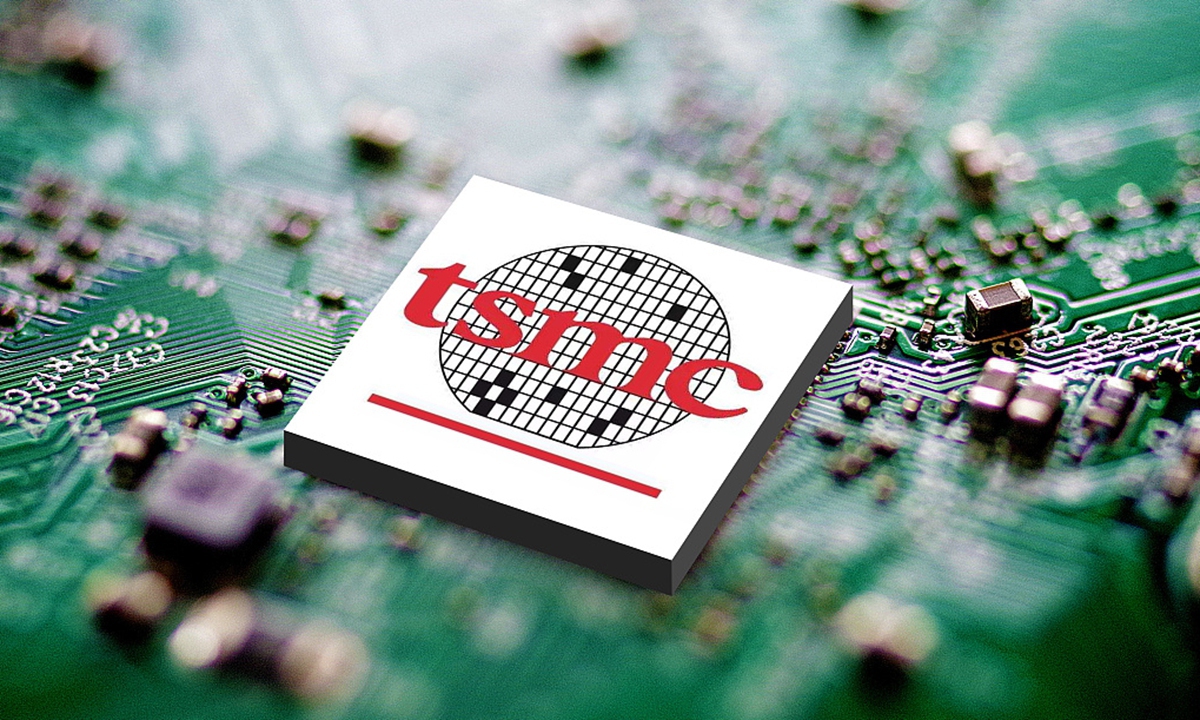
TSMC Photo: VCG
Taiwan regional authorities are considering much stricter export controls on artificial intelligence (AI) chip sales to the Chinese mainland to further align with US measures, Bloomberg reported on Tuesday. The controls, which would restrict chip sales to all customers in the Chinese mainland, are part of the Taiwan island's ongoing trade talks with the US, the report said.
A Chinese mainland expert slammed the latest chip restrictions, saying that if implemented, they would be yet another classic example of the Democratic Progressive Party (DPP) authorities willingly serving as a pawn of the US and currying favor with Washington.
He warned that by using the island's semiconductor industry as a "certificate of loyalty" to please the US, the DPP authorities risk dragging the Taiwan region from a "high-tech island" into the abyss of a "hollowed-out island," inflicting severe damage on the local tech industry and the well-being of the people on the island.
The reported restrictions have drawn harsh criticism from some Taiwan-based media outlets.
The United Daily News, quoting industry insiders, reported that the ban "is bound to increase corporate compliance costs."
Taiwan-based news website cnyes.com said that the Taiwan island occupies a central position in the global artificial intelligence (AI) supply chain, and it is home to key chip manufacturers such as TSMC. It also hosts a large number of AI server supply chain companies responsible for assembling Nvidia chips into AI servers used in large-scale data centers. The report noted that "any further measures restricting the Chinese mainland market could impact the business of these related companies."
In the first quarter, clients in the Chinese mainland accounted for 7 percent of TSMC's total revenue, according to media reports.
The proposed chip controls would be an expansion from a ban the Taiwan regional authorities imposed last year. In June 2025, the Taiwan regional authorities added Chinese chipmakers Huawei Technologies and Semiconductor Manufacturing International Corp (SMIC) into the so-called export control list, according to a report by the Associated Press.
In July last year, Chinese Ministry of Commerce (MOFCOM) announce it has added eight entities from China's Taiwan region to the export control list, and the export of dual-use items to these eight companies was prohibited.
The Bloomberg report, quoting sources close to the matter, claimed that Taiwan regional authorities "have agreed to directionally follow the US approach" and are likely to curb Chinese mainland sales of AI chips with processing power above a certain threshold — "much like Washington does," though they have not entirely decided on how far it will go to adopt American policies.
Li Yong, an executive council member of the China Society for WTO Studies, told the Global Times on Wednesday that the DPP authorities' proposed export controls targeting the Chinese mainland disregard the interests of companies and residents on the island, as they seek to cater to and curry favor with the US.
"On the one hand, facts have proven that the development of high-tech industries on the Chinese mainland will not be suppressed by any export ban. On the other hand, if implemented, such a ban would bring catastrophic consequences to the Taiwan region's semiconductor industry and gradually hollow out the island's core competitiveness," Li said.
Chinese mainland observers also warned that considering the US' ultimate aim is to completely drain the island's semiconductor industry to serve its own interests, the DPP authorities' move of "kneeling to the US" would only harm and destroy the island's high-tech industries.
They also drew a comparison to an investment memorandum of understanding reached between the Taiwan island and the US early this year, which was another example of an unequal deal that sells out the island's core industries, sacrifices the island's development prospects, and harms the interests and well-being of the people on the island.
In response to a question related to media reports saying that the island of Taiwan added chipmakers Huawei Technologies and SMIC to its export control list under US pressure, China's Foreign Ministry said that DPP authorities' subservience to the US will only harm and destroy the island of Taiwan.
RELATED ARTICLES