GT on the spot: Shanghai court demonstrates innovative approach to environmental education
Foreign guests impressed by China’s efforts to combine legal practice with public education
By in Shanghai Published: Jun 10, 2026 10:06 PM

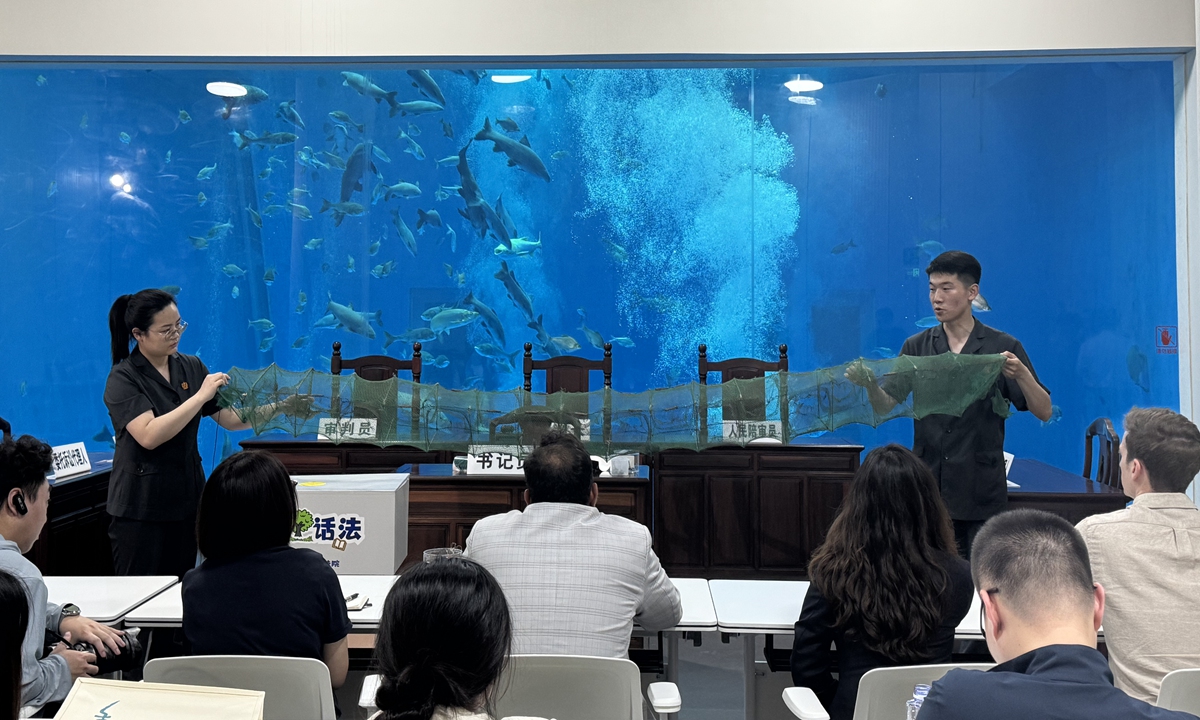
Picture of circuit court in Chongming island, Shanghai. Photo: Zhao Yusha/GT
This court was unlike any courtroom most visitors would expect. Located on Shanghai's eco-island of Chongming, the circuit court features a massive aquarium behind the judges' bench, where schools of fish drift silently beyond the glass. Visitors can watch aquatic life swimming in the background while learning about cases involving wildlife and environmental protection.On Wednesday, members of a legal observation group, including both Chinese and foreign guests, took part in a "blind box" challenge in the circuit court, drawing cards depicting different fishing tools and trying to determine whether they are legal under Chinese law. After each guess, a guide explained how the tool is used and whether its use is permitted by law.
The event was part of a program organized by the Shanghai High People's Court to showcase China's development of the rule of law. On Wednesday, members of a legal observation group visited the circuit court, where a judge from the Chongming court said the visit provided an opportunity to highlight the court's environmental adjudication efforts and showcases how specialized judicial practices are helping protect the ecosystem at the Yangtze River estuary.
The guests were first introduced to the ecological diversity of the Yangtze River through a series of aquariums outside the circuit court housing Chinese sturgeon - a nationally protected first-class aquatic species and one of the Yangtze River's flagship species - as well as other aquatic creatures.
The exhibition hall also features specimens of extinct animals as well as a number of rare species. Alongside them are displays detailing related court cases, helping visitors understand both the environmental damage caused by threats to biodiversity and the legal consequences faced by those responsible.
Later, the legal observers were introduced to the number of environmental protection cases the Chongming court has handled as this year marks both the 10th anniversary of building of Chongming's world-class eco-island and a decade of specialized environmental adjudication by the Chongming court.
The Chongming court has handled more than 2,300 environmental cases over the past ten years, including landmark cases involving the illegal killing of Chinese sturgeon, unlawful occupation of farmland and ecological restoration along the Yangtze estuary.
Court officials said the declining number of environmental cases in recent years reflects growing public awareness of environmental protection and improved ecological governance in the region.
One court official explained that the establishment of the circuit court brought environmental justice closer to where ecological crimes occur. Because many environmental violations, such as illegal fishing and poaching, take place in wetlands, forests and nearby waters, the court occasionally holds hearings at the scene of the offenses and invites local residents and fishermen to observe the proceedings.
The aim is not only to facilitate trials but also to raise public awareness of environmental protection, the official said. In addition to hearings, the site serves as a public education center, featuring exhibitions of environmental cases to help visitors understand the ecological damage caused by environmental crimes and the legal consequences for those responsible.
The foreign guests who participated in this activity were amazed by China's unique way of combining education with legal process.
"The beauty of this exhibition is that it is a good initiative for disseminating knowledge. We saw technical data on nature conservation here. We also saw reports on the cases that have been tried by the Chongming court so far. It is an important asset for environmental education. This is a trend in which China is leading the world," Douglas de Castro, a professor of international law at the School of Law of Lanzhou University, told the Global Times.
"It was very interesting because there was a combination of the theory and practice of law, which is very important for environmental protection," he noted.
"What impressed me is that the courts here are thinking beyond fines, jail sentences and other forms of punishment. They are also asking: How can we restore what has been taken away from nature? That's where things become creative, and I found that very enlightening," said Cameron Andersen, an Australian TV presenter.
"The judges are not simply thinking, 'We need to put this person in jail.' They are also thinking about nature and how to repair the damage that has been done. It was encouraging to hear that they are looking for creative ways to fix the problem, not just punish the offender," Andersen noted.
RELATED ARTICLES