China blasts Japan’s security draft, warns against attempt to justify re-militarization
Intl community needs to stay vigilant, nip dangerous trajectory in the bud: FM
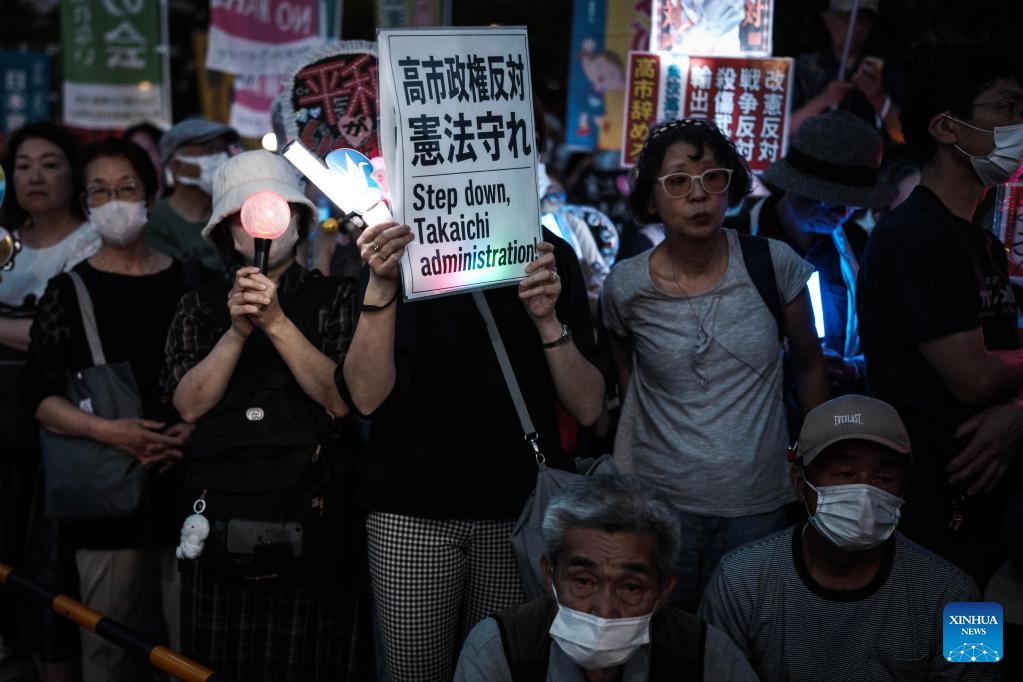
People holding slogans participate in a protest rally in front of the National Diet Building in Tokyo, Japan, May 19, 2026. Thousands of demonstrators gathered in front of Japan's National Diet Building in Tokyo on Tuesday evening to protest the government's attempts to undermine the country's pacifist constitution through constitutional revision and military expansion policies. (Photo: Xinhua)
China on Wednesday blasted Japan's draft proposal that seeks to revise the country's three key security documents, saying the proposal smears China's normal military activities, deceives Japanese public and the international community to justify its acceleration of re-militarization and China called on the international community to remain vigilant on such moves.
Japan's ruling Liberal Democratic Party (LDP) on Tuesday adopted a draft proposal related to revising the country's three major security documents, calling for an unprecedented strengthening of institutional support for its military industry, according to a Yomiuri Shimbun report on Wednesday.
A Chinese expert said the move revealed Tokyo's continued use of the so-called "China threat" narrative to justify military expansion and a departure from its long-standing post-war security restraints.
The Chinese expert said the draft proposal along with Japan's 2026 Defense White Paper that portrays China as a major security challenge are closely linked, adding that these documents use China as a justification for military buildup, while Tokyo is steadily advancing policies aimed at loosening restrictions on military capabilities, expanding arms exports and pursuing a neo-militarist agenda under Sanae Takaichi's administration.
Security documents revision
When asked to comment on LDP's adoption of the draft proposal on revising the country's three key security documents, Chinese Foreign Ministry spokesperson Lin Jian said at the regular press conference that the draft proposal adds to existing evidence that exposes some Japanese forces' attempts and moves to seek re-militarization, break free from post-war norms, and accelerate military buildup.
By wantonly criticizing and smearing China's normal military activities and hyping up tensions surrounding Japan, the proposal seeks to deceive the Japanese public and the international community and justify the need to speed up re-militarization at home, Lin said.
They seek to embed military expansion and war preparedness into national institutions, economic infrastructure and public opinion, chip away at the constraints imposed by Japan's constitution, international law and domestic legislation, renounce their obligations under international law, and challenge the post-war international order. This trajectory is becoming more pronounced and posing a real danger. The international community needs to stay highly vigilant and nip it in the bud, Lin said.
According to Mainichi Shimbun, besides calling for a higher military budget, the draft urges Japan to clearly demonstrate its "national will" to strengthen self-defense.
The LDP is expected to submit the recommendations to Takaichi later this month. The government plans to take into account recommendations from an expert panel expected this autumn before formally approving a new set of the three key security documents at a Cabinet meeting in December, Mainichi Shimbun reported, adding that "further expansion of defense expenditures could result in increased financial burdens on Japanese people."
Apart from the expected revision of the security documents, according to Yomiuri Shimbun, the Japanese government is also set to publish a 2026 Defense White Paper. The white paper is expected to state that Japan will "strengthen cooperation with allies and like-minded countries and enhance deterrence and response capabilities" in response to what it describes as China's rapidly growing military power.
The white paper also mentioned the planned revision of Japan's three security documents this year, and detailed efforts to strengthen Japan's defense industrial foundation. Following revisions in April to the Three Principles on Transfer of Defense Equipment and Technology and related implementation guidelines, it emphasized the importance of expanding military equipment transfer to strengthen the deterrence and response capabilities of its allies and like-minded partners, according to the Yomiuri Shimbun.
"The Japanese government has used the China threat as a pretext to intensify military expansion, particularly in the area of lethal weapons exports, a trend that should raise concerns within the international community," Liu Jiangyong, a professor at the Institute of International Studies of Tsinghua University, told the Global Times.
Japan's military buildup
Japan is also taking concrete steps to boost its military industrial base. The Yomiuri Shimbun reported on Wednesday that the government is considering establishing a new organization to support the military industry through measures including promoting exports of military equipment.
The plan would potentially introduce a "Japanese version of Foreign Military Sales (FMS)," under which the government would act as an export intermediary on behalf of private companies.
Japan has already concluded several arms export arrangements under the framework established by its 2025 Defense White Paper. These include the planned export of Mogami-class destroyers to Australia.
Such developments have also sparked concerns abroad and within Japan. In March, the Japan Federation of Bar Associations issued a statement opposing the expansion of lethal weapons exports through the removal of restrictions under the "five categories" framework governing defense equipment transfers.
The organization warned that implementing the ruling party's proposals would effectively allow Japan-produced and exported weapons to contribute to and expand global conflicts.
The statement further argued that the proposals undermine Japan's long-standing principle of restricting arms exports, weaken its commitment to achieving international peace through peaceful and diplomatic means, and erode the foundations of the country's pacifist identity under its Constitution.
Neighboring countries are also worried. Yahoo Japan previously reported on opposition to the Japan-Philippines Comprehensive and Strategic Partnership. One Filipino resident identified as Mel expressed concern that growing defense cooperation between Japan and the Philippines could draw Manila further into US- and Japan-led military strategies in the region.
"Japan's re-militarization and the expansion of the military role of the Self-Defense Forces are not good for the Asia-Pacific region," he said, adding that memories and consequences of World War II continue to affect people today.
RELATED ARTICLES