Exclusive: Alleged 'new structure' on China's Huangyan Dao is a temporary research facility
China sanctions Philippine Defense Secretary for undermining China's legitimate interests, sabotaging China-Philippines relations
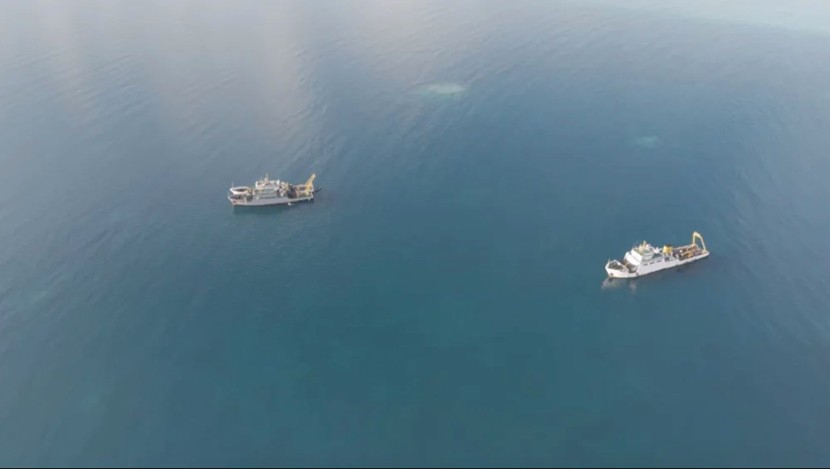
Aerial footage of the research vessels during the scientific expedition released by the South China Sea Institute of Oceanology under the Chinese Academy of Sciences Photo: South China Sea Institute of Oceanology under the Chinese Academy of Sciences
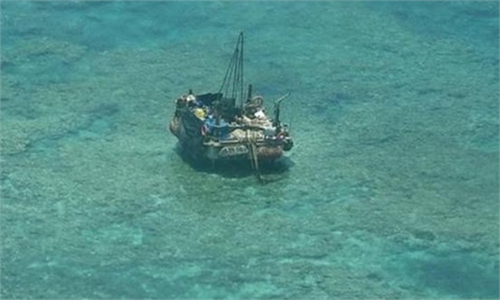
Recently, the Philippine side has repeatedly hyped up an alleged "new structure" that was observed inside the lagoon of China's Huangyan Dao. On Wednesday local time, the Philippine authorities held a briefing, releasing what it called "details" of the so-called floating structure found at China's Huangyan Dao, along with related aerial images, while making irresponsible remarks about China's normal activities at Huangyan Dao.
The Global Times reporter has learned that the so-called "new structure" at Huangyan Dao recently hyped by the Philippine side is in fact a temporary scientific research facility set up there by the South China Sea Institute of Oceanology under the Chinese Academy of Sciences. The floating in-situ sampling and experimental platform is designed to improve ecological monitoring, research and forecasting at Huangyan Dao.
Regarding the Philippine side's hype over the so-called "new structure" at Huangyan Dao, Chinese Foreign Ministry spokespersons responded twice at regular press conferences respectively on June 5 and June 9. The spokespersons said China has indisputable sovereignty over Huangyan Dao and its adjacent waters. Any activities carried out by China at Huangyan Dao, including scientific research, are the legitimate rights of a sovereign country.
New hype
According to Philippine media outlets including ABS-CBN, Philippine Coast Guard spokesperson Jay Tarriela displayed photos of the so-called "new structure" recently taken by the Philippine Coast Guard at a briefing on June 10 local time. Tarriela described the so-called "new structure" as a movable floating platform with a deck area of more than 30 square meters and fitted with metal poles.
The chief of staff of the Armed Forces of the Philippines, Gen. Romeo Brawner claimed in an official statement that the structure appeared to be equipped with antennas and that personnel were seen on it. As for the scientific research activities that China had made public, Tarriela gave a vague response, claiming he did not know its specific purpose. Some Philippine officials also claimed that China's activities could be a precursor to more permanent facilities.
After Philippine officials repeatedly sought to play up the issue, the South China Sea Institute of Oceanology under the Chinese Academy of Sciences, which conducted the research activity, released information on Wednesday about the operation and its findings.
The South China Sea Institute of Oceanology said that since May 20, 2026, it has led a comprehensive scientific expedition on the development, evolution and ecological resilience of Huangyan Dao. The expedition aims to deepen understanding of the patterns and trends in the development and evolution of Huangyan Dao's islands and reefs, the mechanisms sustaining coral reef biodiversity, and their ecological connectivity with islands and reefs in the Xisha and Nansha areas. So far, the research team has conducted a comprehensive survey covering the entire Huangyan Dao atoll.
The so-called "new structure" hyped by the Philippine side is in fact a floating in-situ sampling and experimental platform set up by the research team in the waters of Huangyan Dao. The platform can be used for core sampling, time-series observation of environmental factors, and in-situ experiments.
The samples and experimental data obtained from the expedition are of great value for studying the historical development process of Huangyan Dao, the physiological and ecological responses of coral reef organisms to changes in environmental factors, assessing geomorphological evolution and ecological changes in the protected area, and predicting the impact of global climate change, overfishing and other human activities on the ecological security of Huangyan Dao.
"The Philippine side should clearly recognize that the Huangyan Dao National Nature Reserve established by the Chinese government will not exist in name only. Instead, China will only step up its protection of Huangyan Dao," Yang Xiao, a research fellow at the Institute of Peaceful Development under the Chinese Academy of Social Sciences, told the Global Times.
Yang said such protection is reflected in two aspects: On the one hand, China will not allow Philippine personnel to enter Huangyan Dao and its adjacent waters to carry out destructive activities; on the other hand, China will make the protection of Huangyan Dao's ecology a priority, not only reducing the impact of human activities on the ecological security of Huangyan Dao, but also intensifying scientific research and accelerating ecological restoration there.
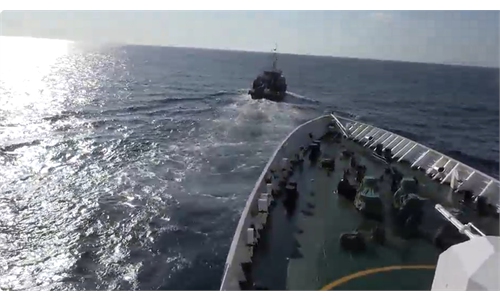
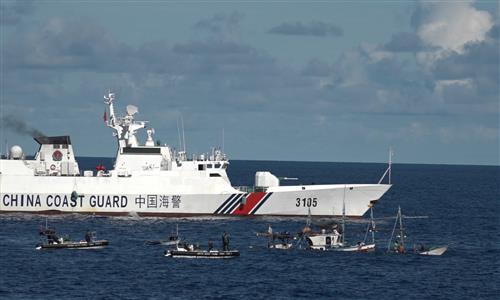
He further noted that Philippine officials often speculate that China may build "permanent facilities" at Huangyan Dao - such smears are in fact a case of "judging others by one's own petty standards." China has exercised effective control over Huangyan Dao, with maritime rights protection and law-enforcement forces maintaining a regular presence there.
"We can see that since last year, the Southern Theater Command of the Chinese People's Liberation Army and the China Coast Guard have issued monthly updates on combat-readiness patrols and law-enforcement patrols in the territorial waters, airspace and surrounding areas of China's Huangyan Dao," Yang said.
Yang said the Philippine side should recognize the reality that it cannot "meddle in" China's Huangyan Dao, face up to China's continued, peaceful and effective exercise of sovereignty and jurisdiction over Huangyan Dao, and stop its crude and meaningless sensationalization.
Sanctions
China's foreign ministry on Thursday announced sanctions against Philippine Defense Secretary Gilberto Teodoro Jr. who repeatedly made irresponsible remarks on China, which undermines China's legitimate interests and sabotages China-Philippines relations.
To uphold China's sovereignty, security and development interests, China has decided to prohibit Gilberto Teodoro Jr. and his spouse and child from entering the Chinese mainland, Hong Kong and Macao, and not allow organizations and individuals in China to engage in any transaction, cooperation or other activities with him and his spouse and child.
Before China's announcement of the sanction against Gilberto Teodoro Jr., on Wednesday, Philippine Secretary of Foreign Affairs Maria Theresa Lazaro claimed that establishing clear maritime boundaries between the Philippines and Japan is of vital importance to the country's national defense and "has nothing to do" with China. She added, "We should continue with our delimitation talks," even if China keeps objecting or increases pressure, Nikkei Asia reported.
Chinese experts on Thursday said the so‑called Japan-Philippines maritime delimitation talks concern an area east of China's Taiwan island. They noted the move carries ulterior purposes beyond bilateral discussions.
Ding Duo, Director of the Research Center for International and Regional Issues at the National Institute for South China Sea Studies, told the Global Times that the collusion between Japan and Philippines aims beyond "delimitation," but serves as stepping stone to squeeze China's maritime operational space in the waters east of the Taiwan Island.
After so-called delimitation, they could scheme to carry out security cooperation, military collaboration and naval exercises, confining China's maritime activities in this area, Ding elaborated.
The so-called cooperation between Japan and the Philippines cater to both countries' respective ambitions and carries strong Cold War undertones, analysts said, warning against Japan's dangerous neo-militarist resurgence and Philippines' adventurist tendency.
RELATED ARTICLES