Chinese envoy calls for political solutions to advance peace amid continuing Middle East tensions; observer says region’s future path remains fraught with uncertainty
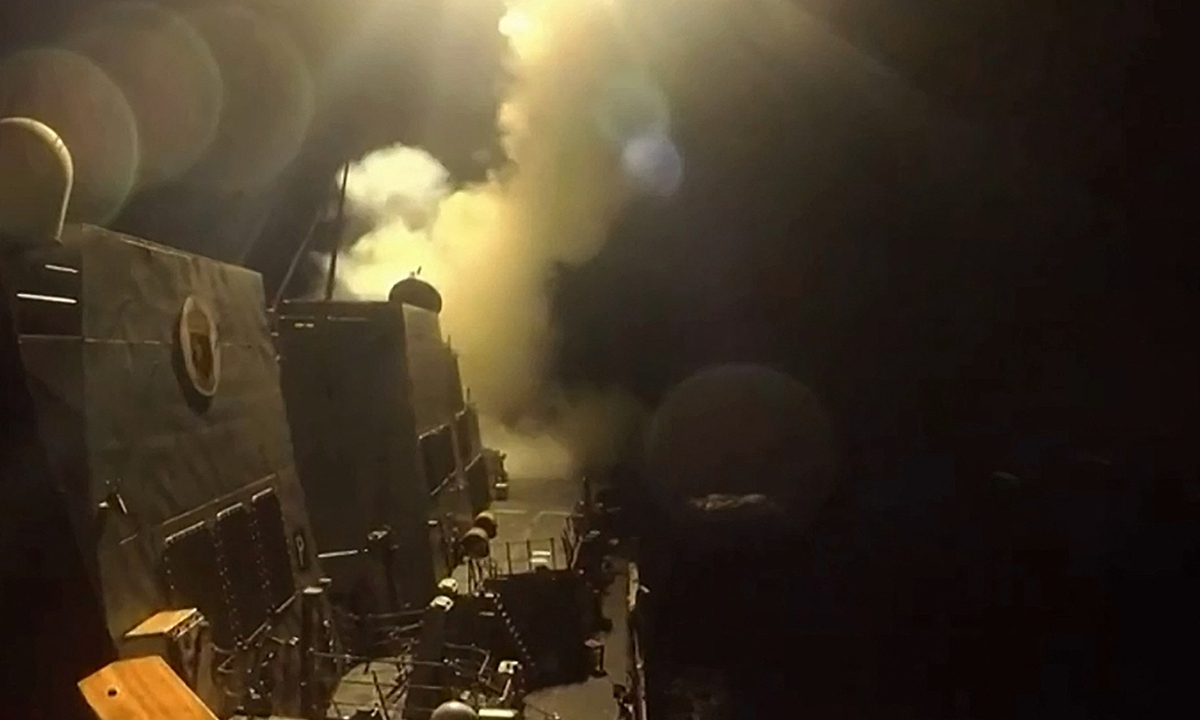
An image grab from a video released by the US Central Command (CENTCOM) on June 11, 2026 shows what the military says are strikes targeting "Iranian military surveillance capabilities, communications systems and air defense sites". The US launched a new wave of attacks against Iran as efforts to end the three-month old war sputtered, and Tehran hit back saying it will target any ship going through the Strait of Hormuz. Photo: VCG
With tensions remaining unresolved across the Middle East and fresh attacks ongoing between the US and Iran, the Chinese envoy to the United Nations voiced proposals on Wednesday local time to advance peace in the region, calling for political solutions, fairness and justice, independence and self-reliance, and addressing both symptoms and root causes.
During a Security Council open debate, China's Permanent Representative to the United Nations Fu Cong called for resolving disputes through political means and peaceful approaches. Fu urged all parties to abide by the purposes and principles of the UN Charter, bridge differences through dialogue and consultation, and refrain from the use or threat of force.
Fresh rounds of attacks continue between the US and Iran. Iran's Revolutionary Guard Corps (IRGC) said it launched retaliatory attacks targeting US military bases in Kuwait, Bahrain and Jordan early Thursday, after the US said it struck multiple targets in Iran, according to CNN.
In the context of strikes, Kuwait closed its airspace and air defenses are engaged with "hostile objects", state media reported, citing the country's army. Sirens sounded in Bahrain, according to the country's Ministry of Interior, per CNN.
Also on Thursday, Iran's top joint military command announced the closure of the Strait of Hormuz, including oil tankers and commercial ships, saying any vessel that will attempts passage will be shot at, according to Reuters.
According to a post by US Central Command, the forces completed additional strikes against multiple targets in Iran on Wednesday. US President Donald Trump also warned that the US is prepared to rapidly escalate military action if Tehran does not soon sign an agreement to end the ongoing crisis, Fox News reported.
When asked about reports that US military bases in the Persian Gulf are used to attack Iran, Chinese Foreign Ministry spokesperson Lin Jian said on Thursday that the use of force will only aggravate the situation, and military means cannot solve fundamental issue. China urges the parties concerned to halt military actions at once, return to dialogue and negotiation, and respond to relevant countries' mediation efforts so that a comprehensive and lasting ceasefire could be realized as soon as possible, the spokesperson added.
At the same time, Israeli attacks on Lebanon continued on Wednesday, with multiple reports of casualties in strikes on the south of the country and in the Bekaa Valley region, as the death toll since March from Israel's bombardments reached 3,696, according to Al Jazeera.
China called on the relevant parties to the Iran-related situation to exercise calm and restraint, halt actions that could escalate tensions, and resolve differences through political and diplomatic channels, Fu said during the debate. He also urged all parties involved in the Lebanon-Israel situation to immediately cease hostilities and achieve a genuine ceasefire.
Strikes between the US and Iran have further heightened tensions across the Middle East over the past days, Tian Wenlin, a professor at Renmin University of China's School of International Studies, told the Global Times, adding that both sides appear to be using military pressure to push for talks, since prolonged confrontation brings no benefit to either party.
Another factor behind the rising tensions in the Middle East stems from recent developments around Israel and Lebanon, Tian said.
Amid renewed fighting in the Middle East, UN Secretary-General Antonio Guterres warned on Thursday that the Middle East is being pulled deeper into crisis, and the consequences reach far beyond the region. "This week has brought wider attacks and further deterioration where the ceasefire is more like a lesser-fire. We should not minimize the risks of lesser fire becoming full fire," Guterres wrote on a X post.
Due to the destructive impact of the conflicts, the development and future path of the Middle East, where multiple conflicts intersect, remain fraught with uncertainty, Tian also told the Global Times.
RELATED ARTICLES