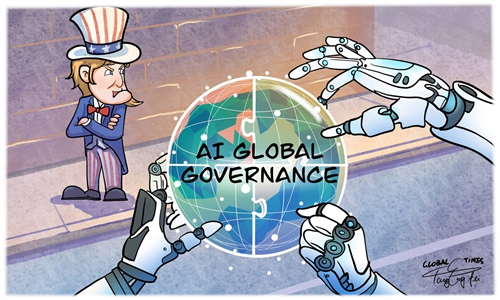
Illustration: Xia Qing/GT
Artificial intelligence has emerged as the defining technology of our era, turbocharging the latest wave of global innovation. Yet its dual nature is nowhere more starkly visible than in the military sphere, where unregulated advancement risks spiraling into a race without guardrails.The US' "accelerationist" approach to weaponizing AI is edging the world closer to the precipice. In July 2025, the White House released Winning the Race: America's AI Action Plan, tasking the Department of Defense - renamed the Department of War later - with leading an interagency push - alongside the Commerce Department and the Office of the Director of National Intelligence - to scale up military AI development and deployment. The following January, the Pentagon doubled down with a new AI Acceleration Strategy, centering its agenda on "AI acceleration." The document waters down earlier commitments to "responsible AI frameworks," reframing the technology as a means to secure unchallenged military dominance.
To that end, Washington is forging unprecedented ties between its defense establishment and Big Tech giants. Google, Microsoft, Amazon and others have inked massive contracts to build intelligent combat systems, algorithmic weapons and intelligence analysis tools for the US military. Reports indicate that the Defense Department's GenAI.mil platform already powers more than 100,000 AI agents, which process real-time data streams from different sources around the clock. The stakes grew higher in May 2026, when the Pentagon announced partnerships with eight tech leaders - including SpaceX, OpenAI, Google and Nvidia - to deploy cutting-edge AI directly to classified defense networks.
This reckless arms race has already yielded devastating humanitarian consequences on the battlefield. US-backed AI-powered drone strikes in recent Middle East conflicts have repeatedly killed civilians, victims of algorithmic errors, flawed intelligence and lax human oversight. During this year's US-Iran flare-up, for example, as AI systems guided hundreds of rapid-fire strikes across Iran, a US strike mistakenly hit a primary school in the country's south in late February, killing more than 160 children. Such collateral damage is often dismissed as "unavoidable" under the logic of US hegemony, with the military blaming "technical glitches" or "intelligence gaps" to obscure fatal flaws in its black-box systems. For civilians caught in the crossfire, there is no clear path to accountability.
The world now faces a defining choice: allow AI to become a tool of domination, or rally around a shared framework for responsible governance.
China's approach stands in sharp contrast to Washington's militaristic agenda. Beijing has consistently prioritized human-centric, responsible AI development, positioning the technology as a force for collective good - not a weapon for hegemony.
In 2021, China submitted to the Convention on Certain Conventional Weapons a position paper on Regulating Military Applications of AI, laying out core principles: no pursuit of absolute military advantage, meaningful human control over AI systems and full compliance with international humanitarian law. Two years later, it released the Global Artificial Intelligence Governance Initiative, calling on all nations - especially major powers - to exercise prudence in military AI development and use, offering a blueprint for global cooperation.
Domestically, China has built one of the world's most comprehensive AI governance ecosystems, from its Governance Principles for the New Generation of Artificial Intelligence and AI Safety Governance Framework (Version 1.0) to the Data Security Law and Interim Measures for the Management of Generative Artificial Intelligence Services. These rules draw clear lines for how AI can be developed, deployed and regulated. On the global stage, Beijing has championed multilateral cooperation, using platforms like the UN, BRICS and the Shanghai Cooperation Organisation to share best governance practices and help developing nations build their own AI guardrails.
AI's breakneck advance cannot proceed without limits being set - and global leadership demands more than just innovation. As some nations race to weaponize AI with little regard for the consequences, the international community must reject zero-sum competition and embrace a multilateral approach to establish clear, universally accepted rules for military AI. These guardrails are essential to ensuring the technology remains safe, secure and controllable. China will continue to play a constructive role in this effort, contributing its wisdom and experience to protecting global peace and stability.
The author is an associate research fellow at Qiyuan Laboratory's Center for Strategic Studies. opinion@globaltimes.com.cn
RELATED ARTICLES