IN-DEPTH / IN-DEPTH
Across the linked Tianshan Mountains, 'seeing China' in Kyrgyzstan
By Liu Yang, , Lin Xiaoyi and Xia Wenxin in Bishkek Published: Jun 11, 2026 11:06 PM

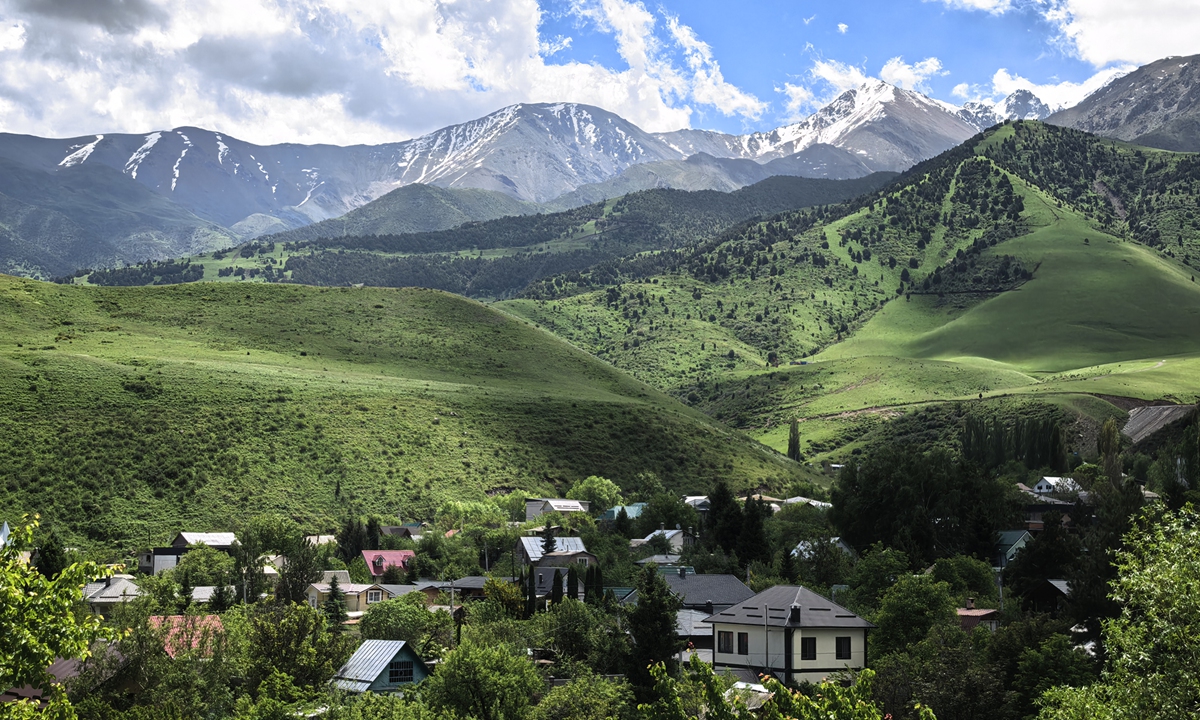
A view of the Tianshan Mountains in Kyrgyzstan Photo: Liu Yang/GT
Kyrgyzstan, China's neighbor linked by mountains and rivers, is this year's rotating chair of the Shanghai Cooperation Organisation (SCO).Although the two countries are geographically very close, the Chinese public as a whole seems far less familiar with this western neighbor than with Japan and South Korea to the east. For some, their impression of the country may be limited to the idea that the legendary poet Li Bai might have been born in Suyab city over a thousand years ago. What is Kyrgyzstan like today? How do local people view China? In late May, a team of Global Times reporters visited Bishkek, capital of Kyrgyzstan. What left the deepest impression was not only the snow-capped mountains visible almost everywhere in the city, but also China-related signs throughout the journey, as well as the positive and optimistic attitudes shown by local residents and Chinese people living there when talking about relations between the two countries.
Li Bai, Suyab and Tokmok
Driving east from Bishkek toward Issyk-Kul Lake for a little over an hour brings you to Tokmok, a town in the Chuy Valley. It is a must-visit destination for many Chinese travelers to Kyrgyzstan, because it is home to the ruins of an ancient city known as Ak-Beshim, which is listed as a World Cultural Heritage site. Chinese visitors know it better by its Chinese name, Suiyecheng or Suyab, and many believe it was the birthplace of Li Bai.
"My Chinese name is Li Bai," 28-year-old Kyrgyz tour guide Mitrofanov Leonid Dmitrievich told the Global Times. He spoke excellent Chinese and had spent many years studying and living in Xiamen, East China's Fujian Province. "Look, this is my Xiaohongshu (RedNote) account. It's called 'Li Bai, a Kyrgyzstan tour guide,'" he said.
The Suyab where Global Times reporters met "Li Bai" has long since lost the appearance of a city. What remains are a few stretches of earthen wall wrapped in green grass, along with several signs put up in recent years telling visitors what once stood here.
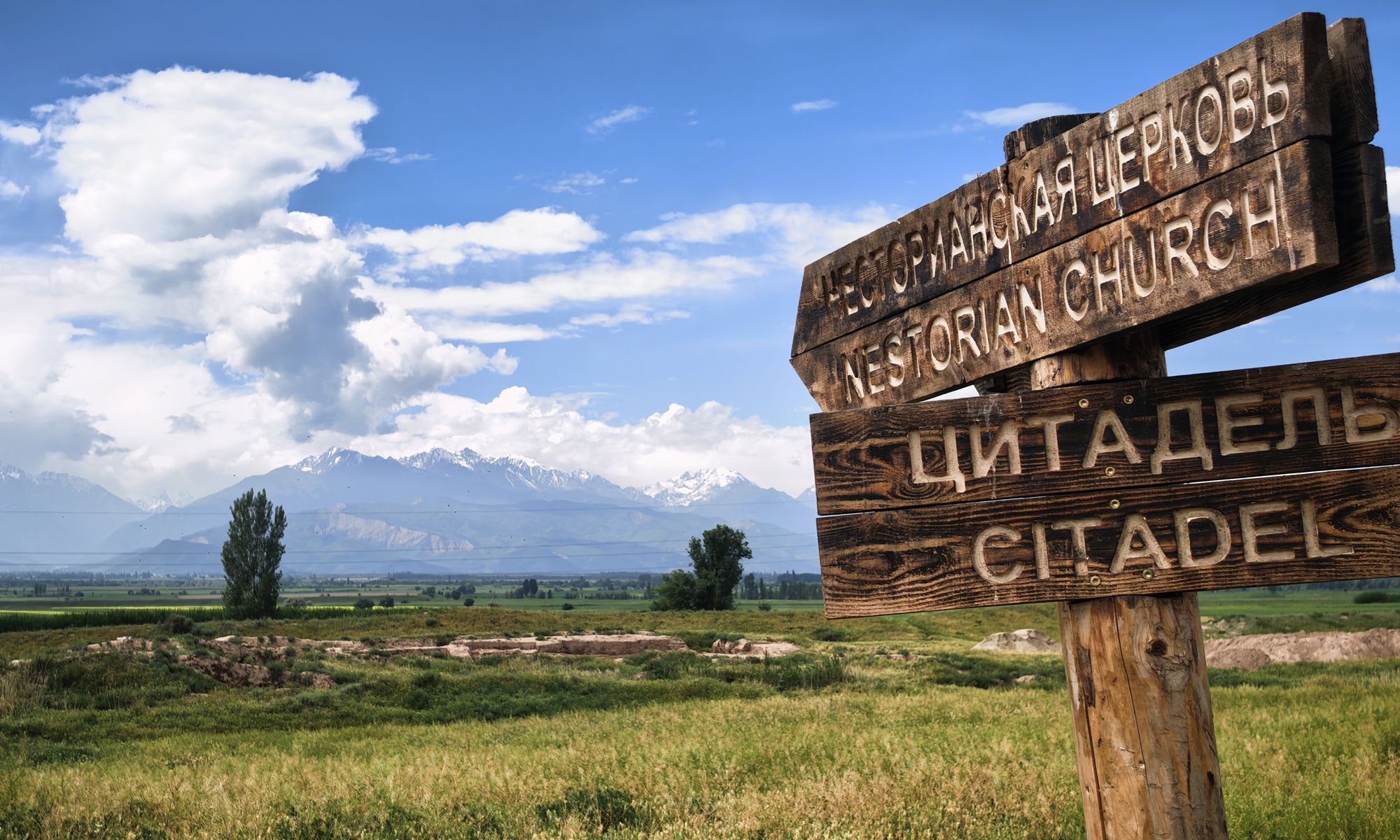
A view of the area where the Suyab ruins are located in Tokmok, Kyrgyzstan Photo: Liu Yang/GT
In the middle of the site is a very important set of monitoring equipment: an observation station jointly established by China's Dunhuang Academy and Kyrgyzstan's local cultural and heritage protection authorities for environmental monitoring and data collection.Just then, a bus pulled up. A group of archaeologists from Central Asian countries arrived at the site, having just attended a joint archaeological meeting in Bishkek. The experts from China and Central Asia began exchanging ideas beside the site's ramparts - a scene poet Li Bai could hardly have imagined in his lifetime.
"Are you Chinese?" The reporters' thoughts were interrupted by familiar Chinese. More than a dozen Chinese tourists had appeared at Suyab. They were part of the tour group led by Leonid, coming from Jiangsu and other provinces across China. Kyrgyzstan was the second stop on their Central Asia tour.
"Since you're reporters, you should really point this out - the sign for Li Bai's birthplace is only in Kyrgyz and Russian, not a single Chinese character," one man in the group said.
'Signs of China' everywhere in the city
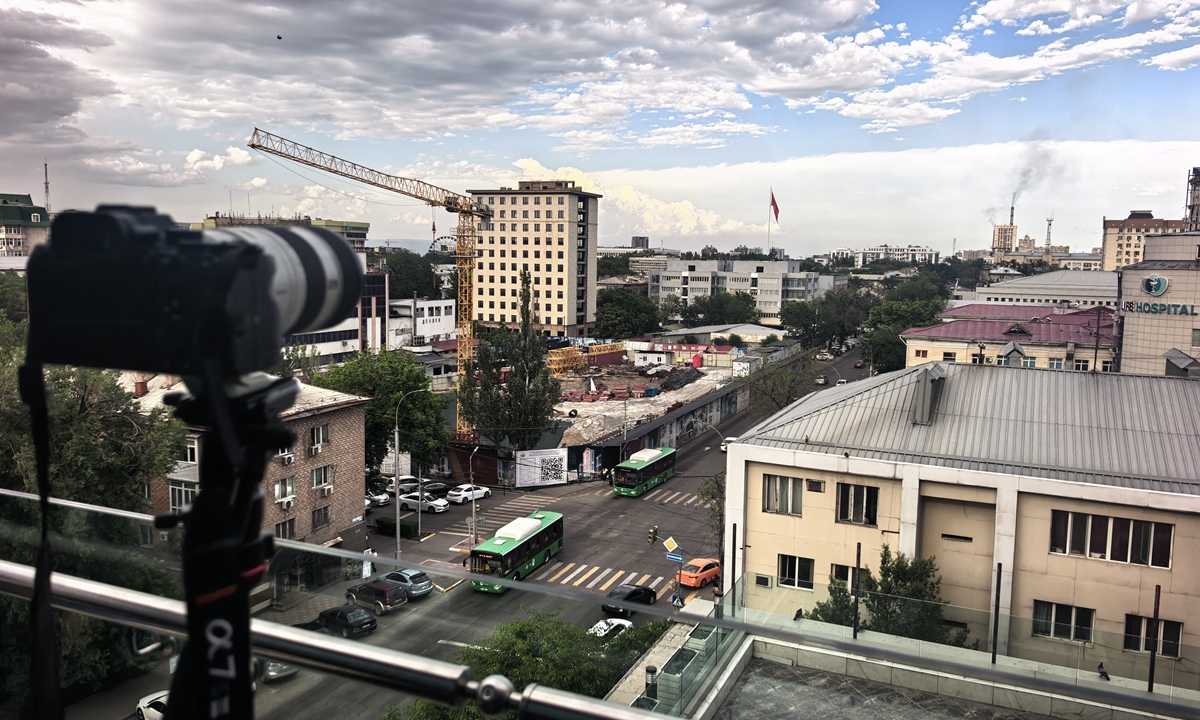
A view of Bishkek, capital of Kyrgyzstan Photo: Liu Yang/GT
Kyrgyzstan uses both Kyrgyz and Russian as official languages. Road signs across Bishkek usually display Kyrgyz on the top line and Russian below. As a former Soviet republic, many street scenes here are reminiscent of the Russian Far East. But construction sites are everywhere in the city, and many cranes can be seen on the skyline, showing that the real estate sector is just taking off and urban development is in a phase of rapid construction.During interviews, local people told the Global Times that many building projects are undertaken by Chinese companies. However, at three construction sites, we found that all of the workers working that day were locals.
Why did we pay attention to these details? On the flight to Bishkek, we had read foreign media reports from the past year or two about China-Kyrgyzstan relations. Many of them sounded alarming - headlines like "A clash reveals growing anti-Chinese sentiment in Kyrgyzstan," "An influx of cheap Chinese labor leaves Kyrgyz people jobless," and "Chinese design and technology rob Kyrgyz cities of their Central Asian character." Yet during the reporters' brief four-day reporting trip, the information shared by more than 20 interviewees from both China and Kyrgyzstan made these foreign media claims sound very much outside the mainstream.
The Global Times found that the signs of China are everywhere in Bishkek. Many of the green buses running through the city have the word "ZHONGTONG" on the back. According to a Global Times report on May 22, 2023, the first batch of 1,000 Zhongtong buses purchased by Kyrgyzstan rolled off the production line in Liaocheng, East China's Shandong Province, on May 20 that year, Kyrgyz President Sadyr Japarov attended the ceremony.
The cars on the streets of Bishkek are highly varied. Some brands look quite old and carry a distinctly Soviet-era feel. There are also many cars from Japan and South Korea. "But more than 40 percent of the new cars sold in Kyrgyzstan come from China," Lu Yunran, CEO of 212 Off-Road Vehicle Co., Ltd., which is preparing to enter the Kyrgyz market, told the Global Times at the 2026 China-Kyrgyzstan Media Cooperation Forum held on May 27. The reason Chinese carmakers are entering the Kyrgyz market, he said, is simple: "There is demand here."
In a shopping mall in central Bishkek, as the escalator slowly carried the reporters up to the sportswear section on the third floor, the three brands that came into view from left to right were Li-Ning, Xtep and Anta. Taking the elevator up another three floors, we also found Lanzhou hand-pulled noodles and Chinese ice cream and beverage chain Mixue.
Another Chinese imprint in Bishkek is traditional Chinese medicine (TCM).
At the China-Kyrgyzstan Qihuang Traditional Chinese Medicine Center, located at 120 Umitalieva Street, Bishkek, a patient in his 50s was undergoing acupuncture. "I'm from Bishkek," he told the Global Times. "I have a pretty severe spinal misalignment. Tomorrow marks my fifth day of acupuncture treatment, and I've already felt immense relief."
Another patient, who was receiving cupping therapy for polyarthritis, shared a similar sentiment: "TCM works wonders for me." During the interviews, both patients vouched for the effectiveness of TCM and praised the Chinese doctors for being even more dedicated than local physicians. "They are genuinely here to help the local people," one patient noted.
Aishoola Rysbekova, a 31-year-old Chinese language lecturer at the Kyrgyz National University, goes by the Chinese name "Xinyue," which means "new moon." She told the Global Times that Bishkek's economy has been booming over the past two years, mirroring a broader national economic uptick. Consequently, university faculty salaries have seen a major boost - "nearly doubling," she said. The current average salary is now equivalent to over 5,000 yuan ($738). "Our economic and trade cooperation with China has played a massive role in this," the Kyrgyz woman added.
During the interviews, many Chinese people living in Bishkek also expressed a positive outlook on the country.
Within the local Chinese community, the Guoying supermarket is well-known. Spanning roughly 500 square meters, the store is divided into three sections: Chinese-made daily necessities, Chinese snacks and Chinese fast food. Walking through the Guoying supermarket feels like being back in China, with shelves packed with everything from dried noodles to snacks, milk tea, and even the popular Chinese brand Mind Act Upon Mind tissues.
Zhao Shulin, who leases the supermarket's food section, told the Global Times that while Kyrgyzstan had previously gone through periods of political instability due to a sluggish economy, recent years have seen strong economic growth. As a result, the public mind-set has become more rational. Living here, you really feel the locals are very friendly, Zhao said.
Not far from where Zhao stood, three local middle school girls were choosing Chinese snacks. "Chinese is a beautiful language," one of the girls said, in English, as she told the reporters about her plans to study Chinese.
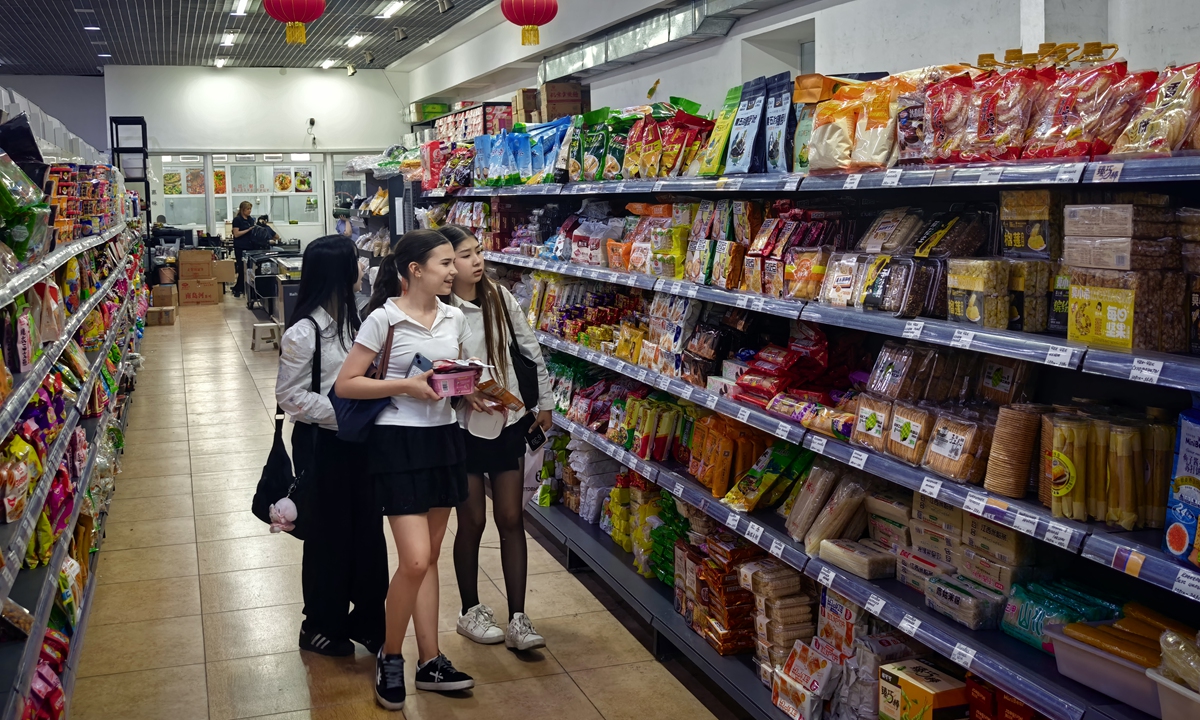
Kyrgyz students shop for Chinese snacks at Guoying supermarket in Bishkek on May 25, 2026. Photo: Liu Yang/GT
Exporting high-quality development opportunities
"The most valuable advantage for Kyrgyzstan is to be the neighbor of China," Kyrgyz President Japarov told the Chinese top leader on August 31, 2025, during his visit to Tianjin for the SCO Summit 2025 and the commemoration of the 80th anniversary of the victory of the Chinese People's War of Resistance Against Japanese Aggression and the World Anti-Fascist War. He emphasized that China is a good neighbor and a good friend of Kyrgyzstan.
At the 2026 China-Kyrgyzstan Media Cooperation Forum, Kyrgyz commentator Ismail Dairov echoed this sentiment when discussing bilateral ties: "Geography is destiny." Fellow panelist and commentator Kurmanbek Mambetov noted that China and Kyrgyzstan are harmonious neighbors. "You might fight with relatives, and you might lose friends, but the bond of being neighbors is something that never changes," he said.
Explaining the booming trade ties and the strengthening cooperation between the two countries, Mambetov pointed out that their strategic interests are perfectly aligned. "China needs a stable Kyrgyzstan, and the stronger China becomes, the more opportunities open up for Kyrgyzstan."
Zhu Yongbiao, executive director of the Research Center for the Belt and Road at Lanzhou University, told the Global Times that practical cooperation between China and Kyrgyzstan is not a one-way transfer of benefits. Rather, it is a healthy, mutually beneficial relationship built on the strong complementarity of the two countries' trade and economic structures.
Zhu said this complementarity is also a common feature of cooperation among SCO member states, making China-Kyrgyzstan cooperation representative, replicable and worth promoting. In his view, the Chinese presence the reporters observed in Bishkek shows that what China is exporting today is not only culture, but also high-quality development opportunities.
Of course, this does not mean there are no bottlenecks in bilateral cooperation. During the interviews, people from both China and Kyrgyzstan mentioned that the two peoples still do not know enough about each other and media coverage between the two sides remains insufficient.
Four days of reporting in Bishkek was clearly not enough to gain a deep understanding of Kyrgyzstan. Nevertheless, the trip provided some firsthand knowledge of China's friendly neighbor. On the flight back to Beijing from Bishkek, the reporters found that most of the passengers were also Chinese. Among them were people selling agricultural machinery in Kyrgyzstan, employees of state-owned enterprises, business visitors, and tourists.
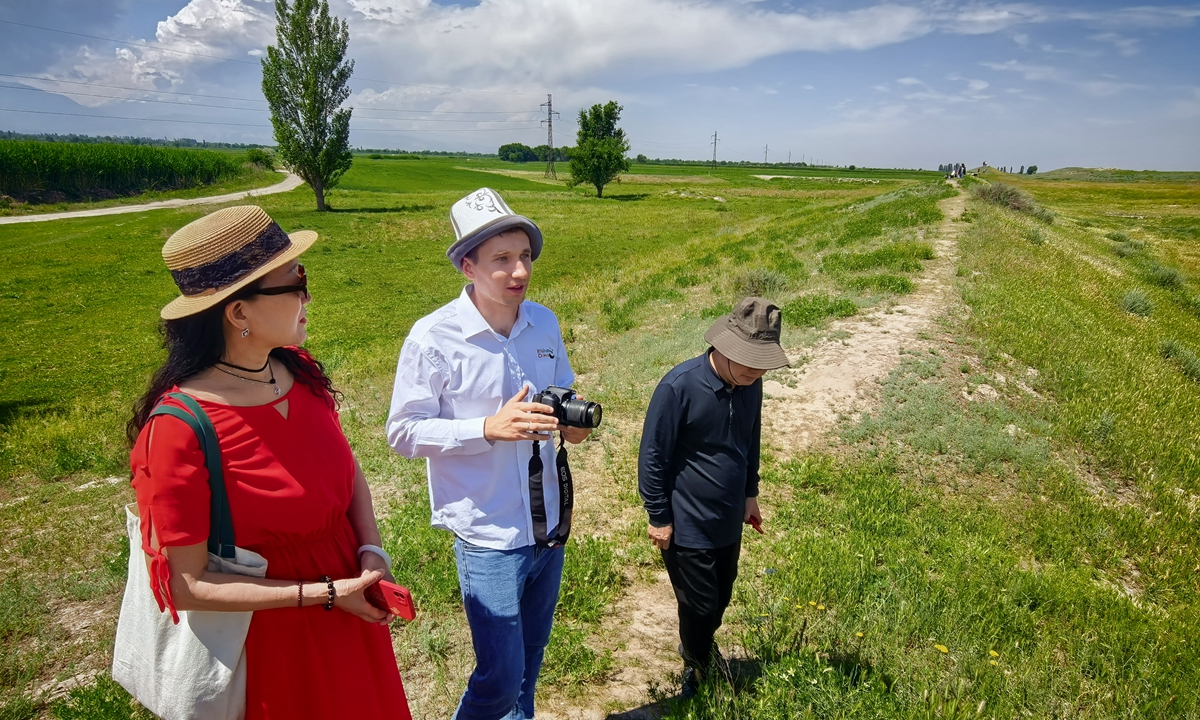
Kyrgyz tour guide Mitrofanov Leonid Dmitrievich (center) takes tourists to visit the ancient city of Suyab on May 26, 2026. Photo: Liu Yang/GT
Perhaps by a twist of fate, we ran into Leonid and his tour companions again at a Chinese restaurant in Bishkek. Regarding foreign media descriptions of negative sentiment between the Chinese and Kyrgyz peoples, Leonid said that if such feelings do exist, it must be because those people have not worked hard enough and are jealous of those who have benefited from China-Kyrgyzstan cooperation.Xue Ke and Shen Sheng also contributed to this story
RELATED ARTICLES