IN-DEPTH / IN-DEPTH
Preserving Xinjiang salamander dating back 350 million years at China-Kazakhstan border
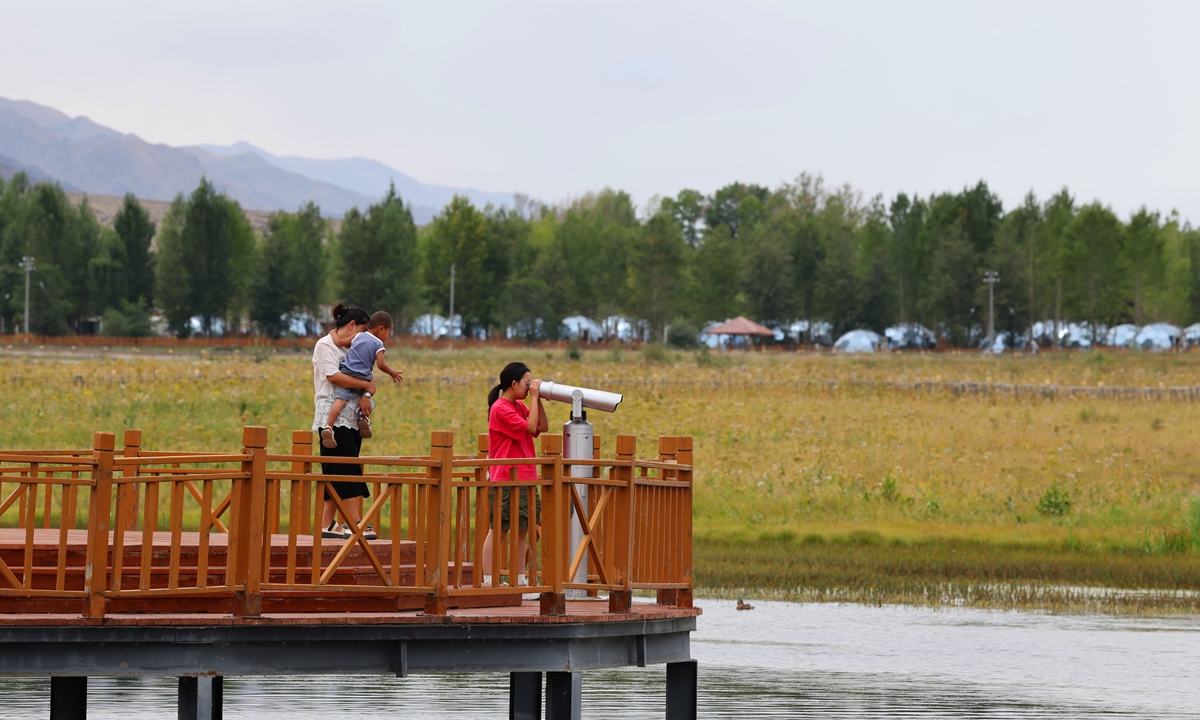
Visitors enjoy the scenery of Bortala River National Wetland Park in Wenquan county, Bortala, Northwest China's Xinjiang Uygur Autonomous Region on August 15, 2025. Photo: VCG
Crystal clear brooks weaving down green grassy slopes against the backdrop of snow-capped mountains - this is the home of the Central Asian salamander, or Ranodon sibiricus, a relict species dating back 350 million years and co-habitants of dinosaurs, which is listed as EN (endangered) status by the International Union for Conservation of Nature (IUCN) Red List.
This rare amphibian, also called Xinjiang salamander, predominantly inhabits high-altitude mountain springs, streams, and also the shallow waters of lakes at elevations ranging from some 2,000 to 3,000 meters, the exact phrases that describe Wenquan county of Bortala Mongolian autonomous prefecture in Northwest China's Xinjiang Uygur Autonomous Region, which borders Kazakhstan.
Xinjiang salamander is a survivor of geological changes, a living fossil that bears witness to the evolution of life on Earth that also serves as a core indicator species reflecting the health of mountain ecosystems in Xinjiang.
Through a visit to the national nature reserve of Xinjiang salamander, the Global Times has gained a deeper understanding of how the local people have safeguarded the "living fossil" species at the borderland, writing their own verses in the building of a Beautiful China.
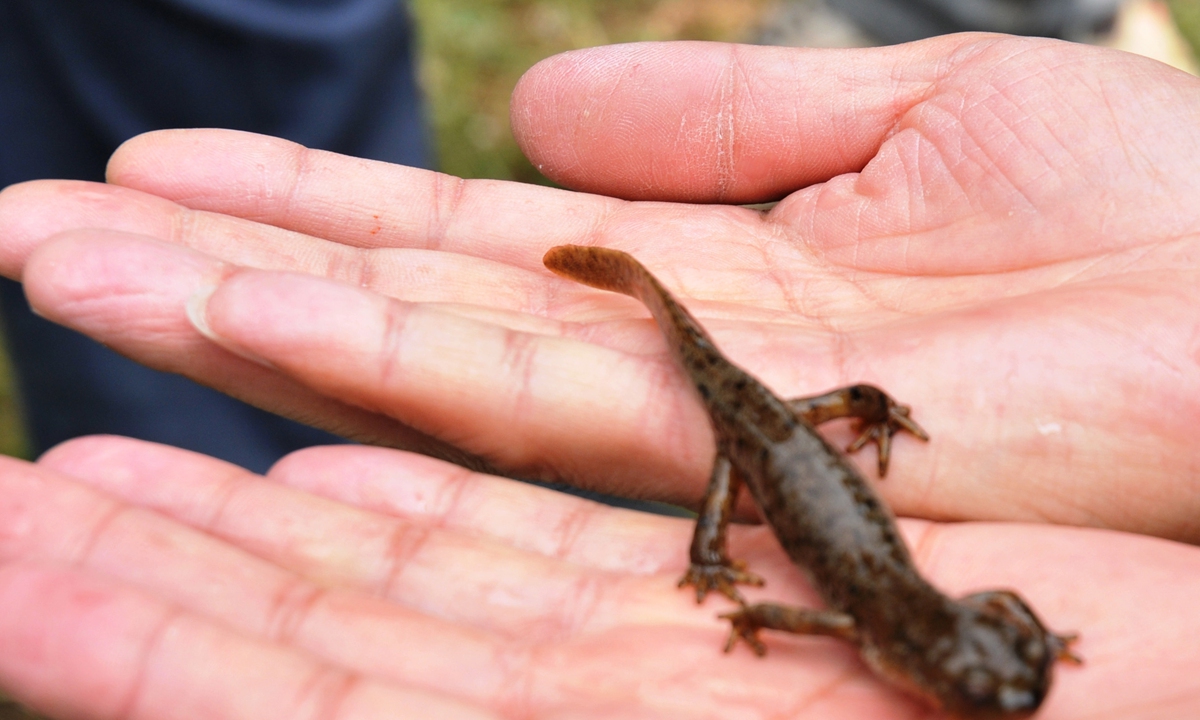
The Central Asian salamander, or Ranodon sibiricus Photo: VCG
'Living fossil'
The story of Xinjiang salamander started in 1866 when a Russian biologist discovered the Central Asian salamanders, which only live in an area spanning 500 square kilometers in Dzungarian Alatau, a mountain range in the northern Tian Shan, in northwestern China and Kazakhstan.
It was never spotted again in the following century until in 1989 when a student at Xinjiang Normal University brought from their hometown Wenquan county a mysterious "four-foot snake," which was identified by biologist Wang Xiulin as the previously discovered Central Asian salamander, the Global Times learned from the Xinjiang Salamander National Nature Reserve.
For the following decades, studies were carried out on this species, which "did not transform much over the past 350 million years and provides unique and irreplaceable values in understanding the evolution of vertebrates, earning the title of a 'living fossil,'" Zhu Wenjing, chief at the manage station of the nature reserve, told the Global Times.
Measuring around 20 centimeters, Xinjiang salamanders are nocturnal and hibernant. They usually seek shelters in damp grass tussocks and burrows on the banks, or crevices beneath stones in the water, and live on insect larvae.
An interesting behavior of Xinjiang salamander recently observed is that the family members never meet each other - the mother lays eggs on stones; the father passes by, inseminates eggs and leaves; the egg self-hatches for 40 days and the baby comes to the world.
The "rediscovery" of this species in the 1980s fueled great public interest in the species and due to lack of protection awareness at that time, its population quickly dropped due to loss of habitats and poaching.
Fortunately, there were rising efforts to protect the species from the day it was rediscovered.
Wang and her team surveyed an area of 2,500 square kilometers, identified six habitats of the species, and through measures such as artificial mimicking of favorable conditions, succeeded in artificial hatching, the Global Times learned.
In 1997, the Xinjiang Salamander Nature Reserve was established at the autonomous region level. And in 2016, the Xinjiang Salamander Research and Education Center was also instituted, integrating science outreach, research, communication, and education. The following year, the Xinjiang Salamander Nature Reserve was upgraded to a national-level protected area.
Over the past decade, herding was banned in the area to turn grazing lands back into grasslands and wetlands, water has been diverted to improve habitat, and efforts have been made to promote public awareness to protect nature and the species, according to Wenquan county officials.
Zhu told the Global Times with excitement that "a latest survey estimated the wild population in China has recovered to 3,300 from around 1,500 in 2015."
"But we will not be satisfied with that. One obstacle is that the artificial-hatched salamanders are infertile, and that is the choke point we will strive to overcome in our conservation work," Zhu said.
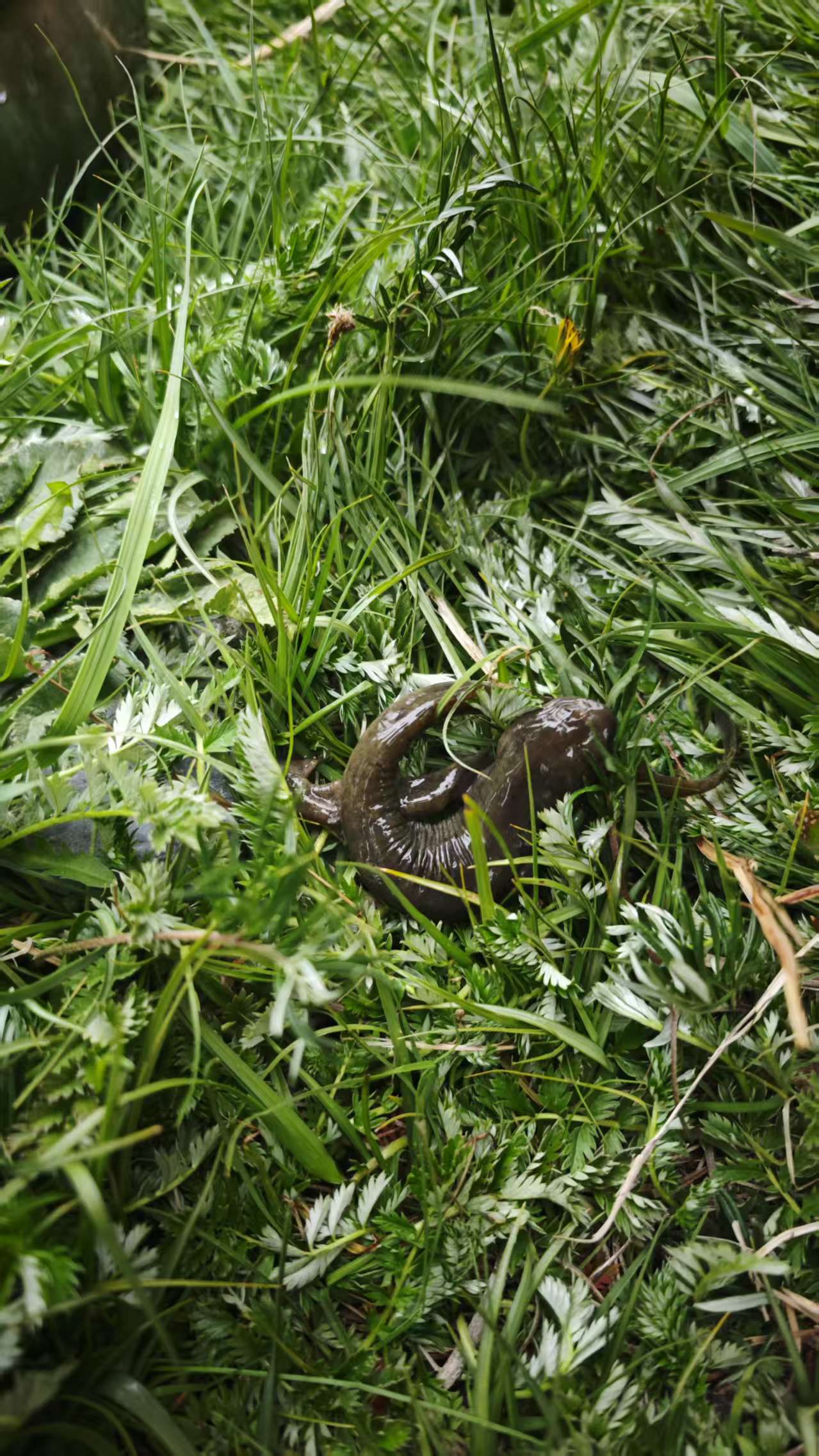
The Central Asian salamander, or Ranodon sibiricus Photo: Zhang Han/GT
From species to ecology
Outside the fencing of the nature reserve stands a one-story building with a light blue roof, which is bluer than the clear sky on plateau. It is the Wusitubiegezen post under the manage station. Namucila, a local Mongolian and the ranger of the reserve, lives here with his wife, who is a civil border guard.
Namucila's duty is to patrol the reserve, monitor the streams and grasslands, expel livestock which break into the reserve, prevent risk of bushfire, and take care of all wildlife in this area if they are in need.
He endures strong winds and almost eight months of snow year-round, the man in his fifties said with a smile that the work isn't tiresome. "I like it. It is not toilsome."
Namucila has known of Xinjiang salamanders since his youth, but his life has been woven together with the rare species only recently when he left his small pasture nearby and became a full-time ranger.
Equipped with pan-tilt cameras, high-definition infrared dome cameras and high-definition infrared cameras, Namucila now can "patrol" the reserve online in extreme weathers. Also, the station dispatches drones often to monitor the reserve area.
Such measures can minimize the interruptions to the natural habitat of the Xinjiang salamanders, Zhu explained, adding that such systemic conservation efforts with the assistance of high technologies have greatly improved the overall health of the ecosystem.
The efforts invested for Xinjiang salamanders have benefited more wildlife, as the visitors include ibex goats, foxes, boars and even snow leopards, Zhu noted.
More importantly, through unwavering conservation efforts and growing public education, more and more local people now understand that environmental protection is bringing greater and longer-term benefits, prompting a voluntary participation in conservation of nature and the pursuit of harmony between human and nature, local officials said.
Saving endangered species
RELATED ARTICLES