Trump’s AI-generated avatar sparks debate among Japanese netizens; expert highlights copyright challenges in the AI era
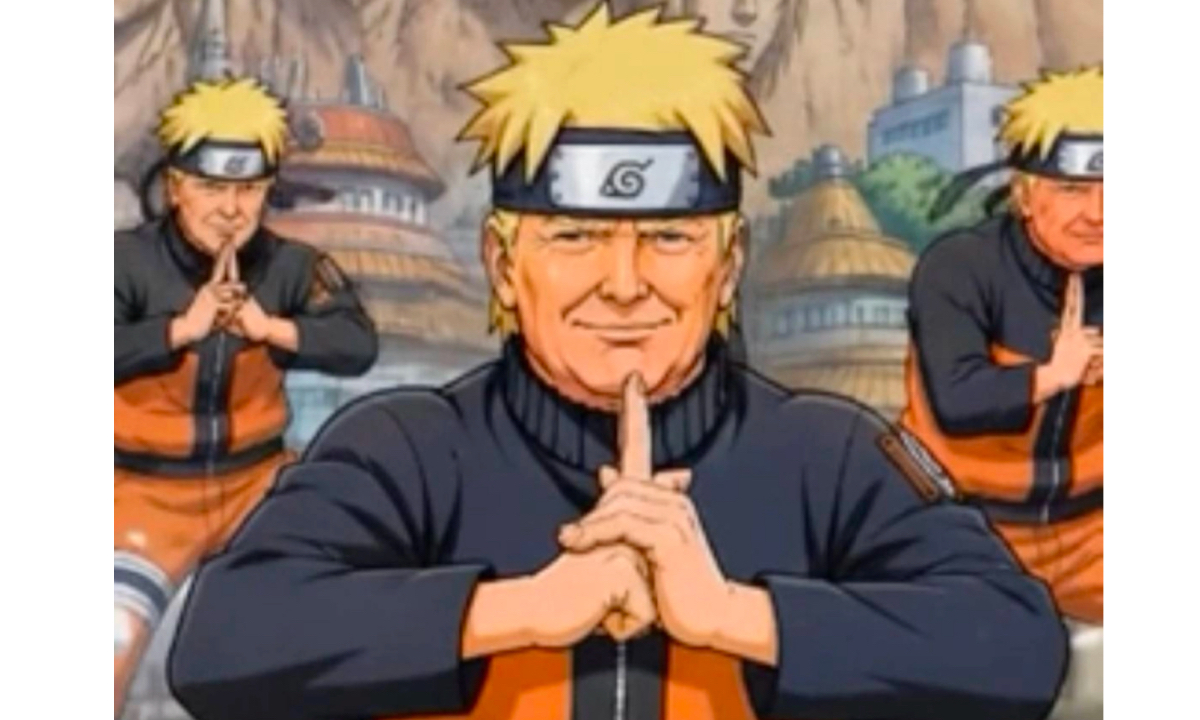
A video posted by US President Donald Trump on his social media account portrays himself as the protagonist of Japanese anime series "Naruto." Photo: screenshot of the Japan Times
The Japanese government on Friday criticized US President Donald Trump's use of Japanese companies' intellectual property, with a top minister warning that the practice could damage the integrity of Japan's creative exports. She said Japan had conveyed this position to the US, the New York Times reported.
US President Donald Trump posted an apparently AI-generated video on digital platform Truth Social last Saturday that included a short segment depicting himself dressed as the protagonist from the popular anime franchise "Naruto," clasping his hands together with index fingers pointing up.
According to Japan Today, Kimi Onoda, minister for the "Cool Japan" strategy of promoting Japanese cultural exports, told a press conference that the "basic principle" of obtaining permission from rights holders to use copyrighted material "applies equally when the user is a public institution."
Onoda claimed that even in cases that may not clearly constitute copyright infringement, there is a risk that a work may be used in a manner contrary to the rights holder's intentions. She added that Japan has "conveyed its views on such matters to the US side through diplomatic channels on multiple occasions."
The issue has sparked discussions online. In the comments section of Japan Today, one user said, "The worst thing is I saw the image and I can't unsee it."
Some other users played down the controversy, saying, "Chill out, that video in total is 60 seconds, [the] material in question [was] only 2-3 seconds." And the user added, "What Japan will do, ask some compensation to King? Good luck."
Onoda claimed that even in cases that may not clearly constitute copyright infringement, there is a risk that a work may be used in a manner contrary to the rights holder's intentions. She added that Japan has "conveyed its views on such matters to the US side through diplomatic channels on multiple occasions."
The issue has sparked discussions online. In the comments section of Japan Today, one user said, "The worst thing is I saw the image and I can't unsee it."
Some other users played down the controversy, saying, "Chill out, that video in total is 60 seconds, [the] material in question [was] only 2-3 seconds." And the user added, "What Japan will do, ask some compensation to King? Good luck."
The White House's social media posts have also drawn from other animated franchises including "SpongeBob SquarePants," Marvel and DC Comics and "Call of Duty," however, its use of Japanese imagery has set off a strong backlash, the New York Times said.
Wang Peng, an associate research fellow at the Beijing Academy of Social Sciences, told the Global Times on Saturday that Japan's decision to raise the issue through diplomatic channels was a choice based on political and practical considerations. Given the complexity of cross-border legal disputes and the challenges of pursuing a case involving a US president, diplomatic communication allows Japan to express its concerns while avoiding a direct legal confrontation.
Wang said the controversy highlights the growing challenges that artificial intelligence poses to copyright protection worldwide. As AI-generated content becomes increasingly sophisticated and accessible, the boundaries between inspiration, fair use and infringement are becoming more difficult to define.
He noted that existing copyright frameworks in many countries were developed before the rapid rise of generative AI and may not fully address issues involving AI-generated images, videos and digital replicas of copyrighted works. As a result, governments, technology companies and rights holders will need to strengthen cooperation to establish clearer rules for the use of copyrighted content in the AI era.
Wang Peng, an associate research fellow at the Beijing Academy of Social Sciences, told the Global Times on Saturday that Japan's decision to raise the issue through diplomatic channels was a choice based on political and practical considerations. Given the complexity of cross-border legal disputes and the challenges of pursuing a case involving a US president, diplomatic communication allows Japan to express its concerns while avoiding a direct legal confrontation.
Wang said the controversy highlights the growing challenges that artificial intelligence poses to copyright protection worldwide. As AI-generated content becomes increasingly sophisticated and accessible, the boundaries between inspiration, fair use and infringement are becoming more difficult to define.
He noted that existing copyright frameworks in many countries were developed before the rapid rise of generative AI and may not fully address issues involving AI-generated images, videos and digital replicas of copyrighted works. As a result, governments, technology companies and rights holders will need to strengthen cooperation to establish clearer rules for the use of copyrighted content in the AI era.
RELATED ARTICLES