China’s development model ‘invaluable lessons for Global South prosperity and human dignity’
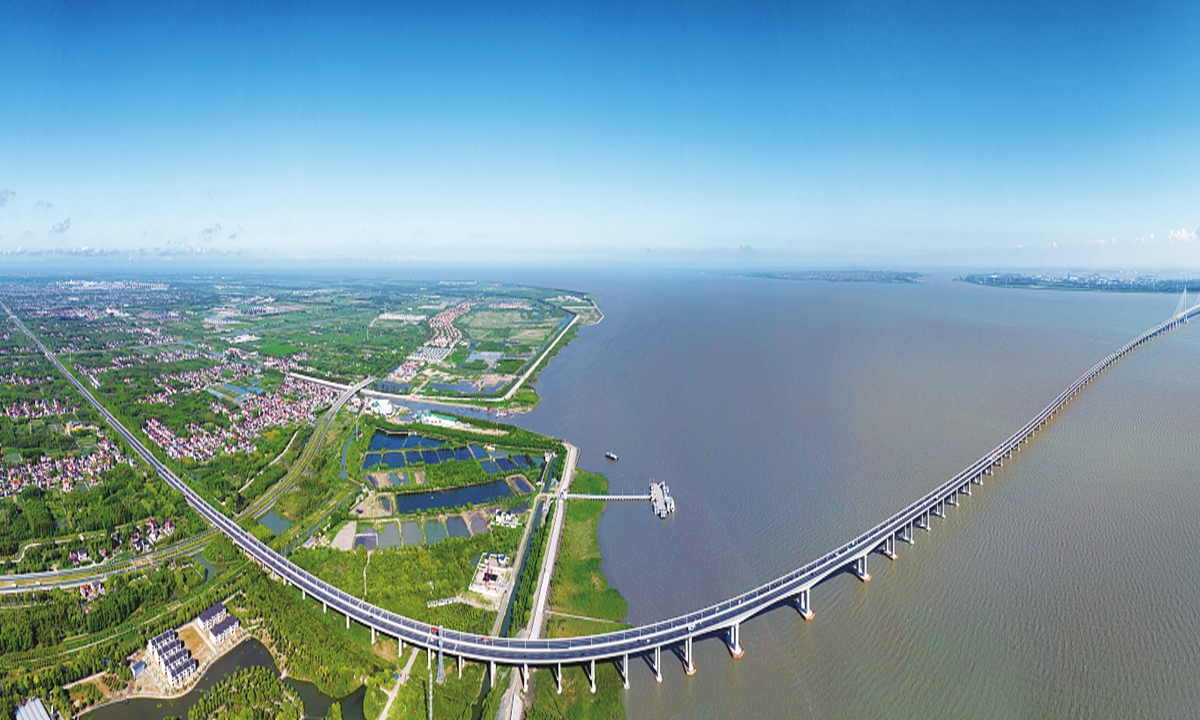
An aerial view of Shanghai's eco-island of Chongming and the Shanghai Yangtze River Bridge Photo: VCG
Editor's Note:On the path of advancing human rights through development and promoting shared prosperity through cooperation, China's vision and practical achievements are injecting hope and momentum into the Global South.
Development is not only a driver of prosperity - it is also the essential pathway to advancing human rights. The Global Times has gathered insights from three participants at the 2026 Forum on Global Human Rights Governance, themed "Joint Development, Shared Human Rights: The 40th Anniversary of the Adoption of the Declaration on the Right to Development and a New Vision for Global Human Rights Governance," held in Beijing on Thursday and Friday, to share their views on this topic.
Abdel Latif Jamal Rachid, former president of the Republic of Iraq
The right to development is measured by its impact on the people and on daily life: by a child's ability to obtain clean water, by a patient's right to medical treatment, by a farmer's ability to see his land green and productive, and by an entire community's ability to reclaim its right to life and dignity after years of deprivation. That is what development brings. That is the essence of human dignity.
This is what the world sought to protect and uphold when the UN adopted the Declaration on the Right to Development on December 4, 1986.
It affirms that development is an inalienable human right. Every human being has the right to participate in, contribute to and enjoy economic, social, cultural and political development.
The right to development is a fundamental pillar of the global human rights system. Rights may lose their meaning if the necessary conditions are absent. A child without access to school, a family without electricity or water, and a farmer who loses his life due to drought - all face the genuine deprivation of their fundamental human rights.
Iraq has come a long way on the path of recovery and reconstruction. Although much remains to be done, we have benefited from the support and partnership of many countries, including the People's Republic of China, which has made tangible contributions to Iraq's energy infrastructure and many other projects - contributions that we highly appreciate.
In our classical texts, China is described as a distant source of knowledge and know-how. As the Arabic saying goes: "Seek knowledge even if you must go as far as to China."
This sentiment has endured for centuries because it reflects the esteem in which China has long been held in our part of the world - as a distant land associated with learning, wisdom and achievement.
We look forward to a more balanced, cooperative and equitable international order, one in which the right to development is regarded as a shared right of all humanity, not the privilege monopolized by a few nations.
Marcella Favretto, acting chief of the Development, Economic, Social and Cultural Rights Branch of Office of the United Nations High Commissioner for Human Rights
We meet at a time of profound global uncertainty marked by widening inequalities, climate disruptions and rising geopolitical tensions. We are alarmingly off track in achieving the 2030 Agenda for Sustainable Development.
These trends not only undermine the realization of rights in practice, but also threaten to weaken the very foundations of justice and dignity worldwide. Many countries are steadily being deprived of the fiscal and policy space needed to invest in the rights of their people.
Against this backdrop, we welcome the Global Governance Initiative and its commitment to multilateralism, to the principles of the UN Charter and to the application of international law, as well as its ambition to inject renewed momentum into global efforts for development and human rights.
This is where the right to development finds its place at the center of a holistic, universal and interdependent vision of human rights and development - one that is rooted in social justice and meaningful participation, and one that demands the success of policies be judged by who benefits and who is left behind.
Thus, the right to development is both an individual and a collective right, and it operates on two levels: requiring governments to create the conditions for development at home, while tasking the international community to build a fair and equitable global environment.
The call for global solidarity is one of the most transformative aspects of the right to development. It underscores the shared responsibility of states to ensure that the benefits of development are fairly distributed and challenges us to rethink the foundations of international economic and governance systems.
Douglas de Castro, a Brazilian professor of international law at the School of Law of Lanzhou University
I have been living in China for the past four years. One of the things that has impressed me most is how China addresses environmental protection and connects it with human well-being. I was deeply touched when I first learned about the concept of ecological civilization - a principle that improves people's lives while preserving the environment.
Recently, I visited Shanghai's eco-island of Chongming. As someone from the legal field, I was particularly impressed by how the local courts operate there. They don't just apply the law by punishing violations; they actively engage in educating the public. This is something I keep telling my students: The law is not everything. Education is far more effective for environmental protection. It's not only about punishing wrongdoers, but about helping people understand why protection matters. For example, why we need to protect a certain fish species so they can reproduce and ensure we still have fish next year.
That's part of China's emphasis on development. And the reason for putting development at the center of human rights is clear - to fulfill other human rights. Economic resources are essential, and people need to benefit from these resources. This is China's approach: creating the conditions for the government and society to generate enough resources to realize other rights.
Development is essential for the Global South, not only for economic progress, but for the promotion of human rights as well. Take Brazil for example. In recent years, a growing number of Chinese enterprises have contributed to Brazil's green development by promoting innovative technologies, expanding investment in green sectors, and actively fulfilling their environmental protection responsibilities, thereby supporting local Brazilian companies in advancing their green transition.
In Brazil's historically impoverished northwest region, recent reports show rapid progress: The area is growing wealthier thanks to development initiatives, with more children attending school and greater access to healthcare. This vividly illustrates how development serves as a cornerstone of human rights. China's development model, therefore, provides invaluable lessons for Global South prosperity and human dignity.
RELATED ARTICLES