HK to commence public consultations on first five-year plan
Institutional move to realign development direction: expert
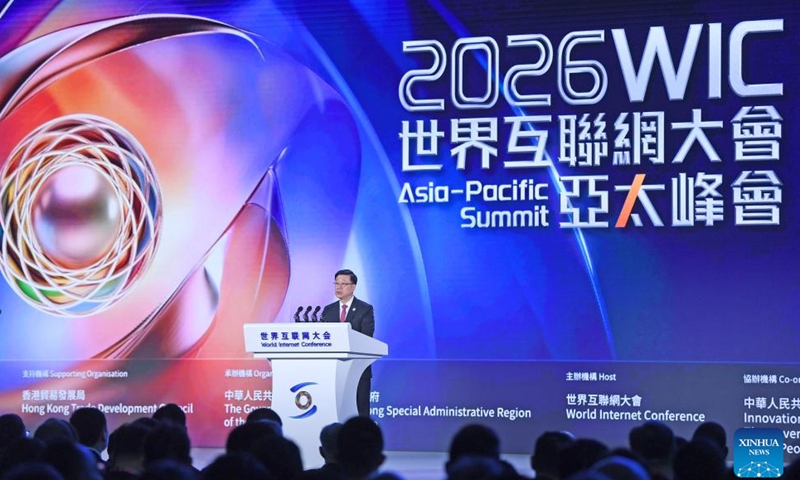
John Lee, chief executive of the Hong Kong Special Administrative Region, addresses the opening ceremony of the 2026 World Internet Conference Asia-Pacific Summit in Hong Kong on April 13, 2026. (Xinhua/Chen Duo)
The Hong Kong Special Administrative Region (HKSAR) is expected to commence two-month public consultations on its first five-year plan on Monday. In a Sunday blog post, Financial Secretary Paul Chan Mo-po said that the five-year plan aims to boost economic momentum, advance technology, promote inclusive development, create quality jobs, and improve residents' quality of life.
A Chinese expert said that the consultation is not just about "soliciting opinions," but represents an institutional move for the HKSAR to realign its development direction at the start of the nation's 15th Five-Year Plan (2026-30) period and deepen integration into the Greater Bay Area (GBA).
"As the nation enters the first year of the 15th Five-Year Plan period, we also find ourselves at a critical juncture in the new era of artificial intelligence (AI). How to seize this development opportunity, better leverage our own advantages, serve the nation's needs, and at the same time bring richer substance and consolidate strength for Hong Kong's own development will be key to driving Hong Kong's progress forward," Chan wrote.
The national 15th Five-Year Plan outlines clear, forward-looking positioning for the HKSAR: consolidating and enhancing its status as an international financial, shipping, and trade center; building an international innovation and technology (I&T) hub; strengthening its role as a global offshore yuan business hub; establishing a commodity trading ecosystem; and creating a premier hub for high-caliber talent, Chan noted.
These strategic directions provide a road map for Hong Kong. However, how to integrate these directions with Hong Kong's advantages and unique characteristics, address its shortcomings, identify concrete implementation pathways, and amplify development dividends are precisely the issues that need to be discussed during the consultation process, Chan added.
John Lee, chief executive of the HKSAR, said last week that the formulation of Hong Kong's first five-year plan is a historic step of great significance, benefiting Hong Kong residents and all sectors of society. This includes consolidating and enhancing Hong Kong's advantages in international finance, shipping, trade, technology and innovation, and other areas.
This will enable Hong Kong to seize more opportunities arising from national strategies and development and help Hong Kong better integrate into and serve the country's overall development, while sharing more development dividends with its residents, Lee said.
The significance of the public consultation is not simply about "soliciting opinions," but rather an institutional alignment for Hong Kong to recalibrate its development direction at the start of the national 15th Five-Year Plan, amid global industrial restructuring and the AI revolution, marking a new phase in the integration of the GBA, Tian Yun, a Beijing-based veteran economist, told the Global Times on Sunday.
This move will further help integrate the development of Hong Kong and the GBA in terms of livelihoods, industrial synergy and policy collaboration. If the relevant regions leverage their strengths and address their weaknesses, it will hold immeasurable forward-looking significance for the future development of the Chinese economy, Tian added.
Chan also said on his blog that Hong Kong's development has long benefited from the nation's long-term planning and continuous progress, while also making unique contributions to the building of a strong nation.
The five-year plan consultation must ask not only how to sustain these positive trends, but also how to consolidate, enhance, and open up new development spaces and new markets, creating new growth curves, Chan said.
Li Changan, an economist at the University of International Business and Economics, told the Global Times on Sunday that the plan will help Hong Kong better align with national and GBA regional plans - enhancing coordination in mechanisms, policies, and legal safeguards, while leveraging Hong Kong's strengths in AI, fintech, and its unique institutional advantages as a global free trade port to promote industrial integration and create shared growth momentum within the GBA.
Hong Kong's economy posted solid growth in the first quarter, with real GDP rising 5.9 percent year-on-year, the Xinhua News Agency reported on May 5. This was up from the previous quarter's revised 4 percent growth and marked the strongest quarterly expansion in nearly five years, per Xinhua.
RELATED ARTICLES