China slams Australian think tank’s claim of ‘Chinese military threat’ as grave strategic miscalculation
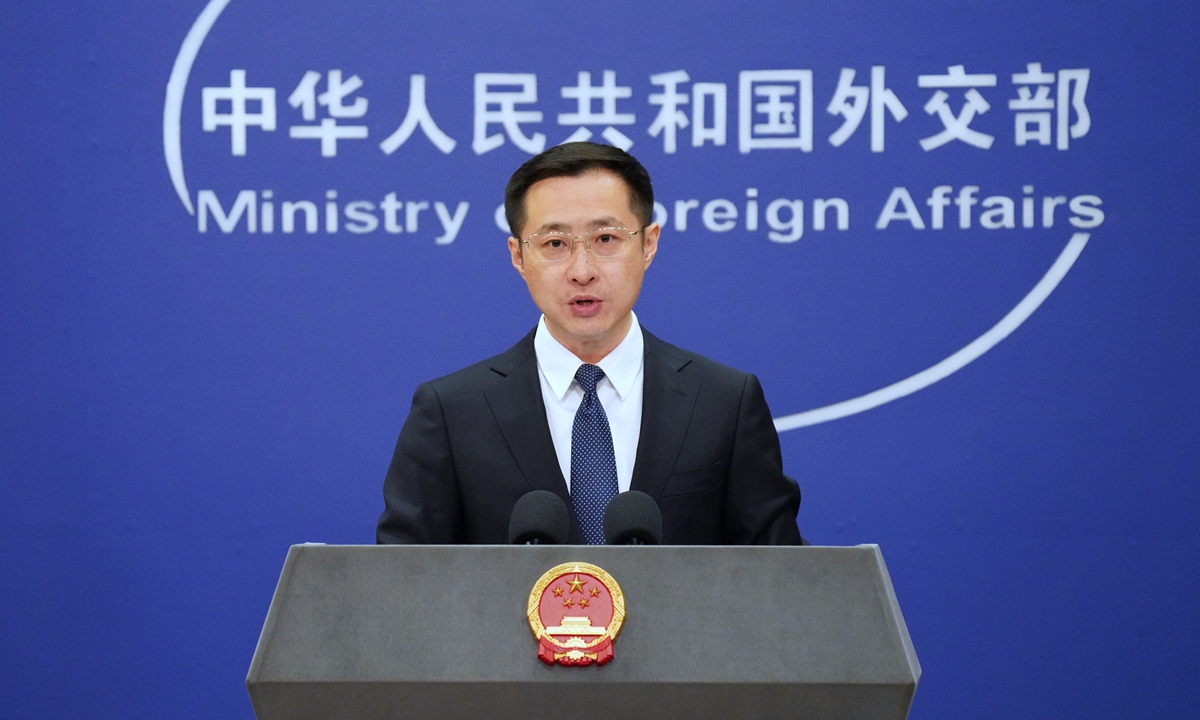
Chinese Foreign Ministry spokesperson Lin Jian
Australia's domestic anxiety over China-related security issues appears to be intensifying, as ABC News reported on Monday that the Australia-based foreign policy think tank the Lowy Institute released a report claiming it had tracked the "dramatic" scale of Beijing's military build-up, describing it as a "historic shift" with sharp consequences for Australia's security.The new analysis, titled "Understanding the Chinese military threat to Australia," claimed that China's military is developing a "real and growing" ability to hit the Australian mainland with missiles, and can "already threaten Australia's trade routes, subsea cables and critical infrastructure," ABC reported.
Chinese Foreign Ministry Spokesperson Lin Jian responded during Monday's press conference that the report tries to interpret China through the trite pattern that a great power is bound to seek hegemony. This is a grave strategic miscalculation.
The report also claimed that China can already hit Australia with ballistic missiles launched from ships and submarines and could strike northern Australia with its DF-26 missile system if fired from its artificially built islands in the South China Sea, per ABC.
Liu Qing, vice president of the China Institute of International Studies, told the Global Times that Australia's practice of portraying itself as a target of China's military projection does not hold water.
"Any major country with an extensive coastline, substantial overseas interests and a vast global trade network needs to develop military capabilities commensurate with its stage of development, and the report exaggerates the so-called China threat by portraying China's normal military modernization as a threat to Australia and Pacific island countries," Liu said.
Simply because a country possesses certain capabilities does not mean it will necessarily use them. Inferring hostile intentions solely from military capabilities runs counter to the basic logic of international relations research, the expert said.
China's cooperation with Pacific island countries has largely focused on infrastructure development, climate change, fisheries and development assistance. However, in recent years, some Western narratives have increasingly framed such cooperation through a security lens, militarizing these engagements and even equating them with geopolitical expansion.
The Australia-UK Ministerial Consultations (AUKMIN) on June 10 stated that ministers from both countries opposed activities that "raise tensions and risk miscalculation and escalation in the South China Sea." The statement also reaffirmed opposition to actions deemed to undermine regional peace and stability, including military activities on disputed features, dangerous maneuvers and the unsafe use of military assets, coast guard vessels and maritime militia, according to the statement released on the UK Government's official website.
Against this backdrop, the Lowy Institute's latest report on China objectively caters to certain political and public opinion demands of some China hawks in Australia who have sought to reinforce security anxieties in recent years, and frame China as a hypothetical enemy to legitimize its increases in military spending, Liu said.
China is committed to a path of peaceful development. Its efforts to strengthen defense capabilities are aimed at safeguarding national sovereignty, security and development interests, and are not targeted at any country. China's growth in military strength reinforces the force for peace in the world, foreign ministry spokesperson Lin said at Monday's press conference.
"We hope the institute will stop hyping up 'China threat' narratives and view China's development in an objective, fair and rational light," Lin added.
RELATED ARTICLES