Listen
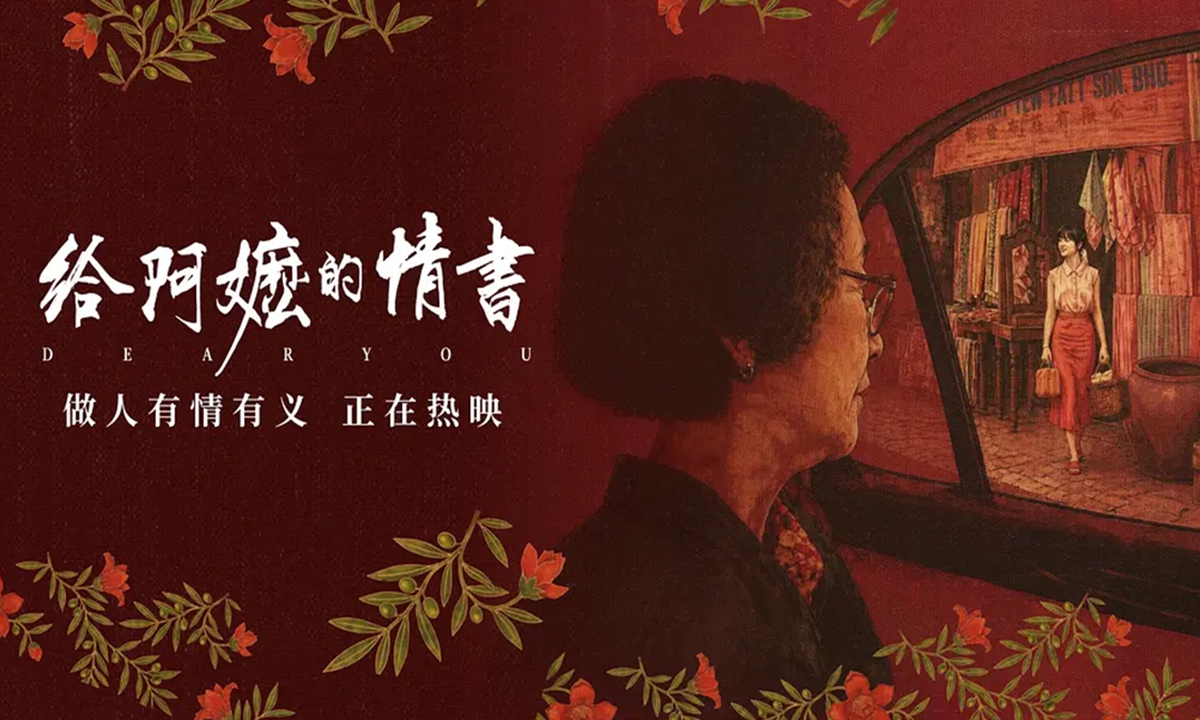
Promotional material of Chinese film Dear You Photo: Douban
The film Dear You will be released in Singapore, Malaysia, and Brunei on June 18, with subsequent rollouts in more than 10 countries and regions, including the US, Canada, the UK, France, Japan, and South Korea. The film has already received considerable positive reviews in Southeast Asia and even around the world. However, since late May, a well-known Chinese-language media outlet in Singapore has published several sarcastic articles, labeling this heartwarming film as a tool of the "united front work." This stands in stark contrast to the widespread praise the film has received, leaving the media outlet a lonely outlier. Many netizens keep asking: what exactly are they so upset about?
Dear You is a typical low-budget, small-scale production with a simple storyline. Zheng Musheng leaves the Chaoshan region of Guangdong for Southeast Asia to earn a living but passes away unexpectedly. His Thai friend Xie Nanzhi continues to send letters and money in his name to Zheng's hometown for 18 consecutive years. Not a single shot in the film is related to Singapore and the theme of the film is that "one must be compassionate and righteous" and that fellow townspeople and clan members should support one another when away from home. It highlights the warm connection between two families, one Chinese and one Thai.
Yet, this media outlet twists the film into a completely different narrative, claiming it carries political motives related to the so-called "united front work" and is a "psychological warfare" aimed at eroding Chinese Singaporeans' identity. It repeatedly emphasized that elderly generations of Chinese emigrants should be grateful to the country which "changed their lives," instead of "someone from a distant homeland."
How can a dialect film with a modest budget and an entirely non-professional cast be seen by some as a "powerful instrument" capable of shaking national identity? Does this overestimate the power of cinema, or underestimate the independent thinking of Singaporeans?
At its core, the issue is that some people and media outlets have guilty consciences, so they see "ghosts" in everything. As an old Chinese saying goes, "our mindset frames how we view the world." Those with cultural confidence see warmth and resonance; those preoccupied with political calculations see only threats and conspiracies. In the end, it's just an over-interpretation by the certain Singaporean media outlet.
Indeed, Dear You acts like a needle, puncturing the so-called "multicultural coexistence" proclaimed by certain elites. Why is it that Coco, a heartwarming US film about seeking roots, is celebrated globally as a touching and uplifting story representing "universal feelings," while Dear You is instead interpreted as having "hidden intent"?
Singapore is itself a multi-ethnic society. For Chinese Singaporeans, valuing their cultural roots and remembering the history of their ancestors' migration overseas is by no means incompatible with a strong sense of national identity toward Singapore. During the preparation of Dear You, the director's team visited nearly 300 overseas Chinese families.
More than 90 percent of the film's storyline is grounded in real-life experiences. Behind the film's story lies the sweat, toil, and deep longing of ordinary people. To put a political label on this bond that transcends time and space is not only disrespectful to the creative work, but also a flippant misreading of history.
As a multiethnic country in Southeast Asia, Singapore has clearly defined its national sovereignty and identity. A former Singaporean political figure has stated that Singapore's relationship with China is grounded in mutual benefit, not common ethnicity. This view is unobjectionable. What is problematic is that when confronted with the rising influence of Chinese culture and the growing cohesion of the broader Chinese cultural community, some Singaporean media outlets seem less interested in promoting cultural exchange and connectivity across the Asia-Pacific than in worrying that their space to play both sides between East and West may be shrinking.
This has led some to wonder whether certain forces may be behind these "media commentaries." Whether this concern is accurate remains to be seen.
True cultural confidence is often reflected in the tolerance of diverse emotions. A majority of ethnic Chinese in Southeast Asian countries have a more composed and confident cultural mindset. They can openly appreciate virtues and values such as "keeping one's word," "respecting and caring for the elderly," and "remembering one's roots," which are both the essence of Chinese culture and part of the broader Asian cultural tradition.
They see these values as nourishment that enriches local multicultural societies. For example, many Thai words were derived from Chaozhou (Teochew) dialect and the Chaozhou-Shantou cuisine can be found throughout Bangkok. These are clear pieces of evidence of this shared cultural lineage. For audiences in these countries, Dear You is a remembrance of and tribute to their ancestors, and a warm return of the heart.
For any country, regardless of size, to truly become a respected nation, it is not enough to be merely an economic "parvenu." It must also demonstrate inclusiveness and confidence in its history and culture, and show an open-minded vision.
We hope that after Dear You is released in Singapore, media representatives in the country can walk into cinemas, watch the film carefully, and truly reflect on the universal human virtues it conveys: affection, kindness and perseverance.
RELATED ARTICLES