Intangible cultural heritage connects China and Europe in Huangshan
By and Niu Yingbo Published: Jun 01, 2026 10:10 PM

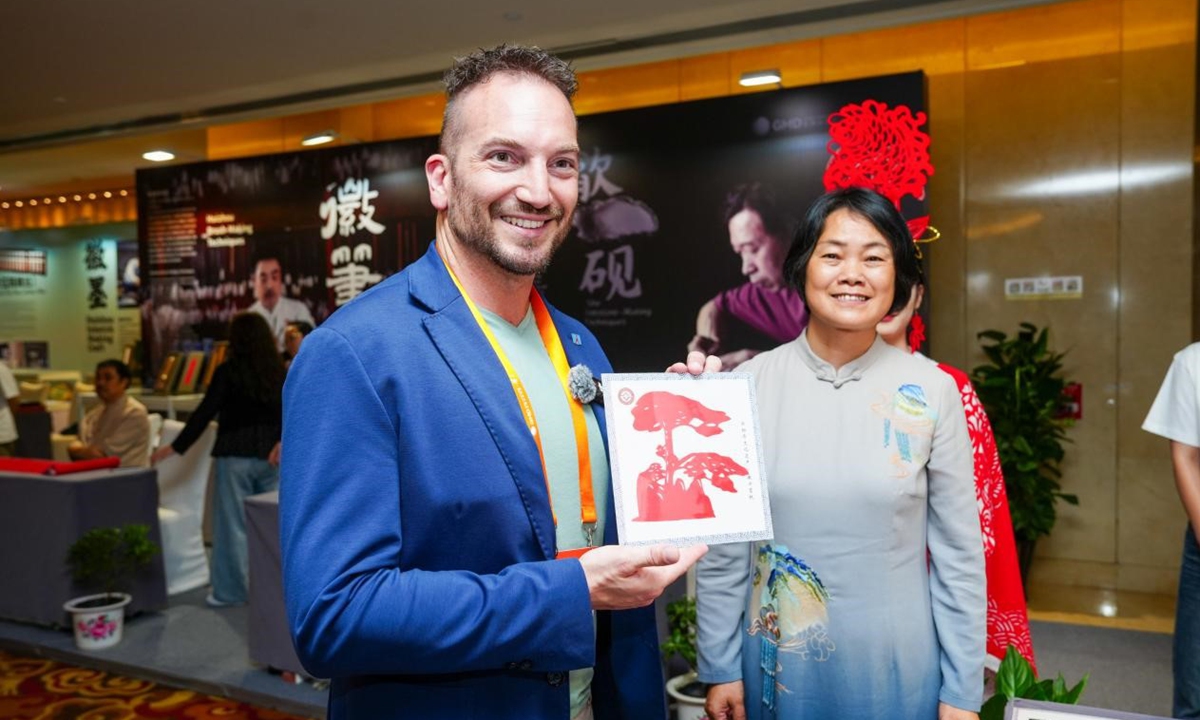
During the 2026 World Mayors Dialogue in Huangshan, East China's Anhui Province, a mayor learns paper-cutting from intangible cultural heritage inheritors. Photo: Courtesy of Global Mayors Dialogue
From May 28 to 31, atop Huangshan Mountain in Anhui Province, East China, pine-scented breezes welcomed guests. The four-day World Mayors Dialogue, hosted in Huangshan, brought together mayors and municipal government representatives from multiple European countries.Cities from East and West, bridging mountains and seas, engaged in candid dialogue across three dimensions: cultural empathy, governance experience, and industrial cooperation.
European representatives experienced the living heritage of Chinese intangible cultural heritage (ICH), compared the similarities and differences between Chinese and European folk customs and aesthetics of life, and came to understand the philosophy of "harmony without uniformity" in civilizational coexistence. This also resonated with Europe's own ideal of multicultural symbiosis.
With winding bluestone paths, horse-head walls in orderly rows, and dark-tiled eaves with flying rafters glowing under the early summer sun, the bustling atmosphere of Tunxi Ancient Street captivated the European visitors, among whom was the delegation from Stralsund, Germany.
While walking along the ancient street, Stralsund Mayor Alexander Badrow frequently paused to examine architectural details. Tunxi Old Street has preserved the original appearance of its ancient buildings while integrating everyday commerce and vibrant local life, keeping the street full of vitality, the mayor noted.
Frank Bertolt Reiss, director of Stralsund's Planning and Construction Bureau, said that Tunxi Ancient Street's management model was impressive - many aspects aligned closely with German conservation philosophy, and the practical approaches complemented each other.
The European mayors' curiosity extended beyond ancient architecture.
They soon discovered that Huangshan's ICH skills and traditional practices have long moved beyond static exhibitions. The Huizhou fish lantern is a vivid example. This cultural IP, brimming with cultural significance and market appeal, has been showcased at Chinese New Year celebrations in Rome and Spain, as well as the 79th Cannes International Film Festival. Traditional tea-making techniques have been woven into tea culture tourism experiences, enabling these intangible heritage crafts to thrive in modern life.
The mayors also toured the local ICH exhibition and held face-to-face discussions with ICH inheritors. Officials and delegates from various countries stepped into interactive experience areas, where they ground Huizhou ink under the guidance of masters and got first-hand experience of the exquisite traditional craftsmanship.
Filippo Gaspari, Mayor of Gradara, Italy, took a keen interest in Huizhou ink-making techniques. He pointed out that while Western ink-making differs from traditional Chinese methods, the core goals of protection and inheritance are largely the same: using natural ingredients instead of chemical additives, paired with antique paper or parchment for creation, so that artworks can stand the test of time for thousands of years.
Andrea Crescentini, Mayor of Serravalle, San Marino, said the trip allowed him to truly appreciate Huangshan's profound history and abundant cultural heritage. He hailed the dialogue as a vital bridge for boosting bilateral exchanges, mutual trust and deeper understanding.
Covering this event, we came to see how ICH diplomacy and inter-civilizational exchanges can turn a city into a global forum for dialogue. In Huangshan's case, ICH diplomacy has turned traditional culture into a universal language for international communication - an emotional tie that links peoples across cultures and embodies the soft power of cultural empathy in global interactions.
Historical and cultural heritage matters not only for preserving local memories, but more importantly, for acting as a bridge for inter-civilizational dialogue. As a shared spiritual treasure of humanity, ICH serves as a remarkable medium for Chinese and European people to understand, appreciate and respect one another's civilizations. Moving forward, these cross-cultural communications are expected to keep nurturing trust and affinity, and write new chapters of harmonious coexistence between China and Europe.
The authors are reporters with the Global Times. The article is originally published on Swedish media outlet The Nordic Times. opinion@globaltimes.com.cn
RELATED ARTICLES