Xizang communication forum attendees highlight role of locals, new media to present real picture of region, counter biased narratives
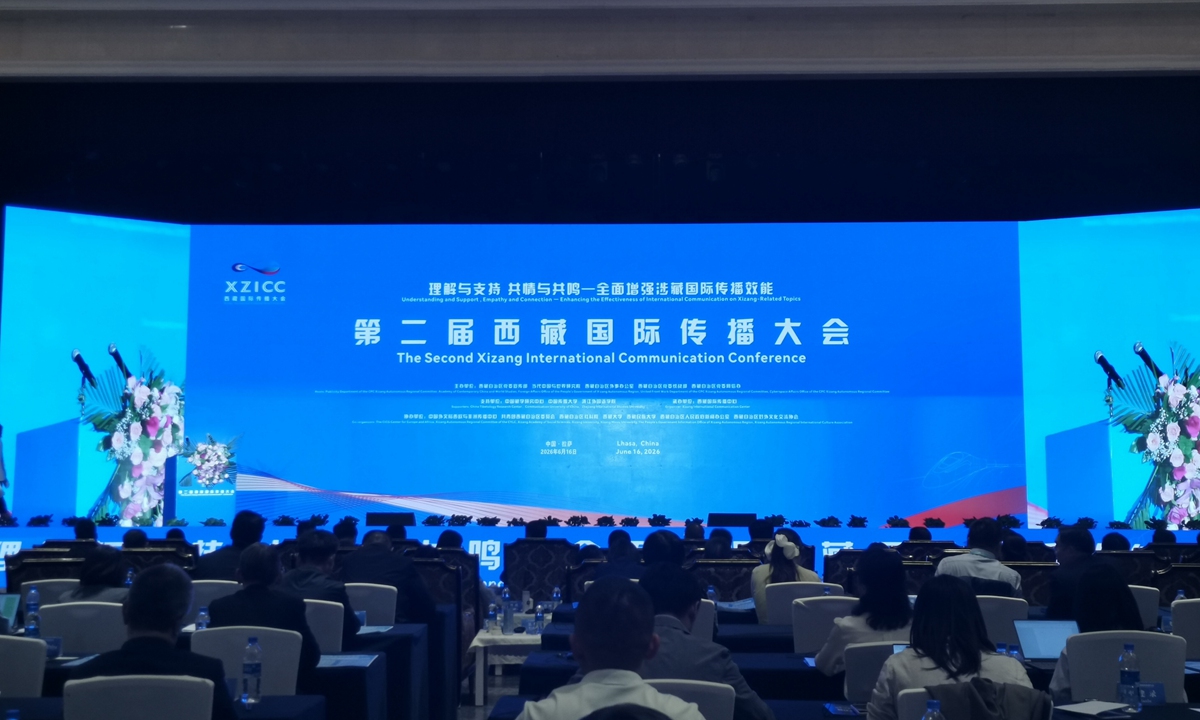
The Second Xizang International Communication Conference is held in Lhasa, Southwest China's Xizang Autonomous Region, on June 16, 2026. Photo: Zhang Yuying/GT
With a medley of songs performed by the Xizang Mount Everest Youth Choir such as "The Tibetan Youth" and "Snow Lotus" and selected segments from China's first tap dance drama Zaxi Xiaduo showcased on stage, the Second Xizang International Communication Conference kicked off on Tuesday in Lhasa, Southwest China's Xizang Autonomous Region, with experts from home and abroad highlighting authentic stories of local Xizang residents and leveraging new media channels to refute biased Western narratives.
Under the theme "Understanding and Support, Empathy and Connection - Enhancing the Effectiveness of International Communication on Xizang-Related Topics," the conference brought together nearly 300 domestic and international experts and scholars, who exchanged views on Xizang's regional development and ways to forge a more effective path for Xizang's international communication.
Chinese actor Hu Ge, the Xizang international communication ambassador, delivered a video message to the conference, inviting more international guests to visit and witness local development in person.
At the conference, several experts shared their in-depth observations on Xizang's international communication. Ye Hailin, director of the Institute of West Asian and African Studies (China-Africa Institute) at the Chinese Academy of Social Sciences, said in his keynote speech, "International communication efforts regarding Xizang have faced a challenge. Even with plenty of facts and figures to share, we still find it hard to shake deep-rooted stereotypes and show the world the real picture. A straightforward truth sits at the core of global outreach: Communication about Xizang ultimately centers on its people."
Xizang residents of all ethnic groups ought to take center stage. Instead of having others speak for them, they can tell us their own stories themselves. Farmers, herdsmen, craftsmen, village doctors, young scholars and cafe owners alike should share firsthand personal stories. Their genuine accounts can carry an authenticity that no other narratives can never match, Ye said.
Li Yafang, deputy editor-in-chief of the China Foreign Languages Publishing Administration and secretary of the Party Committee as well as dean of the Institute for Contemporary China and the World, noted the importance of sharing the experience of regional ethnic autonomy, under which people of all ethnic groups are the masters of society and share the fruits of development. She also stressed the importance of presenting vivid examples of Xizang's efforts to protect its forests, grasslands, rivers and mountains, and show how people of all ethnic groups stand united and carry forward the region's cultural heritage.
"We should let genuine stories from Xizang resonate worldwide, conveying a credible, lovable, and respectable image of China," Li said.
This year marks the 75th anniversary of the peaceful liberation of Xizang. Figures and facts show the significant strides in economic and social development in the region. The region's gross domestic product exceeded 300 billion yuan ($44 billion) in 2025, a huge increase from only 130 million yuan in 1951. Today, Xizang's annual grain output remains stable at over 1 million metric tons, and plateau-featured agriculture and animal husbandry, green industry, clean energy, and modern service industries are thriving, the Xinhua News Agency reported.
According to the China News Service, Xizang received 70.73 million domestic and foreign tourists in 2025, a year-on-year increase of 10.71 percent, of which 437,400 were inbound tourists from overseas, marking a 36.5 percent year-on-year growth.
Right before the international communication conference, over 10 Chinese and foreign guests visited the Potala Palace, Xizang Museum and Drepung Monastery to witness Xizang's well-preserved cultural heritage. They also toured the plateau light industry, cultural tourism firms and a photovoltaic pasture near Lhasa, learning how clean energy lifts local incomes while protecting the environment, the Paper reported. Camera in hand, they captured Xizang's unique scenery and prosperous development throughout the trip.
Kundan Aryal, associate professor at the Central Department of Journalism and Mass Communication of the Tribhuvan University in Nepal, shared with the Global Times at the conference that after his on-site experience in Xizang, he realized "Xizang is not less than any modern city of the world. At the same time, the people are very prosperous and they are happy, and life here is very free."
Echoing Aryal, Manukonda Rabindranath, a professor from the Media Research Centre at Jawaharlal Nehru University in India, said that "I have seen lots of places here. One of the important development parts is highways and roads and buildings. They are very well developed."
"When I see this, it is totally different from what the Western media is projecting. So things are very different," Rabindranath told the Global Times.
Gayan Madushanka, director of the International Affairs Division and head of the Department of Film and Television Production Technology at the University of Vocational Technology in Sri Lanka, told the Global Times that some Western countries create narratives to suppress Asian countries. Noting that people now are not engaged with the traditional capitalist mass media, he highlighted how widely accessible new media platforms offer diverse channels to present the authentic side of Xizang to the world.
"If they (Western media) make narratives, even a single citizen in Xizang can make a video and give answers. Now we have social media. Now we can answer that," Madushanka told the Global Times.
RELATED ARTICLES