Nepal hopes to build strong relations with China, advance cross-border joint projects: Nepali FM tells GT
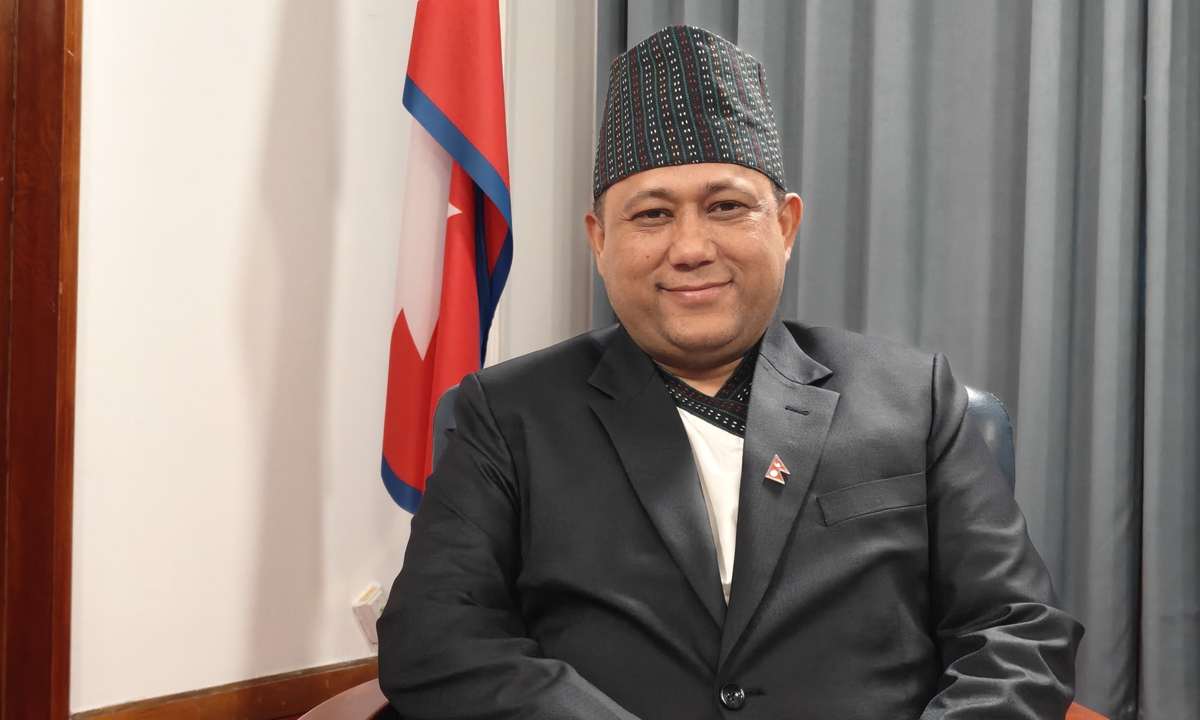
Nepali Foreign Minister Shisir Khanal Photo: Xie Wenting/GT
Nepal is grateful for assistance from the Chinese government and hopes to build a strong relationship with China, Nepali Foreign Minister Shisir Khanal told the Global Times in Beijing on Tuesday, identifying connectivity and infrastructure as top priorities for bilateral cooperation with China.
Khanal is visiting China from Sunday to Wednesday. As his China visit comes right after his visit to India, it is viewed by many as a move to pursue diplomatic balance. Asked about his view on this, the Nepali foreign minister underscored the importance of balanced relations with both China and India, describing the two neighbors as vital partners.
"My visit was to indicate the importance that we give to both countries and we want to build on our existing relationship and also make it stronger and better and deeper than what has it been in the past," he told the Global Times.
Khanal said that Nepal shares thousands of years of exchanges with both China and India, two ancient civilizations, and that bilateral relations are rooted in civilizational bonds. From this perspective, Nepal has a unique relationship with both countries.
As close neighbors connected by mountains and rivers, cooperation between China and Nepal covers a wide range of areas. Khanal told the Global Times that the Chinese government has long provided strong support to Nepal in community development, healthcare, education, infrastructure development, rural development and bilateral trade. There are many areas of cooperation between the two countries.
The current priority for Nepal is to see the country's economy grow at a much faster rate than in the past. Therefore, cooperation priorities with China will focus on connectivity, infrastructure development, and science and technology.
Opening cross-border channels and overcoming the constraints of being a landlocked country has long been Nepal's development aspiration. During the interview, the foreign minister emphasized the importance of advancing major infrastructure projects under the framework of the Trans-Himalayan Multi-Dimensional Connectivity Network, including cross-border railways, roads and power grids, to help Nepal transform from a landlocked country to a land-linked country.
Recently, the Nepali government has approved a reply letter to China to move ahead with the Chilime-Kerung cross-border transmission line project. Khanal revealed that in the next stage, Chinese technical teams will conduct a full feasibility survey on the ground. Only after the survey is completed will both sides determine the route and specific construction plan.
There is no exact timeline yet because it is a very difficult mountainous area, but the preliminary processes are moving forward, he said.
Khanal also provided details on the overall Trans-Himalayan Multi-Dimensional Connectivity Network, which includes the cross-border transmission line and cross-border rail as core projects. A feasibility study for the railway project has been completed by the Chinese side, and Nepal expects to receive the full feasibility report by the end of June. Subsequent work on border facilities, freight corridors and capacity building will be based on this report.
In his view, these cross-border connectivity projects hold both economic and people-to-people value. On the trade side, China is already Nepal's second-largest trade partner. Improved connectivity will help expand exports of Nepal's specialty products to China, ease the current large trade imbalance, and increase overall trade volume. On the human level, connectivity is not only for the movement of goods but also serves as a bridge for people-to-people exchanges. Better transportation will significantly increase mutual visits and deepen mutual understanding.
"Our priority for these connectivity projects is largely to forge a stronger relationship with China," he said.
As July 1 marks the 105th anniversary of the founding of the Communist Party of China (CPC), the Nepali foreign minister expressed congratulations for this milestone during the interview. "What we've seen under the leadership of the CPC take place in China has been magnificent. We really feel inspired and would want to learn from China on its experiences in fast economic growth. We've seen almost 1 billion people be lifted out of poverty in a very, very short time and that's also the aspiration of Nepal... Our vision for Nepal is to become a respectable middle-income country in the next decade. So with that aspiration, we want to engage and work with China."
RELATED ARTICLES