Why Japanese-owned auto plant becomes contract manufacturer for Chinese brand?: Global Times editorial
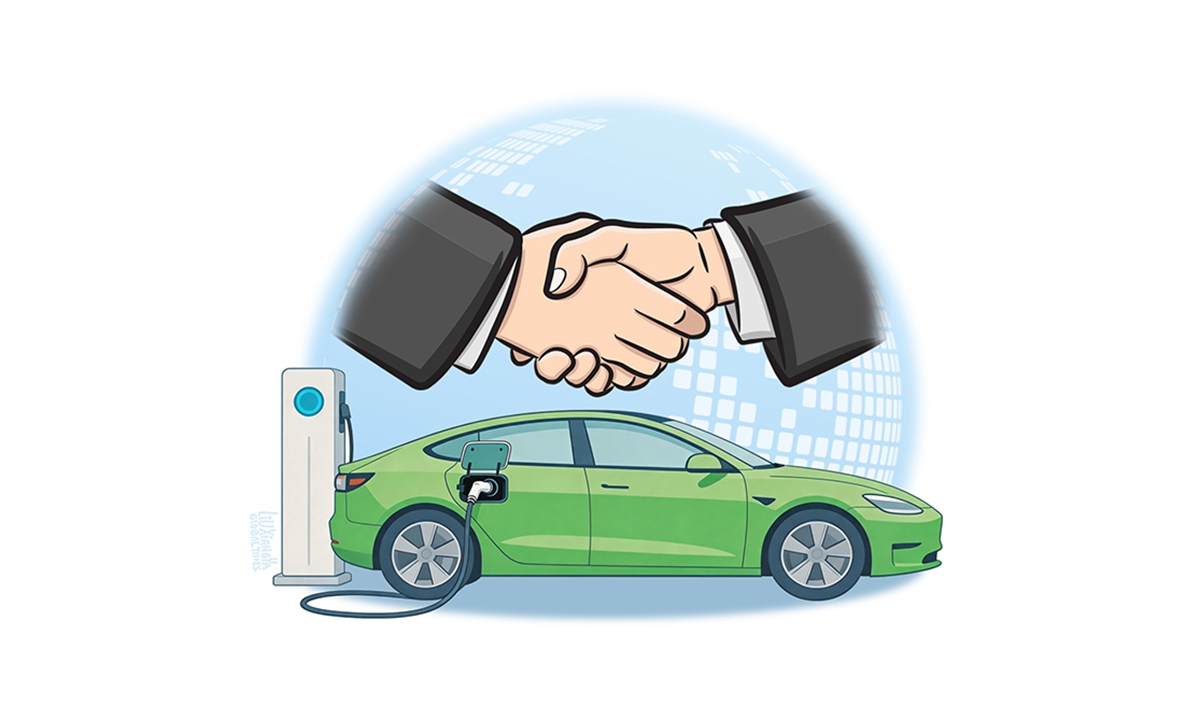
Illustration: Liu Xiangya/GT
Recently, Nissan announced that it had signed a non-binding Memorandum of Understanding (MoU) with Chery International UK, under which it will study manufacturing Chery passenger vehicles at its Sunderland plant's production Line One in the UK from April of financial year 2027. Why is this worth paying attention to? Because it underscores a simple yet profound truth: Industrial and supply chains are cooperative networks shaped jointly by efficiency, markets, technology, employment, and rules under economic globalization. The global automotive industry is, through the most practical business logic, putting this basic economic principle into practice. The signing of the MoU once again underscored that point.
The foundation of cross-border industrial cooperation lies in the economic logic of pragmatism and mutual benefit. The Sunderland plant is an important automotive manufacturing base in the UK, owned by Nissan with established production capacity and workforce. The cooperation between Chinese and Japanese companies on a UK production line for contract manufacturing is based on complementary needs. One side brings a mature factory, workforce, quality system, and localization foundation in Europe, while the other offers a rapidly expanding lineup of different vehicle models, intelligent electric vehicle (EV) technologies, and strong global market expansion capabilities. When traditional automakers face underutilized production lines, while demand for new-energy vehicles surges and requirements for localized production in Europe grow, such cooperation becomes a natural adjustment of the global industrial division of labor under new conditions.
The market's real-world choices have rendered the so-called "threat theory" self-defeating. Currently, some Western media outlets and politicians have been framing China's automotive exports as a "threat" and portraying normal industrial competition as a "shock." Yet the partnership between Chery and Nissan dismantles the false narrative of a so-called "zero-sum game" between Chinese and Western enterprises. Protectionism may raise costs, but it cannot stop consumers from making their choices; political rhetoric may create noise, but it cannot alter the laws of industry. Today, not only are cost-effective Chinese products selling well across the globe, but China's industrial and supply chains are also accelerating their global expansion, reaching countries including traditional manufacturing powerhouses - proving that China can not only cooperate with other nations for mutual benefit but also offers vast space for industrial complementarity.
The shift from "Western technology, Eastern market" to "Eastern technology, Western production capacity" reflects the transformation of the global automotive industry. Western-centric observers tend to be fixated on the "shifts" in positions along the supply chain, while overlooking the "enabling" role that China's manufacturing system plays for the world. Foreign automakers once produced, sold, and profited in the Chinese market for years, while simultaneously helping Chinese suppliers learn, grow, and upgrade. Today, Chinese companies are bringing their strengths in new-energy technologies, cost management, software innovation, and supply chain coordination to global markets. In doing so, they can also bring orders, jobs, tax revenue, and industrial vitality to local economies. The Sunderland contract-manufacturing cooperation combines China's efficient manufacturing capabilities with Europe's localized market needs, reducing transportation-related carbon emissions while accelerating the supply of green products. Such cooperation clearly represents the broadest "common denominator" for the interests of all parties and is well aligned with the needs of the global energy transition and industrial upgrading.
This development also offers Europe an opportunity for reflection. China's automotive industry has reached its current position not through protectionism, but through open competition. In the face of Chinese automobiles, Europe does not need to keep closing its door ever narrower, still less does it need to waver in the contradiction of "wanting the Chinese market while fearing Chinese competition." The real risk to Europe's automotive industry lies in treating every competitor as a threat and every opportunity for cooperation as a risk. Europe should understand that openness is not a sign of weakness, and cooperation is not surrender. Those who can effectively integrate the world's best resources are more likely to prevail in the next wave of technological and industrial transformation.
In fact, Nissan's cooperation with Chery is far from an isolated case. Nikkei Asia reported last month that Chinese EV makers awaken Western rivals' zombie production lines. Similar examples include Stellantis' plans to share production facilities in Spain and France with its Chinese partners, Leapmotor and Dongfeng. In recent years, Chinese automakers have utilized acquisitions, contract manufacturing, and strategic partnerships to revitalize underused overseas production capacity and build globalized manufacturing networks. This is a microcosm of Chinese manufacturing continuously contributing to global development as it steadily advances toward the higher end of the global value chain.
Trilateral cooperation among China, Japan, and the UK is not about one party giving alms to another, nor about one party depending on another. Rather, it is a partnership built on complementary strengths, shared risks, and mutual benefits. The MoU signed by Nissan and Chery sends a clear message: economic globalization has not disappeared, and global industrial and supply chains have not come to a halt. Instead, all parties should seek a new balance amid ongoing change and restructuring. At a time when the global economic recovery remains weak and protectionist tendencies are on the rise, Chinese automakers are demonstrating through concrete actions that rediscovering the value of cooperation through mutual needs, and pursuing industrial collaboration and win-win outcomes through openness and inclusiveness remain the very embodiment of global economic dynamism.
RELATED ARTICLES