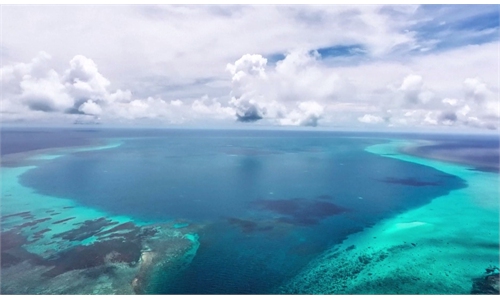
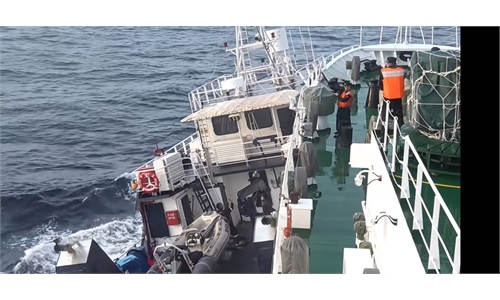
Images show survey mission completed, scientific expedition around China’s Huangyan Dao yielding fruitful results in ecological protection
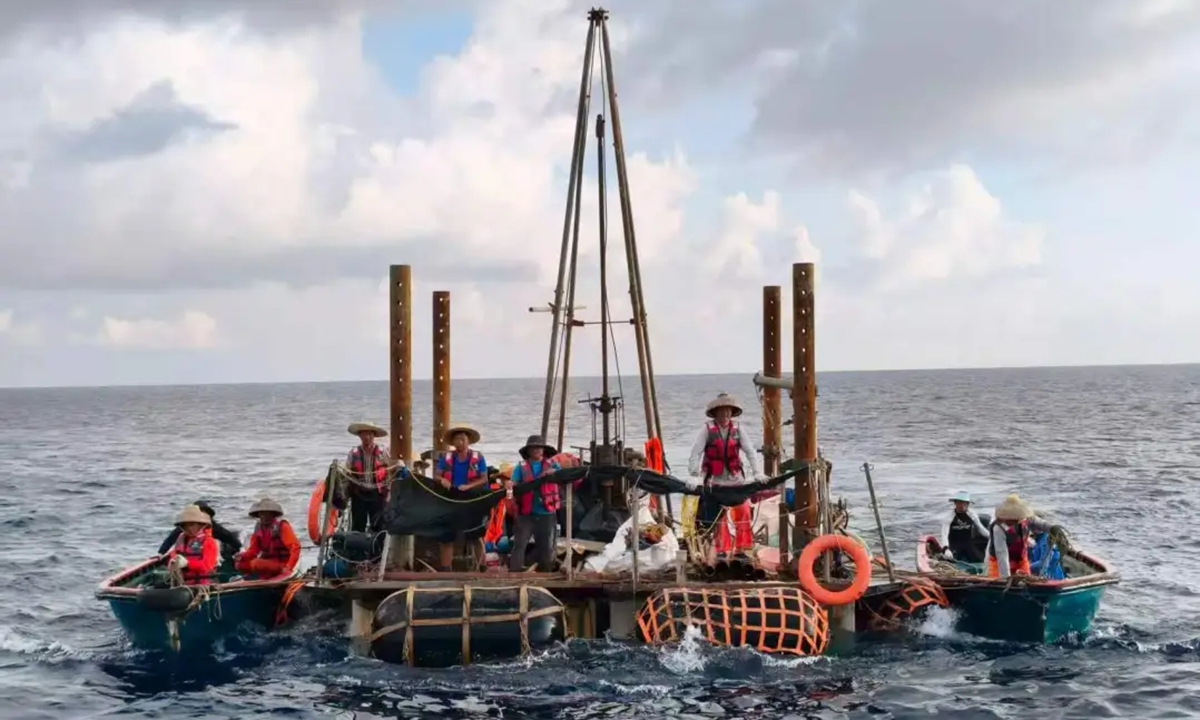
A floating in-situ sampling and experimental platform set up by the South China Sea Institute of Oceanology of the Chinese Academy of Sciences, in the waters around Huangyan Island Photo: Courtesy of South China Sea Institute of Oceanology under the Chinese Academy of Sciences
A Chinese expert said that Tarriela's claim smears China's legitimate scientific research and ecological protection efforts, and such hype of China's legitimate activities in the South China Sea aims to project a fake tough image of the PCG. This reflects the Philippines' anxiety over the current situation in the South China Sea and the latest round of hype is also being used to deflect attention from domestic governance problems.
In the post, Tarriela claimed that his decision to expose what he described as the "illegal presence" of China's floating, movable platform was intended not only to ensure transparency for the Filipino people but also to counter what he called "China's lies."
The PCG spokesperson has repeatedly released comments challenging China's sovereignty claims and normal operations in the South China Sea. His X account has effectively become a routine channel aimed at rapidly amplifying these narratives and shaping public opinion, Chen Xiangmiao, a research fellow at the National Institute for South China Sea Studies, told the Global Times on Wednesday.
On Saturday, Tarriela claimed in a post on X that the Philippine side would continue to monitor and challenge the presence of two Chinese research vessels near Huangyan Dao.
"These kinds of narrative-framing tactics aim to project a falsely tough image of the PCG to gain public support while deflecting attention from domestic governance problems," Chen said.
The Global Times learned from the South China Sea Institute of Oceanology under the Chinese Academy of Sciences on Tuesday that the scientific expedition yielded fruitful results. Discoveries made through a variety of technological means indicate that conservation efforts in the national nature reserve of China's Huangyan Dao have achieved remarkable success. Under the joint protection of the military, law enforcement agencies, and local communities, the ecological environment of Huangyan Dao has been steadily recovering.
The scientific expedition team discovered a large population of green sea turtles, a national first-class protected wild animal species, in the seagrass beds of Huangyan Dao's lagoon. Preliminary observations identified more than 50 individuals.
The discovery was made through the application of drone-based surveillance technology by the scientific expedition team. The researchers conducted population identification and tracking surveys of green sea turtles using this low-disturbance monitoring method, capturing rare footage of groups of green sea turtles swimming together in the lagoon, the Global Times learned from the institute.
In addition, video footage obtained by the Global Times on Tuesday night shows that the institution deployed a floating platform during the scientific expedition. The platform was equipped with a drilling rig and other specialized marine scientific research equipment.
According to the institute, the floating platform is a floating in-situ sampling and experimental platform deployed by the institute in the waters around Huangyan Dao. It was used to carry out core sampling, time-series observations of environmental factors, and in-situ experiments. The collected samples and experimental data are of great significance for studying the historical development of Huangyan Dao, understanding the physiological and ecological responses of coral reef organisms to changes in environmental factors, assessing geomorphological and ecological changes within the protected area, and predicting the impacts of global climate change, overfishing, and other human activities on the ecological security of Huangyan Dao.
The platform has since been towed away from the reef flat of Huangyan Dao by a small boat, and the related equipment has been recovered onto the research vessel, the video clip showed.
When asked to comment on reports claiming that China has removed the "structure" previously placed at Huangyan Dao reportedly under the pressure of the US and the Philippines, Chinese Foreign Ministry spokesperson Lin Jian said during a Wednesday press conference that Huangyan Dao has always been China's territory. China has indisputable sovereignty over Huangyan Dao and its adjacent waters.
Since late May, the South China Sea Institute of Oceanology under the Chinese Academy of Sciences has conducted a comprehensive research covering the entire area surrounding Huangyan Dao. This scientific research helps deepen the understanding and forecast of the ecosystem of Huangyan Dao, and improve the development of ecological civilization in the South China Sea. The research has now been successfully completed. More details of the research can be found on the official website of the institute, Lin said.
"Let me stress that it is fully within China's sovereign rights to carry out activities including scientific research at Huangyan Dao, and no country has the right to interfere," Lin said, adding that China urges relevant countries to stop at once the spread of disinformation and unwarranted accusation against China, and stop making provocations and creating trouble at sea.
According to a statement the institute sent to the Global Times, the Huangyan Dao lagoon has developed extensive seagrass beds across its soft sediment seabed. In recent years, thanks to effective management and conservation measures, these seagrass beds have shown healthy growth. Dominant species include smooth ribbon seagrass and paddle weed, both of which are important food sources for green sea turtles.
The findings indicate that the lagoon's seagrass beds have evolved into a mature coral reef - seagrass bed composite ecosystem, providing high-quality habitats for valuable species such as green sea turtles and humpback conchs.
Meanwhile, the research team also discovered a potential sandbar near the seagrass beds that becomes exposed during low tide. Surveys indicate that it is continuing to develop and may eventually emerge as a permanently exposed sandbar. In the future, it could provide ideal breeding and nesting grounds for green sea turtles and hawksbill turtles, effectively transforming Huangyan Dao from merely a "restaurant" for these species into a true home.
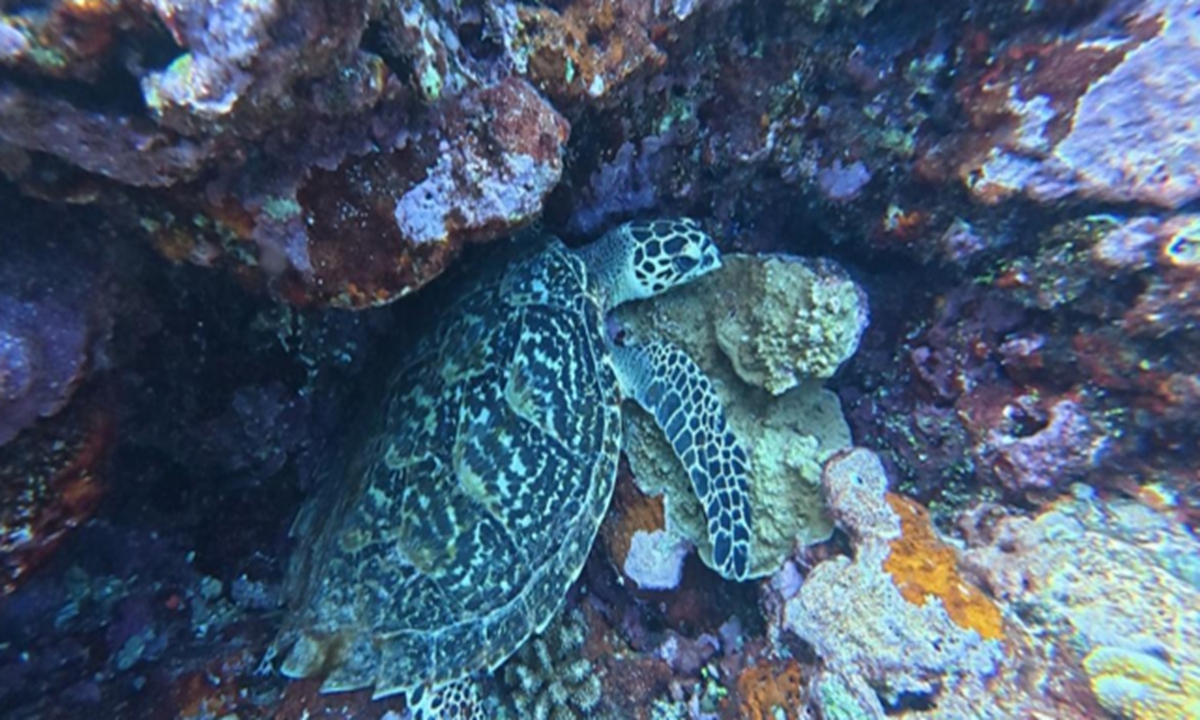
Photo: Courtesy of South China Sea Institute of Oceanology under the Chinese Academy of Sciences

Photo: Courtesy of South China Sea Institute of Oceanology under the Chinese Academy of Sciences
"The significance and outcomes of this scientific expedition are very clear: to monitor ecological and environmental changes in Huangyan Dao and its adjacent waters, while also providing data support for biological surveys," Chen said. "This will allow researchers to gain a clear understanding of which areas have been damaged and which have been effectively protected."
Since 2012, China Coast Guard has strengthened efforts to curb illegal fishing activities in the waters around Huangyan Dao, providing important protection for endangered marine species such as green sea turtles.
RELATED ARTICLES