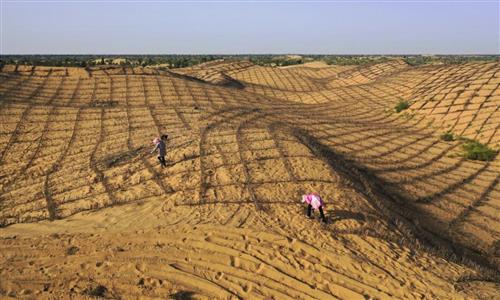
China treats over 10 million hectares of desertified land in past five years, aims to restore nearly 6.7 million hectares by 2030: authority
By and Published: Jun 17, 2026 06:38 PM


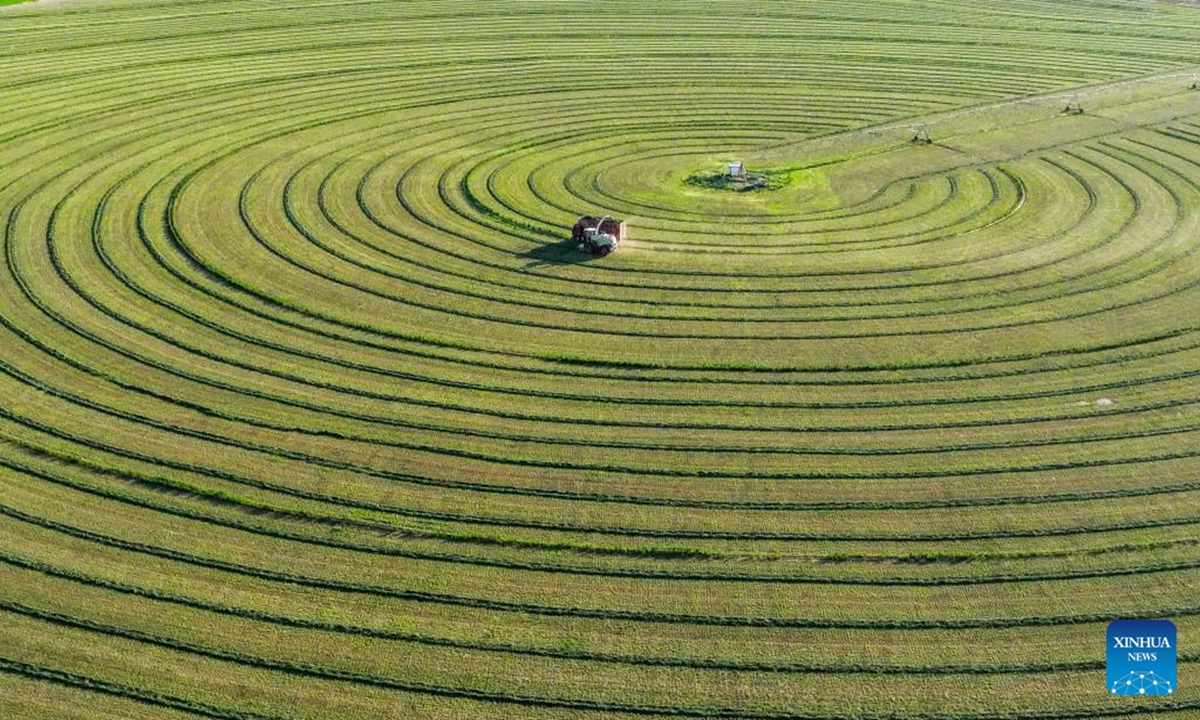
An aerial drone photo taken on May 31, 2026 shows a harvester and a truck at work in a forage field in Ar Horqin Banner, Chifeng, north China's Inner Mongolia Autonomous Region. In recent years, high-quality forage cultivation has helped curb grassland desertification in Ar Horqin Banner, which is now home to nearly 700,000 mu (about 46,667 hectares) of premium forage fields. (Photo by Li Fu/Xinhua)
On the occasion of the 32nd World Day to Combat Desertification and Drought, the Global Times learned from the National Forestry and Grassland Administration on Wednesday that the country has cumulatively treated 152 million mu (about 10.13 million hectares) of desertified land and 29.32 million mu (about 1.95 million hectares) of rocky desertification-affected land over the 14th Five-Year Plan period (2021-25), and the overall level of desertification has continued to decline while ecological conditions in desert regions have steadily improved.
In recent years, China has made the battle against desertification a key priority by advancing the Three-North Shelterbelt Forest Program (TSFP). It is an afforestation program launched in 1978 to tackle desertification in northwestern, northern and northeastern parts of the country.
Since the launch of the TSFP, the central government has allocated a total of 88.9 billion yuan ($12.4 billion) in funding, supported the implementation of 544 major projects, and completed ecological restoration and construction tasks covering 244 million mu (about 16.3 million hectares), according to the administration.
In 1978, China launched this landmark ecological project, which has become the world's largest afforestation endeavor, according to the Xinhua News Agency.
China has also strengthened its policy framework for desertification control. Authorities have issued a national desertification prevention and control plan and a photovoltaic desertification-control plan for the Three-North desert and Gobi regions, revised the overall plan for the TSFP, introduced management measures for the program's implementation, and released 10 industry standards, including technical specifications for desertification control.
Pilot programs for ecological compensation in desert ecosystems have also been launched, further improving the country's policy and regulatory system for combating desertification.
Meanwhile, China has accelerated the construction of desert ecosystem observation stations and ground-based sandstorm monitoring stations, laying the foundation for a nationwide desert ecological monitoring network.
The country has also pursued innovative desertification-control model. Across the Three-North region, local authorities have steadily promoted the "photovoltaic-plus-desertification-control" model, spurring the treatment of 5.3 million mu of land. Efforts to combat desertification through transportation infrastructure have also been expanded, with more than 3,500 kilometers of highways built across sandy areas, contributing to the rehabilitation of 6.8 million mu of degraded land.
At the same time, China has strengthened the role of science and technology in desertification control. Authorities have divided the Three-North region into 136 ecological management zones, developed a number of new drought-resistant, cold-resistant and saline-alkali-tolerant tree and grass varieties, and raised the adoption rate of improved species to more than 75 percent. New equipment and technologies have increased desertification-control efficiency by more than threefold, according to official data.
To date, China's desertified land area has continued to shrink. The trend has reversed from an average annual expansion of 5.15 million mu at the end of the 20th century to an average annual reduction of 10 million mu today, the administration said.
The total volume of wind-induced soil erosion across China's eight major deserts and four major sandy lands has declined by approximately 40 percent compared with 2000. The average vegetation coverage in desert regions has reached 21.17 percent, up 2.84 percentage points from a decade ago, it noted.
Within the TSFP area, forest and grassland coverage has risen to 40.76 percent, while 67.82 percent of treatable desertified land has been brought under effective management and restoration, the administration said.
As a party to the United Nations Convention to Combat Desertification, China has actively fulfilled its obligations under the Convention with guidance from the country's national coordination group for combating desertification, while continuously deepening international cooperation in desertification prevention and control.
Going forward, China will focus on achieving the goals set out in relevant plans, adhere to differentiated conservation and region-specific governance approaches, and promote comprehensive treatment of desertified land in key areas. The country will also appropriately develop green industries in desert regions.
By 2030, China aims to complete the restoration and treatment of nearly 100 million mu (about 6.7 million hectares) of desertified land nationwide, the administration said.
Ecological conditions in key regions - including the country's four major sandy lands, desert oasis areas, the Qinghai-Tibet Plateau, the Yellow River Basin, and areas surrounding the Beijing-Tianjin-Hebei Region - are expected to improve significantly, laying a solid foundation for the country's northern ecological security barrier.
RELATED ARTICLES