AI's World Cup crystal ball: marketing stunt or genuine breakthrough?
2026 tournament becomes a high-stakes testing of generative AI's decision-making capability
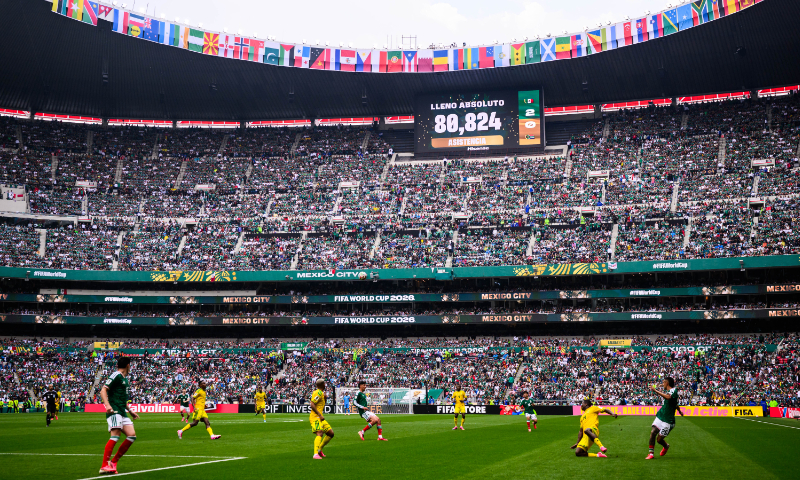
Players from Mexico and South Africa are in action while the attendance figure is displayed on the scoreboard at the Mexico City Stadium in Mexico, on June 11, 2026. Photo: VCG
With the 2026 World Cup now underway in the US, Canada and Mexico, a quieter battle has started - not on the pitch, but inside artificial intelligence (AI) labs.
Chinese AI large models, including Kimi, Qwen, DeepSeek, Doubao and ERNIE Bot, have all begun making public World Cup predictions, turning football forecasting into an unexpected showcase of large-model capabilities.
For a time, the intersection of AI and the World Cup became a focal point of both the tech and the sports communities.
On June 8, Chinese AI start-up Moonshot AI announced that it had deployed 300 sub-agents on its chatbot Kimi to forecast all 104 matches of the tournament, using factors such as tactics, player forms, injuries, scheduling, historical performances, public sentiments, weather, psychology, betting odds and expert commentaries. The company also said it had built a dedicated "counter-agent" to challenge assumptions and identify potential flaws in its own predictions, according to a post on the company's official WeChat account.
Kimi also added a marketing twist: a 1 trillion-token prize pool, allowing users to pick teams and share rewards if they win. By June 11, Kimi's app showed Argentina as the most popular pick to win the tournament, followed by France, Spain, Brazil and Portugal.
Alibaba's Qwen, DeepSeek, ByteDance's Doubao and Baidu's ERNIE Bot soon joined the race. Qwen launched a football prediction assistant open to all users. According to product leader Cheng Fei, the system is trained on massive datasets, including historical matches, player information, injury records, geographic and environmental data from the US, Mexico and Canada, and even weather conditions during the tournament, the Xinhua News Agency reported.
Yet behind the excitement lies a hard question: Can AI really predict football? Or is this just another attention-grabbing marketing campaign?
Industry analysts said that AI's involvement in the World Cup predictions marks a new attempt to apply large AI models in sports-related scenarios, highlighting the growing interest in using advanced AI technologies to analyze and forecast outcomes in sports.
Mixed results
This is the first FIFA World Cup where AI is fully involved in the result predictions, said Xinhua.
World Cup prediction is nothing new. Paul the Octopus became a global sensation during the 2010 FIFA World Cup in South Africa with its uncanny forecasting run. Since then, data models, bookmakers and amateur analysts have all tried their luck.
But the year 2026 is different: AI large models and AI agents are joining the contest at scale, making the 2026 tournament the first World Cup in which AI technology is playing a visible role in public forecasting.
In the World Cup opener between Mexico and South Africa, Qwen predicted a 2-0 win for Mexico. The match ended with exactly that scoreline. Even more notably, there were three red cards in total, which also closely matched Qwen's pre-match warning that South Africa's overly aggressive defending could lead to them being reduced to 10 players early, media reported.
Qwen also forecast a 2-1 victory for South Korea over the Czech Republic, a prediction that turned out to be correct even as many other AI systems favored the Czech side. Although most other AI large models around the world predicted a Czech Republic win, Qwen stuck to its forecast, and South Korea's late winner ultimately proved it right, according to media reports.
But there have been plenty of failures too. According to a Shanghai-based National Business Daily report, the latest KellyBench data showed that top AI models, including ChatGPT, performed poorly on soccer betting markets. KellyBench is a benchmark that tests an agents' ability to build machine-learning models for predicting football matches and betting against market odds.
Several AI large models predicted Spain would win the tournament, resulting in highly similar forecasts across the board. In another case involving Spain and Cape Verde, many AI large models made incorrect predictions about the result.
Kimi's own prediction report even included a team that had not even qualified for the World Cup, highlighting a persistent issue in generative AI: hallucination.
Tian Feng, former dean of SenseTime's Intelligence Industry Research Institute, told the Global Times on Tuesday that Qwen's early correct calls likely reflected a scenario where the matchup was relatively one-sided, rather than a genuine ability to overcome football's inherent unpredictably.
"A human analyst can systematically cover maybe three to five variables before a match," he said. "Qwen's system can process many dimensions in parallel and complete more than 100,000 simulations. That means it can enumerate a space that humans simply cannot process at the same scale."
However, analysts believed that predicting individual matches is one thing, predicting the champion is far harder.
"I also used DeepSeek and Doubao a couple of days ago to predict the 2026 World Cup champion. I wanted to compare which one made the more convincing analysis, but I found that both their predictions and the reasons they gave had obvious limitations," Tian noted.
With more than 40 teams in the tournament, the odds are naturally spread thin. Even the strongest favorites typically have less than a 10 percent chance of winning, meaning that a single champion prediction is almost guaranteed to be wrong most of the time. That makes World Cup winner forecasts a poor test of whether an AI "understands" football, Tian said.
A model may produce a reasonable probability estimate based on historical data, squad value and recent form, yet still miss the eventual winner, Tian said, adding that AI's real strength lies not in picking the champion, but in analyzing match dynamics: red cards, first scorers, tactical shifts and game tempo.
More than predictions
Despite the uncertainty, AI companies are clearly betting that they can do more than produce correct predictions: making the World Cup a public demonstration of what their systems can do.
In its WeChat post, Kimi acknowledged that its predictions could very well be wrong. The company said it wanted to place the analysis process, predictions and post-match review into one transparent framework, helping users better understand both the strengths and the limits of current AI technology.
Industry observers said that AI large models may be improving quickly, but they still lack the kind of tightly controlled, domain-specific data ecosystem that specialized sports simulation systems possess.
"The World Cup offers a huge pool of public attention, one that can be used to attract users, create viral content and turn abstract model capabilities into something people can actually experience," Liu Dingding, a veteran industry analyst, told the Global Times on Tuesday. "For AI companies, the competition is no longer just about model parameters or benchmark scores. It is about user engagement, retention and social sharing."
In this sense, the World Cup prediction race is not merely a football experiment. It is a test of whether generative AI can move from being a chat interface to becoming a public-facing, multi-agent decision system capable of handling uncertainty, real-time data and human interaction, Liu stressed.
The real value of these predictions is not in guessing the winner correctly. It is a typical example of generative AI moving from a question-answering tool to the operation of public events. Chinese AI companies are demonstrating their models' capabilities in agent collaboration, long-context processing, real-time retrieval, probabilistic explanation, and high-concurrency service capabilities, Liu said.
Is AI's World Cup obsession a marketing spectacle, or the beginning of a more capable generation of intelligent systems? Perhaps the outcome itself is not the most important thing. What matters is that this prediction race is pushing Chinese AI large models out of the laboratory and into a much broader world of applications, Liu said.
RELATED ARTICLES