Indian netizens allege China has a ‘caste system’; Chinese commentators say claim reflects ignorance of Chinese historical culture
By and Liu Xuandi Published: Jun 18, 2026 06:54 PM

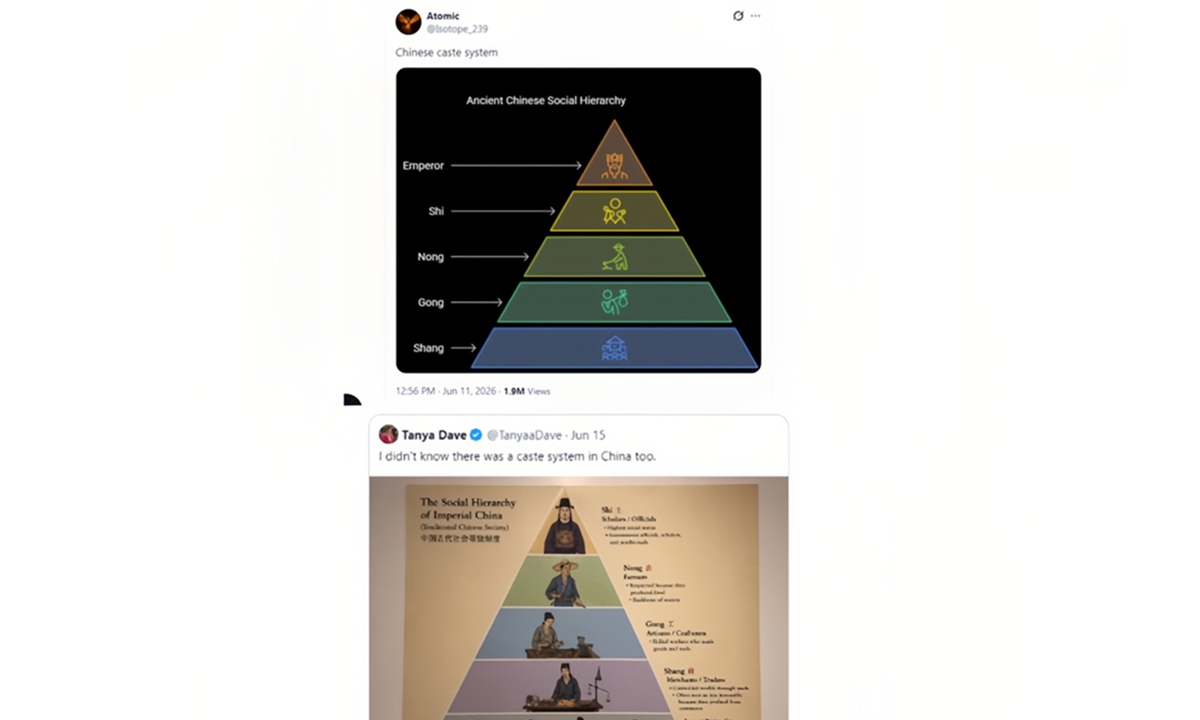
Screenshots show posts by Indian netizens on social media platform X, in which they falsely allege that China operates under a "caste system." Photo: Screenshots on X
Recently, some Indian social media users claimed that they had made a "discovery" that China, like India, supposedly has "a caste system." They shared memes about ancient China's "four occupations" (Shi-Nong-Gong-Shang: scholars, farmers, artisans, merchants) by framing them as equivalent to India's hereditary jati system.
Chinese commentators believe the claim reflects the ignorance of some Indian netizens about Chinese historical culture.
The discussion, which emerged in mid-June, features some Indian netizens sharing memes and posts on social media platforms including X about China's ancient concept of "four occupations," describing them as equivalent to India's caste system.
Under this framework, society was stratified beneath the emperor into four distinct commoner classes: the Shi (scholars and gentry), the Nong (peasant farmers), the Gong (artisans and craftsmen), and the Shang (merchants). Outside this social order were the Jianmin, a group historically regarded as occupying the lowest rung of society.
Some posts by Indian netizens tried to portray the past notion of "four occupations" as a rigid caste hierarchy.
"I didn't know there was a caste system in China too," TanyaaDave, a netizen whose profile shows that she is from Mumbai, claimed on X on June 15 while sharing an infographic illustrating the social strata.
Another user, HaryanviCA, a pro-Indian account, wrote on June 16: "Born rural? Tough luck. You're basically a second-class citizen locked out of proper education, healthcare, housing subsidies, and decent jobs... It's a caste system... that traps hundreds of millions in poverty."
The Global Times found the relevant discussions emerged as early as June 11, when user Isotope_239 posted an image of the "four occupations" and labeled it the "Chinese caste system." The post generated extensive discussion in the comment section.
"In the Indian Dalia's mind, everything he sees is about caste - even the food pyramid is about caste," one Chinese-language commenter wrote under Isotope_239's post.
"They are entirely different concepts. It is hilarious to see the arguments as if they've discovered some devastating secret," Zhang Yiwu, a professor at the Department of Chinese Language and Literature at Peking University, told the Global Times. "The ancient concept of Shi, Nong, Gong and Shang was simply an occupational order, not a hereditary caste system. Apparently, some Indian netizens lack basic knowledge about China historical culture."
Or they are intentionally trying to deflect from the reality that their own caste system is so suffocating that it prevents people from moving up, Zhang argued.
Long Xingchun, a professor from the School of International Relations at Sichuan International Studies University, offered a sharper take, "The caste system is one of those deeply rooted, super toxic things in Indian history that's been screwing them over for centuries. Sure, they've got laws on paper saying everyone's equal, but in reality - marriage, friendships, daily life - caste still runs the show. And they've even exported this mess worldwide with their diaspora."
That explains why some Indian netizens are so desperate to claim China has a "caste system" too. It's classic coping: "If we drag everyone else down to our level, our own mess doesn't look so bad!"
Some netizens dismissed the comparison as humorous projection.
"This is a division of occupational classes, meaning: rulers, officials, farmers, merchants, workers. This is not a caste system, and the children of farmers can become officials, merchants, or workers through their own efforts. All countries in the world have these occupational divisions. Indians, with your level of understanding, it's better not to come out and embarrass yourself," netizen ZhangLinHK posted.
Netizen OopsGuess added that "India's caste system is a civilizational birth prison built around hierarchy, ritual purity, exclusion, and inherited social status. Trying to rename every inequality in the world as 'caste' is just Indian projection."
Netizen Slatzism described the discussion as "hilarious," noting that some Indians were "trying to use these ancient occupational titles as insults."
"Come on, can you investigate some real scandals? Stop fantasizing. This doesn't make us angry at all - instead, it just makes us laugh," X user ruining210 commented.
RELATED ARTICLES